Fractals are typically not self-similar
January 27, 2017
4,494,421
105,488
5,004
2.46%
Search the Record
IndexedEvery word spoken in this episode is indexed. Type any phrase to jump straight to the moment it was said.
Type any word or phrase that may have been spoken. Click a result to seek the player to that exact moment.
Try a name, a topic, or a quoted line
3blue1brown Episodes Around January 27, 2017
See what was published immediately before and after this episode.

 21:36Now Playing
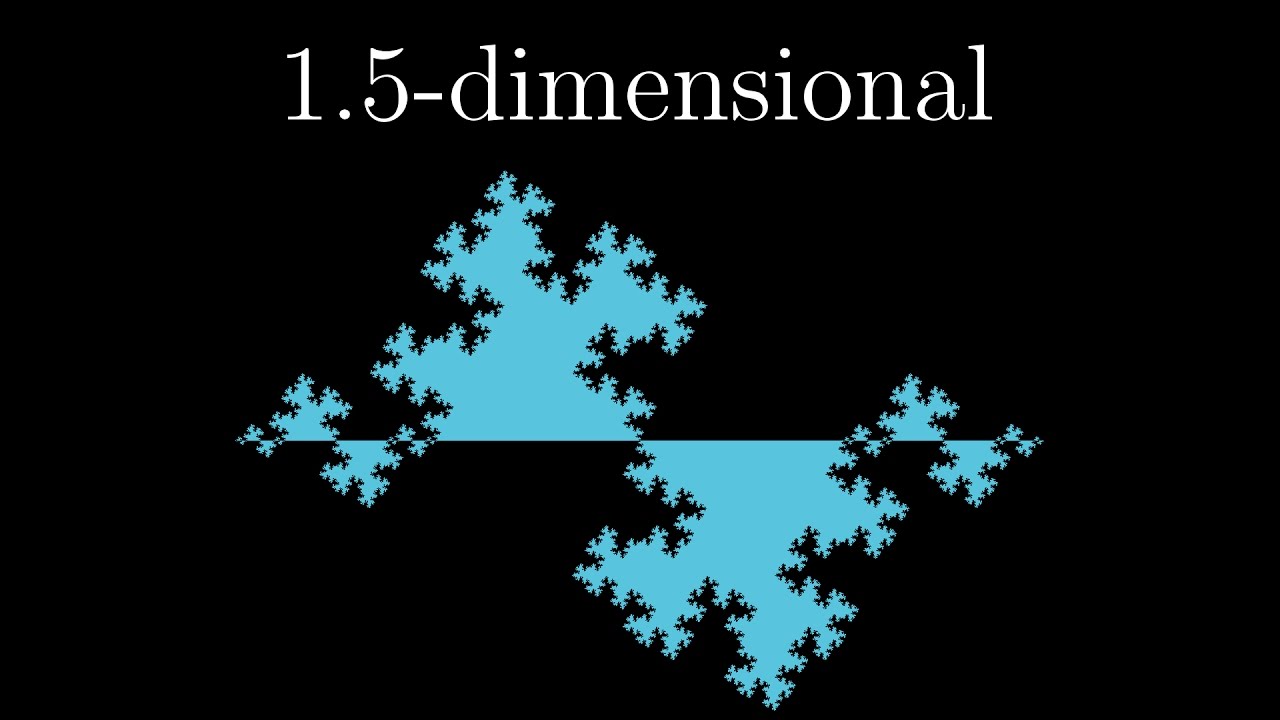
Fractals are typically not self-similar


YouTube Description
as posted by the channelAn explanation of fractal dimension.
Help fund future projects
An equally valuable form of support is to simply share some of the videos.
Special thanks to these supporters
And by Affirm
One technical note: It's possible to have fractals with an integer dimension. The example to have in mind is some *very* rough curve, which just so happens to achieve roughness level exactly 2. Slightly rough might be around 1.1-dimension; quite rough could be 1.5; but a very rough curve could get up to 2.0 (or more). A classic example of this is the boundary of the Mandelbrot set. The Sierpinski pyramid also has dimension 2 (try computing it!).
The proper definition of a fractal, at least as Mandelbrot wrote it, is a shape whose "Hausdorff dimension" is greater than its "topological dimension." Hausdorff dimension is similar to the box-counting one I showed in this video, in some sense counting using balls instead of boxes, and it coincides with box-counting dimension in many cases. But it's more general, at the cost of being a bit harder to describe.
Topological dimension is something that's always an integer, wherein (loosely speaking) curve-ish things are 1-dimensional, surface-ish things are two-dimensional, etc. For example, a Koch Curve has topological dimension 1, and Hausdorff dimension 1.262. A rough surface might have topological dimension 2, but fractal dimension 2.3. And if a curve with topological dimension 1 has a Hausdorff dimension that *happens* to be exactly 2, or 3, or 4, etc., it would be considered a fractal, even though it's fractal dimension is an integer.
See Mandelbrot's book "The Fractal Geometry of Nature" for the full details and more examples.
Music by Vince Rubinetti
Thanks to these viewers for their contributions to translations
Hebrew: Omer Tuchfeld
------------------
3blue1brown is a channel about animating math, in all senses of the word animate. And you know the drill with YouTube, if you want to stay posted about new videos, subscribe, and click the bell to receive notifications (if you're into that).
If you are new to this channel and want to see more, a good place to start is this playlist
Various social media stuffs:
Guests & Subjects Covered
Sentinel Indexing in Progress
Metadata and chapters are available. Claim extraction for this episode is pending.
All video content is delivered via YouTube embedded players in accordance with the YouTube Terms of Service. Sentinel provides research tools that promote discovery and accountability across political media.