
Assessing climate impacts on inland and coastal water quality | Anna M. Michalak
May 24, 2024
26
Search the Record
IndexedEvery word spoken in this episode is indexed. Type any phrase to jump straight to the moment it was said.
Type any word or phrase that may have been spoken. Click a result to seek the player to that exact moment.
Try a name, a topic, or a quoted line
Archived Nasa Climate Change Episodes Around May 24, 2024
See what was published immediately before and after this episode.


 1:06:41
Surface Water and Ocean Topography (SWOT) Mission: Applications Meeting


 1:05:35Now Playing
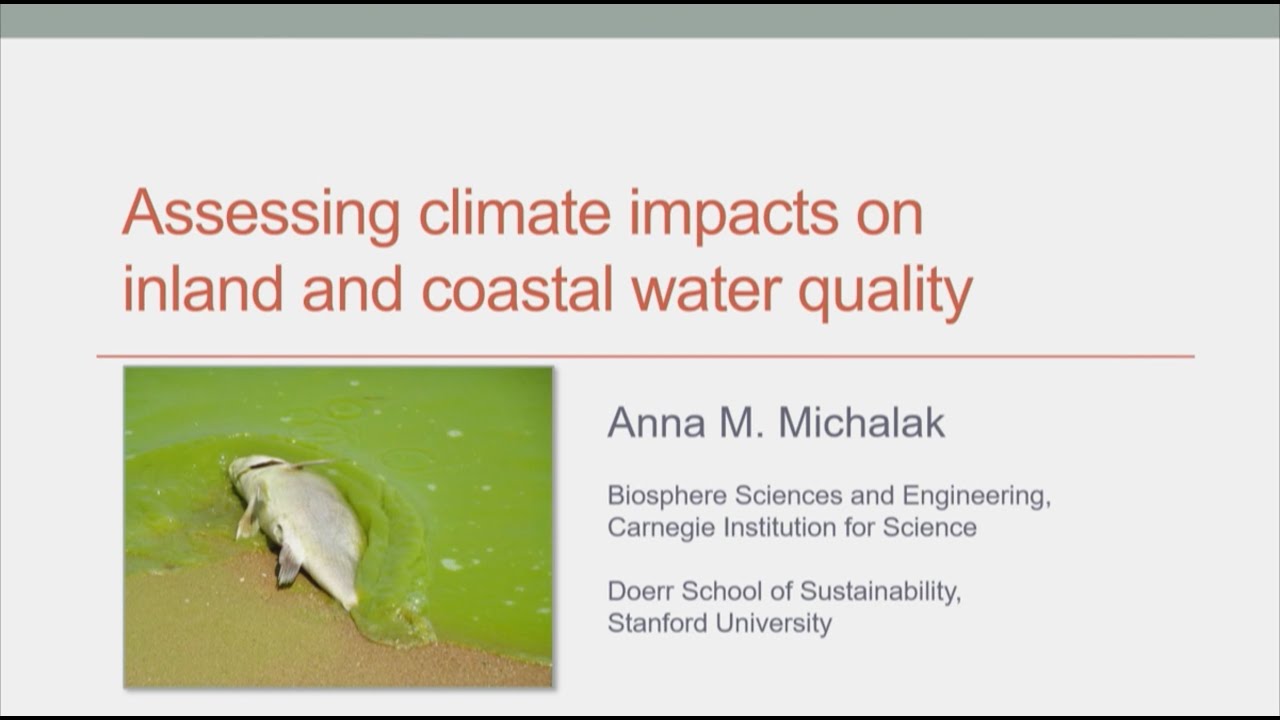
Assessing climate impacts on inland and coastal water quality | Anna M. Michalak



YouTube Description
as posted by the channelQuestions surrounding water sustainability, climate change, and extreme events are often framed around water quantity – whether too much or too little. The economic and ecological impacts of water quality impairments are equally compelling, however, and recent years have provided numerous examples of unprecedented harmful algal blooms and hypoxic dead zones. Linkages between climate change and water quality impacts are often poorly understood, however, due to the complexity of underlying processes, the difference in the spatial and temporal scales traditionally examined by limnologists, ecologists, and climate scientists, and the paucity of long-term observations to support attribution studies. This talk will draw on a number of recent studies that quantitatively link meteorological variability and eutrophication impacts to explore opportunities for characterizing water quality, for bridging from local to global scales, for identifying key drivers, and for understanding the role of climate.
Dr. Anna M. Michalak is the Founding Director of the Climate and Resilience Hub at the Carnegie Institution for Science, where she previously served as Director of the Department of Global Ecology. She is also a Professor (By courtesy) in the Department of Earth System Science and the Department of Biology at Stanford University. Prior to joining Carnegie, she was Associate Professor at the University of Michigan, Ann Arbor. Her research focuses on approaches for characterizing both natural and human emissions of greenhouse gases at urban to global scales – scales directly relevant to informing climate science and policy – and on assessing climate change impacts on freshwater and coastal water quality, with a particular focus on eutrophication and harmful algal blooms. She is the lead author of the U.S. Carbon Cycle Science Plan, a Visiting Faculty Researcher at Google, Co-Chair of the National Academies’ committee tasked with conducting a midterm assessment of NASA’s implementation of the decadal survey for Earth observations, and Co-Chair of the carbon and water advisory boards at Schmidt Sciences. She recently stepped down as Chair of the scientific advisory board for the European Integrated Carbon Observation System. She is the recipient of the Presidential Early Career Award for Scientists and Engineers (nominated by NASA), the NSF CAREER award, and the American Geophysical Union’s Simpson Medal. She is a Leopold Environmental Leadership Fellow and a Fellow of the American Geophysical Union. She holds a Ph.D. and M.S. in Civil and Environmental Engineering from Stanford University, and a B.Sc.(Eng.) in Environmental Engineering from the University of Guelph, Canada.
Recorded on May 7, 2024
Guests & Subjects Covered
Sentinel Indexing in Progress
Metadata and chapters are available. Claim extraction for this episode is pending.
All video content is delivered via YouTube embedded players in accordance with the YouTube Terms of Service. Sentinel provides research tools that promote discovery and accountability across political media.