Big Think
@bigthink·8.8M subscribers·10.1K videos
Big Think Interview with Harrision Ford | Big Think
Posted
April 24, 2012
Views
4,221
Likes
46
Comments
22
Engagement
1.61%
April 24, 2012
4,221
46
22
1.61%
Every word spoken in this episode is indexed. Type any phrase to jump straight to the moment it was said.
Type any word or phrase that may have been spoken. Click a result to seek the player to that exact moment.
Try a name, a topic, or a quoted line
Episode Timeline
Every episode in order around the one you’re watching — click any card and the page flips straight to it.
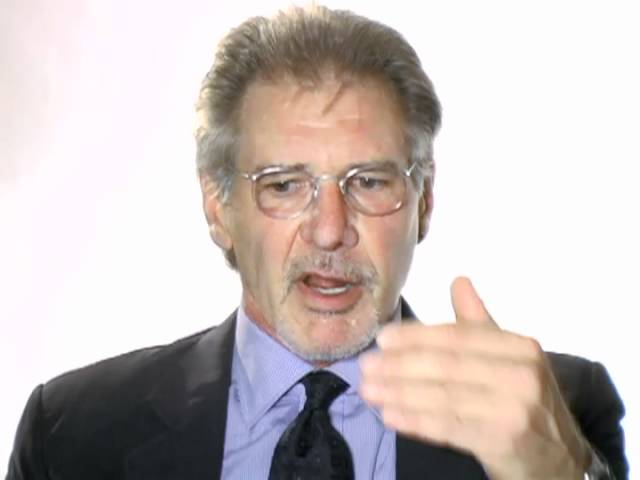 10:50Now Playing
Big Think Interview with Harrision Ford
New videos DAILY
Join Big Think Edge for exclusive videos
----------------------------------------------------------------------------------
The legendary star of “Star Wars” and “Indiana Jones” gives advice to young actors, talks about his mentors, and his work with the E.O. Wilson Biodiversity Foundation.
----------------------------------------------------------------------------------
Harrison Ford:
Harrison Ford is an Academy Award- and BAFTA-nominated, as well as Golden Globe-winning, American actor. During his Hollywood career of four decades, Ford has become best known for his performances in the Indiana Jones film series, the original Star Wars trilogy, and Blade Runner. In 1997, Ford was ranked # 1 in Empire's "The Top 100 Movie Stars of All Time" list.
Publicly political, Ford spoke out against the Iraq War in 2003 and has criticized Hollywood's production of violent films. As an environmental advocate, he shaved a portion of his chest hair to show the effects of deforestation in 2008. Ford sits on the board of directors of Conservation International. He was awarded the Jules Verne Spirit of Nature Award for his ongoing work in preservation of the planet. In 1993, the arachnologist Norman Platnick named a new species of spider Calponia harrisonfordi, and in 2002, the entomologist Edward O. Wilson named a new ant species Pheidole harrisonfordi (in recognition of Harrison's work as Vice Chairman of Conservation International).
----------------------------------------------------------------------------------
TRANSCRIPT:
Question: How did you become involved with the E.O. Wilson Biodiversity Foundation?
Harrison Ford: I became involved with conservation work and thought that Dr. Wilson's Biodiversity Foundation, which I am on the board of because it was clear to me that mankind, human activity, was degrading our Earth's resources at an alarmingly rapid rate and that we were losing species right and left, important species perhaps. In some cases, we knew, and in other cases, we had not yet full knowledge of a species or an organism before it was lost.
It is my understanding that much of our medicine, much of our food stuff that may be required in the future will come from these reserves of biodiversity, which are rapidly disappearing. And unless we have fully protected biosystems, we will lose the potential to learn how nature works in some very specific cases. And that information may be critical in our understanding of how to manipulate what is in our power to manipulate to save biodiversity, save the power of our planet to sustain life.
Question: How has E.O. Wilson affected your thinking on conservation?
Harrison Ford: The work itself is, as Dr. Wilson has said, is an educational effort to cause people to understand and to protect these reservoirs of biodiversity. I have not so much changed my mind about how to accomplish these things; it's really the mission of Dr. Wilson's foundation to bring understanding to the broad population and young people who will be making important decisions in the future and to current leaders both in the business community and in government who can make policies which are more beneficial to the preservation of biodiversity. So I cannot say specifically that his way of approaching biodiversity has changed the way I think about it, except to say that Dr. Wilson has a great gift of language and he has made a very powerful argument in favor of living nature. And I find his argument, his persuasive powers, have led me to think about ways of presenting the problem to other people.
Question: Can you talk about your work with animal trafficking?
Harrison Ford: I make myself available to do on-camera public service announcements and whatever I can do, and I was approached by the State Department which is responsible for animal trafficking in wild animal parts and wild animals to do a series of PSAs, which I was happy to do. So that is just part of my commitment to the work of conservation.
Question: How has your love of nature informed your acting?
Harrison Ford: That is a very difficult question and I do not know that I have an answer for it.
I think the basis of acting is empathy. I have always thought that; knowing how other people feel.
And certainly one of the important judgments you can make about a person is how they fit into their environment, into the world they live in specifically, whether they are a positive force or a negative force.
I have always loved the quiet and the solace of nature; I have been fascinated by the complication of nature, and in a way, I have found that although I was raised without a formal religion, that I have found an ethical reality in nature and the preservation of it, and I think that informs me in every way.
Read the full transcript at
Sentinel Indexing in Progress
Metadata and chapters are available. Claim extraction for this episode is pending.
All video content is delivered via YouTube embedded players in accordance with the YouTube Terms of Service. Sentinel provides research tools that promote discovery and accountability across political media.