Big Think
@bigthink·8.8M subscribers·10.1K videos
Why Don’t We Have a Mars Colony Yet? Blame Nixon. | Big Think
Posted
August 10, 2015
Views
70,228
Likes
2,047
Comments
335
Engagement
3.39%
August 10, 2015
70,228
2,047
335
3.39%
Every word spoken in this episode is indexed. Type any phrase to jump straight to the moment it was said.
Type any word or phrase that may have been spoken. Click a result to seek the player to that exact moment.
Try a name, a topic, or a quoted line
See what was published immediately before and after this episode.
 3:31Now Playing
Why Don’t We Have a Mars Colony Yet? Blame Nixon.
Watch the newest video from Big Think
Join Big Think Edge for exclusive videos
----------------------------------------------------------------------------------
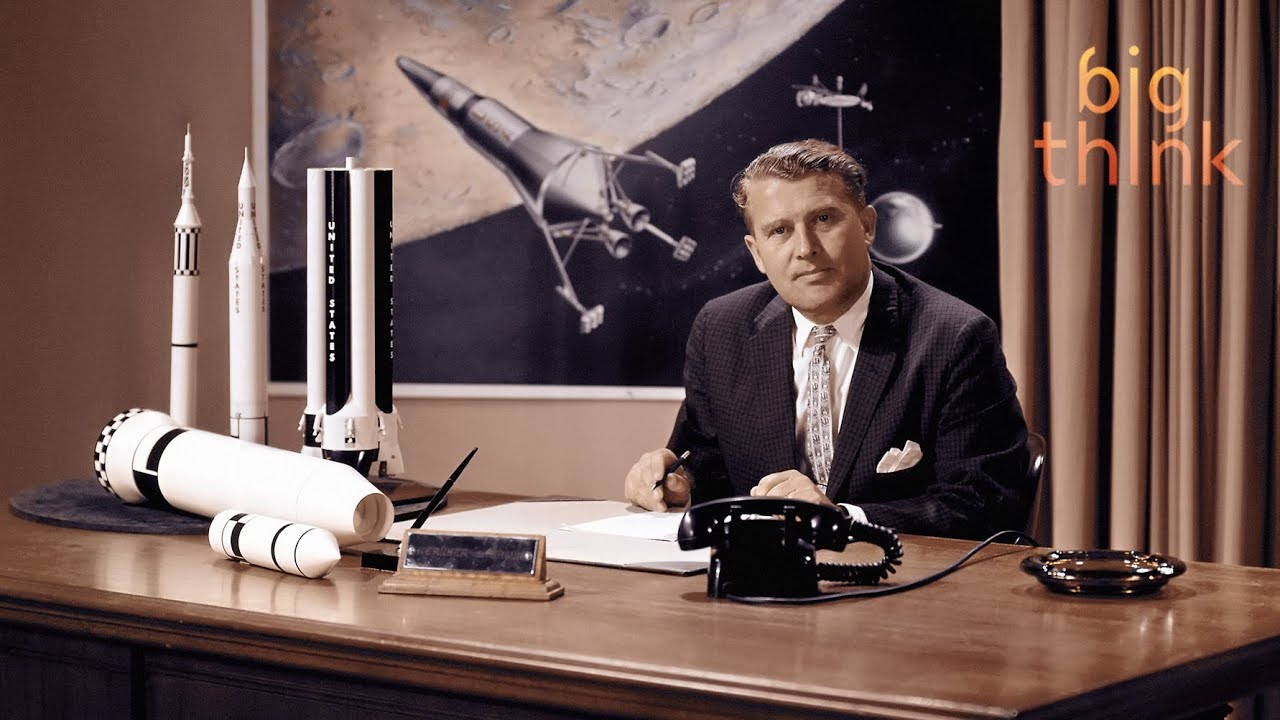
Near the end of the Apollo program, legendary rocket scientist Wernher von Braun sought to drum up support for a new mission to send people to Mars. President Richard Nixon, who had the final say on NASA projects, ended up with two competing proposals on his desk: a mission to Mars and the space shuttle program. Nixon chose the latter — much to von Braun's chagrin — because the U.S. military and intelligence agencies found it so intriguing. The rest is history.
Author Stephen Petranek explains that if Nixon had gone with von Braun's plan instead, we'd already have a Mars colony with potentially thousands of people on it. Instead, we got the space shuttle — a cool ship, no doubt, but not anything that allowed us to take large steps forward with our space program. The past five decades of relative inertia gave rise to private space exploration companies like SpaceX that seek to do what the U.S. government was unwilling to.
----------------------------------------------------------------------------------
STEPHEN PETRANEK:
Stephen Petranek’s career of over 40 years in the publishing world is marked by numerous prizes and awards for excellent writing on science, nature, technology, politics, economics and more. He has been editor-in-chief of The Miami Herald’s prestigious Sunday magazine, Tropic, as well covering a wide range of topics for Time Inc.’s Life magazine. His presentation, 10 Ways the World Could End, is one of the most original and most watched TED talks of all time. He is now the editor of Breakthrough Technology Alert, for which he finds the investment opportunities that create true value and move the human race forward. His new book is titled How We'll Live on Mars.
----------------------------------------------------------------------------------
TRANSCRIPT:
Stephen Petranek: When the Apollo program was coming to an end [Wernher] von Braun was running through the halls of Congress trying to convince congressmen that the next project after the Apollo program should be sending humans to Mars. Unlike many other proposals he had made in the past, that proposal actually ended up on the desk of President Richard M. Nixon. Now a lot of people don’t understand this but the president is not only the commander in chief, he’s the commander in chief of NASA. NASA is actually an administrative function in our government and it reports directly to the president of the United States. So in the early '70s Nixon had two proposals sitting on his desk. One was let’s send somebody to Mars. The competing proposal was the space shuttle. Now the space shuttle originally was a very cool concept. It is exactly what Elon Musk is trying to do with rockets right now by making them reusable. And it was a relatively small space plane that could shuttle astronauts into Earth orbit and then where you would have the capability of building a larger rocket that could go on to places like Mars. Unfortunately, the military and the intelligence agencies of the United States became very interested in the space shuttle and a conflict developed. Nixon chose the space shuttle over going to Mars, over von Braun’s program. And shortly thereafter, von Braun resigned from NASA. And not long after that he died. Had Nixon chosen in the early '70s to go to Mars instead of building the space shuttle we would have a colony on Mars now. And there would probably be thousands of people there.
The tragedy of the space shuttle was that it was really kind of designed for the military industrial complex rather than what NASA really had in mind originally, which was a cheap, small reusable rocket. The joke is that there were 11 secret missions that we know of between 1982 and 1992 in which used the space shuttle for military and intelligence purposes. We have no real idea what those were. They were classified, but we do know that they existed and that those rockets were launched and used for that purpose.
To read the transcript, please go to
Sentinel Indexing in Progress
Metadata and chapters are available. Claim extraction for this episode is pending.
All video content is delivered via YouTube embedded players in accordance with the YouTube Terms of Service. Sentinel provides research tools that promote discovery and accountability across political media.