Big Think
@bigthink·8.8M subscribers·10.1K videos
The Politics of Racist Immigration Policy, with Junot Diaz | Big Think
Posted
December 9, 2015
Views
17,292
Likes
497
Comments
232
Engagement
4.22%
December 9, 2015
17,292
497
232
4.22%
Every word spoken in this episode is indexed. Type any phrase to jump straight to the moment it was said.
Type any word or phrase that may have been spoken. Click a result to seek the player to that exact moment.
Try a name, a topic, or a quoted line
See what was published immediately before and after this episode.
 4:23Now Playing
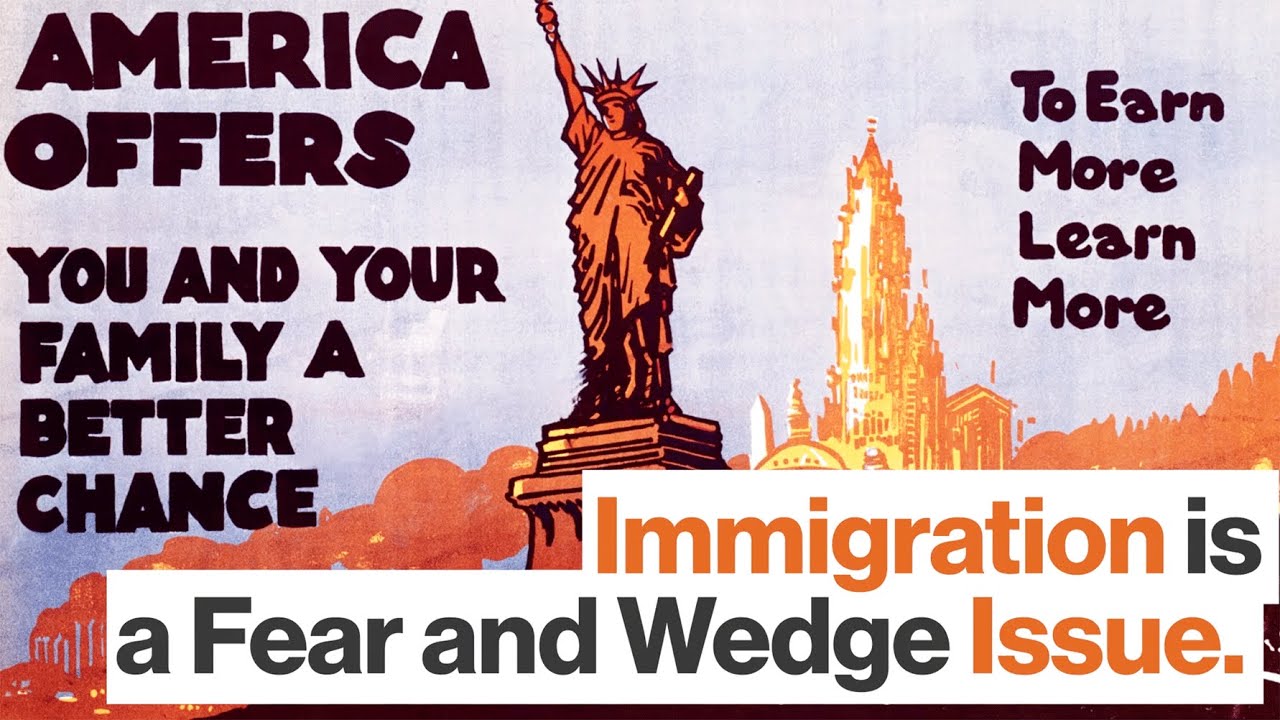
The Politics of Racist Immigration Policy
Watch the newest video from Big Think
Join Big Think Edge for exclusive videos
----------------------------------------------------------------------------------
Immigration has flourished in America despite herself. Nearly every time a wave of immigrants has sought the shores of opportunity in 20th and 21st century America, a fierce public debate has raged, fueled by the fear-stoking of opportunistic politicians. Pulitzer Prize-winning author Junot Diaz has personally experienced the fear and skepticism directed at immigrants. In his loneliness, Diaz turned to writing. Today, his work speaks to the soul of America: It is language that defines his own community and celebrates diversity.
----------------------------------------------------------------------------------
JUNOT DIAZ:
Junot Díaz is a Dominican American writer, creative writing professor at Massachusetts Institute of Technology (MIT), and fiction editor at Boston Review. He also serves on the board of advisers for Freedom University, a volunteer organization in Georgia that provides post-secondary instruction to undocumented immigrants. Central to Díaz's work is the immigrant experience. He received the Pulitzer Prize for Fiction for his novel The Brief Wondrous Life of Oscar Wao, in 2008. He is a 2012 MacArthur Fellow.
Born in Santo Domingo, Dominican Republic, Díaz immigrated with his family to New Jersey when he was six years old. He earned a Bachelor of Arts degree from Rutgers University, and shortly after graduating created the character "Yunior", who served as narrator of several of his later books. After obtaining his MFA from Cornell University, Díaz published his first book, a short story collection entitled Drown in 1995. In 2007, he published his first novel, The Brief Wondrous Life of Oscar Wao, for which he won the Pulitzer.
----------------------------------------------------------------------------------
TRANSCRIPT:
Junot Diaz: Immigration in the 2016 election is playing out the way immigration seems to always play out during these battles. It’s being used as a fear, wedge issue. It’s profoundly been mobilizing racist xenophobic, and nativist tropes. The Latino communities particularly come under tremendous assault. We’re being demonized by many of the leading Republican candidates. We’re being sort of attacked and just the sort of odious and hateful rhetoric being directed at the community which I belong to has been incredible. It’s just been extraordinary. I’m a Dominican immigrant — Dominican immigrant who grew up in New Jersey. A Dominican immigrant who started in Spanish, then lost Spanish — spoke only black English and what we would call white people English. Then relearned Spanish. Someone who has lived with great intimacy in the complexity of bilingualism, of, you know, language acquisition and language loss. Who lives in a community that has often been deeply marginalized and deeply disfigured by kind of slanderous stereotypes versus Dominicans. And someone who grew up absolutely transformed by the practice of reading. Someone whose life was made beautiful by reading. Someone who was granted the world. I was given the world by books. I was given the past. I was given the future. I was given other countries. I was allowed to inhabit a multitude of people. In many ways, reading made me free and all of the things I’ve talked about being Dominican, growing up in New Jersey, being a poor immigrant kid, living in a society that didn’t value my community, didn’t value people of my skin color, didn’t value the kind of poor immigrants that we represented.
And then this practice of reading. These things all come together to inspire me to want to do what reading did for me for other people, but bringing my community and bringing my experiences with me. I wanted to create books and literatures that didn’t erase me, that didn’t kind of do symbolic violence on my community. That didn’t reduce us to stereotypical just gibberish. And my love of reading and my love of my community and my belief not only are we the people I grew up with. Not only are we deserving of great art, but we are the center of great art. All of these convictions, I think, helped to drive me towards becoming the artist I am. We’re in the middle of the Black Lives Matter movement and it’s sort of ironic that on the one hand we’re engaging with Black Lives Matter, but on the other hand this entire issue of the hatred of immigrants and the demonization of immigrants has gone almost unnoted, unchecked. You know you could say anything you want about Latino immigrants and get not only a ton of press but get a ton of support from way too many Americans. And I think that none of this is going to help us with the future........
To read the transcript, please go to.
Sentinel Indexing in Progress
Metadata and chapters are available. Claim extraction for this episode is pending.
All video content is delivered via YouTube embedded players in accordance with the YouTube Terms of Service. Sentinel provides research tools that promote discovery and accountability across political media.