Big Think
@bigthink·8.8M subscribers·10.1K videos
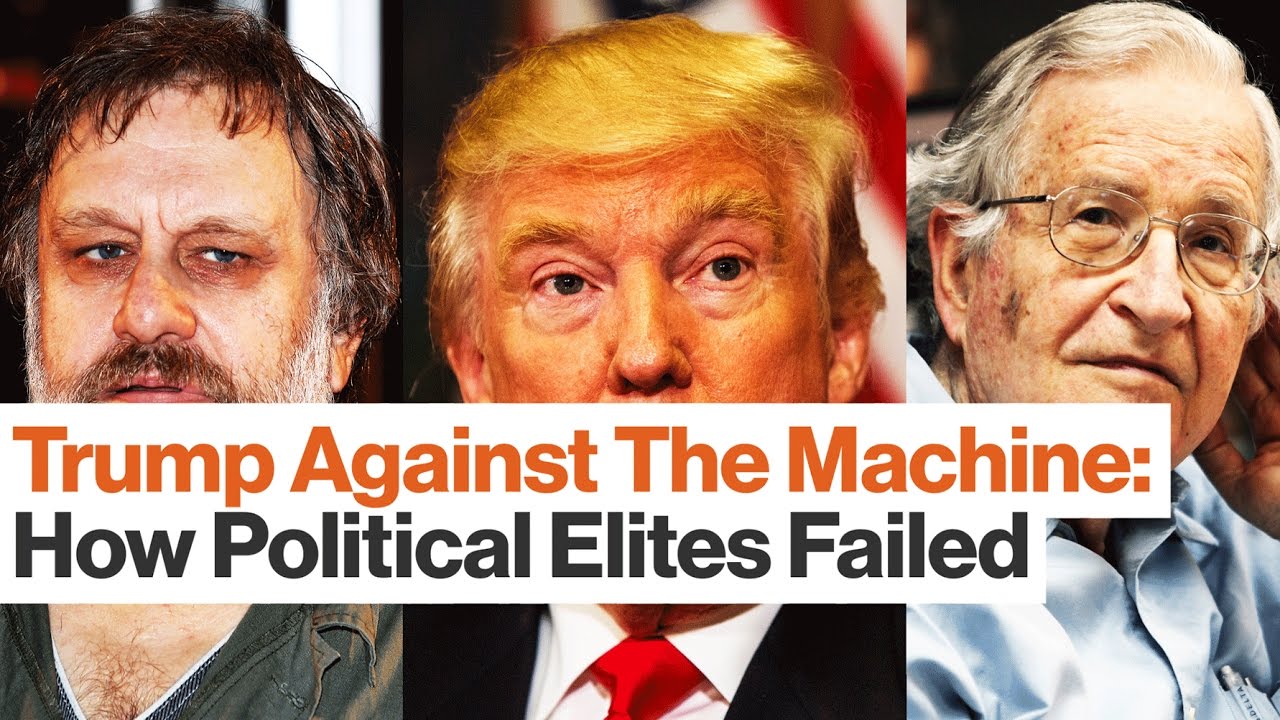
Slavoj Žižek: How Political Correctness Actually Elected Donald Trump | Best '16 | Big Think
Posted
December 24, 2016
Views
48,342
Likes
1,513
Comments
283
Engagement
December 24, 2016
48,342
1,513
283
3.72%
Every word spoken in this episode is indexed. Type any phrase to jump straight to the moment it was said.
Type any word or phrase that may have been spoken. Click a result to seek the player to that exact moment.
Try a name, a topic, or a quoted line
 8:28Now Playing
Slavoj Žižek: How Political Correctness Actually Elected Donald Trump
New videos DAILY
Join Big Think Edge for exclusive video lessons from top thinkers and doers
----------------------------------------------------------------------------------
Free speech is paramount, but how you use your speech defines you as a person. When our politicians stop demanding the moral high ground, we are in a very dangerous place, says Hawke.
----------------------------------------------------------------------------------
ETHAN HAWKE :
Ethan Hawke is an American actor, novelist, screenwriter, and director. Hawke received Academy Award and Screen Actors Guild Supporting Actor nominations for his work in Antoine Fuqua's "Training Day," opposite Denzel Washington. Hawke most recently appeared in Robert Budreau’s “Born to Be Blue,” for which he received rave reviews out of the Toronto Film Festival for his depiction of legendary jazz trumpeter Chet Baker.
In 1996, Hawke wrote his first novel, The Hottest State, published by Little Brown and now in its nineteenth printing. In 2002, his second novel, Ash Wednesday, was published by Knopf and was chosen for Bloomsbury's contemporary classics series. Additionally, Hawke's 2016 graphic novel, "Indeh," with illustrator Greg Ruth, captures the narrative of two nations at war who strive to find peace and forgiveness in a time of great upheaval.
At the age of twenty-one, Hawke founded the Malaparte Theater Co., which remained open for more than five years giving young artists a home to develop their craft. The next year, in 1992, Hawke made his Broadway debut in "The Seagull." Additionally, he has appeared in "Henry IV" alongside Richard Easton on Broadway; "Buried Child" (Steppenwolf); "Hurlyburly," for which he earned a Lucille Lortel Award Nomination for Outstanding Lead Actor and Drama League Award Nomination for Distinguished Performance (The New Group); Tom Stoppard's "The Coast of Utopia," for which he was honored with a Tony Award nomination for Best Featured Actor in a Play and Drama League Award nomination for Distinguished Performance (Lincoln Center); the inaugural season of The Bridge Project's double billings of "The Cherry Orchard" and "A Winter's Tale," which garnered Hawke a Drama Desk Award Nomination for Outstanding Featured Actor in a Play (Brooklyn Academy of Music and The Old Vic); and "Blood From A Stone" (The New Group) which earned him a 2011 Obie Award for Performance. In 2010, Hawke directed Sam Shepard's "A Lie of the Mind," for which he received a Drama Desk Nomination for Outstanding Director of a Play as well as recognition in the New York Times and The New Yorker top ten lists of the leading theatre productions in 2010.
----------------------------------------------------------------------------------
TRANSCRIPT:
Ethan Hawke: The idea that people somehow feel comfortable enough to cheer and laugh when Donald Trump is mocking somebody by calling them Pocahontas, right. Pocahontas – to be totally honest with you and not to be totally corny it makes me want to cry. Because we’re going to get the leaders in this life that we deserve. And if we walk around and we think that stuff is funny – what people I think admire about Trump is that he’s willing to say an off color thing. And I understand what people mean by that. That we live in a culture where – what’s the right – remember Martin Luther King said I prefer the racist because I know where he stands. What I don’t like is all the quiet people who might be secretly – I can’t work with somebody who’s secretly a racist. And so in a way bring it out Donald Trump. Bring it out. Bring out all the toxic stuff. Let’s everybody – and really make sure you want to cheer for that. Really make sure you think that’s funny. Really study who Pocahontas was and you really think that’s not something to be proud of? I mean I’d be honored if somebody were to call me Pocahontas.
If our elected officials aren’t demanding ethical higher ground than we’re in a very dangerous place. And I find that kind of jingoistic hate talk to be terrifying because it’s always – history shows it’s always the easy way. Whenever we’re upset and whenever we’re angry if somebody gives us a chance to express our anger it feels good temporarily. It does. When the two towers fall if you want to start making anti-Arab sentiments for a second it feels good because it feels like a place to put your rage. What it usually does is create a cycle of violence.
A large percentage of the people that I know that support the unmentionable game show host running for president, what they admire about him is that he doesn’t seem chained to some kind of political correctness and it makes him seem like a maverick and it makes – it immediately gives...
For the full transcript, check out
Sentinel Indexing in Progress
Metadata and chapters are available. Claim extraction for this episode is pending.
All video content is delivered via YouTube embedded players in accordance with the YouTube Terms of Service. Sentinel provides research tools that promote discovery and accountability across political media.