Big Think
@bigthink·8.8M subscribers·10.1K videos
Your Life in 2027: A Look at the Future | Vivek Wadhwa (Full Video) | Big Think
Posted
November 20, 2017
Views
585,134
Likes
11,338
Comments
1,928
Engagement
November 20, 2017
585,134
11,338
1,928
2.27%
Every word spoken in this episode is indexed. Type any phrase to jump straight to the moment it was said.
Type any word or phrase that may have been spoken. Click a result to seek the player to that exact moment.
Try a name, a topic, or a quoted line
See what was published immediately before and after this episode.
 4:33
4:33 6:36
6:36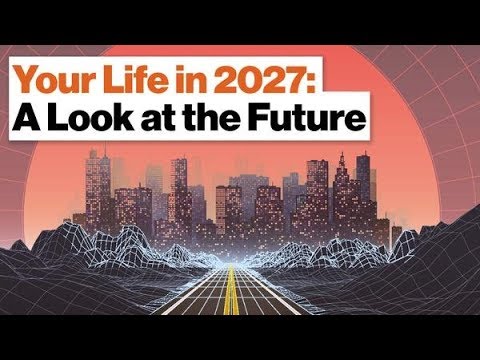 34:32Now Playing
Your Life in 2027: A Look at the Future
Watch the newest video from Big Think
Join Big Think Edge for exclusive videos
----------------------------------------------------------------------------------
Between driverless cars and AI and gene modification technology, we're about to see a lot of very big changes in a short amount of time. But there's a danger of people rebelling because things moved too fast. Imagine an angry, jobless populace once driverless cars take away the transportation industry and electric cars take away the gas industry. Will politicians have to enact universal basic income? It's a sobering reminder that we are—as a country and as a species—still adapting to an every changing world. Even if it's a world that we designed. Vivek tackles this and a host of other issues (as well as some great things to look forward to) in our first long-form video. Vivek is the author of The Driver in the Driverless Car: How Our Technology Choices Will Create the Future. Intro / The Future - 0:00 to 5:26 Health - 5:26 to 11:09 Artificial Intelligence - 11:09 to 15:53 On Demand - 15:53 to 18:35 Energy - 18:35 to 25:29 Jobs - 25:29 to 29:52 Big Decisions - 29:52 to 34:38
----------------------------------------------------------------------------------
VIVEK WADHWA:
Vivek Wadhwa is a Distinguished Fellow at Carnegie Mellon University's College of Engineering. He is a globally syndicated columnist for The Washington Post and author of The Driver in the Driverless Car: How Our Technology Choices Will Create the Future; The Immigrant Exodus: Why America Is Losing the Global Race to Capture Entrepreneurial Talent, which was named by The Economist as a Book of the Year of 2012; and of Innovating Women: The Changing Face of Technology, which documents the struggles and triumphs of women. Wadhwa has held appointments at Duke University, Stanford Law School, Harvard Law School, Emory University, and Singularity University. You can follow him on Twitter @wadhwa.
----------------------------------------------------------------------------------
TRANSCRIPT:
So every technology I look at is now entering this exponential curve. Ray Kurzweil says that as any technology becomes information it starts advancing exponentially. It seems that everything is being digitized now and every technology I look at seems to be entering this exponential curve. And what happens is that when technology is advancing on an exponential curve they do amazing things, but when technologies converge, when exponential technologies converge that’s when you get industry disruptions.
Behind everything is computing. This device over here by my estimate is more powerful than 40 Cray supercomputers were. Do you remember Cray supercomputers that used to cost in the tens of millions of dollars, that had expert controls on them? This is more powerful than those Cray supercomputers were.
There’s something in computing called Moore’s law. What Moore’s law stipulates is that the processing power of computers doubles every year or two. It’s actually the number of transistors, but what in fact happens is that the power increases, the cost drops, and the size becomes smaller.
So these advances in computing are making many other advances possible that this exponential curve that competing is on means that faster computer can design faster computers. With faster computers you can now design new types of sensors. With faster computers you can now build artificial intelligence. With faster computers you can now analyze data like you never could analyze before.
When you have artificial intelligence and sensors and robots coming together you get R2-D2 from Star Wars: You get these humanoid robots that can do what human beings can do.
You get the ability now to have robots that can stock your shelves, that can operate machinery, that can be receptionists in your offices. So you have multiple technologies coming together which make it possible to do things that could never be done before.
If you look at drones: what are drones? We’ve had flying machines for a long time, but these flying machines we used to build as toys—we built these toy helicopters—weren’t stable. When you added Arduino chips to them, when you added computing to them and you added a little bit of artificial intelligence to them so they could keep track of all the data around them, you had the ability to have these drones being stable, and now, ship goods! So drones are advancing almost exponentially...
Read the full transcript at
Sentinel Indexing in Progress
Metadata and chapters are available. Claim extraction for this episode is pending.
All video content is delivered via YouTube embedded players in accordance with the YouTube Terms of Service. Sentinel provides research tools that promote discovery and accountability across political media.