Big Think
@bigthink·8.8M subscribers·10.1K videos
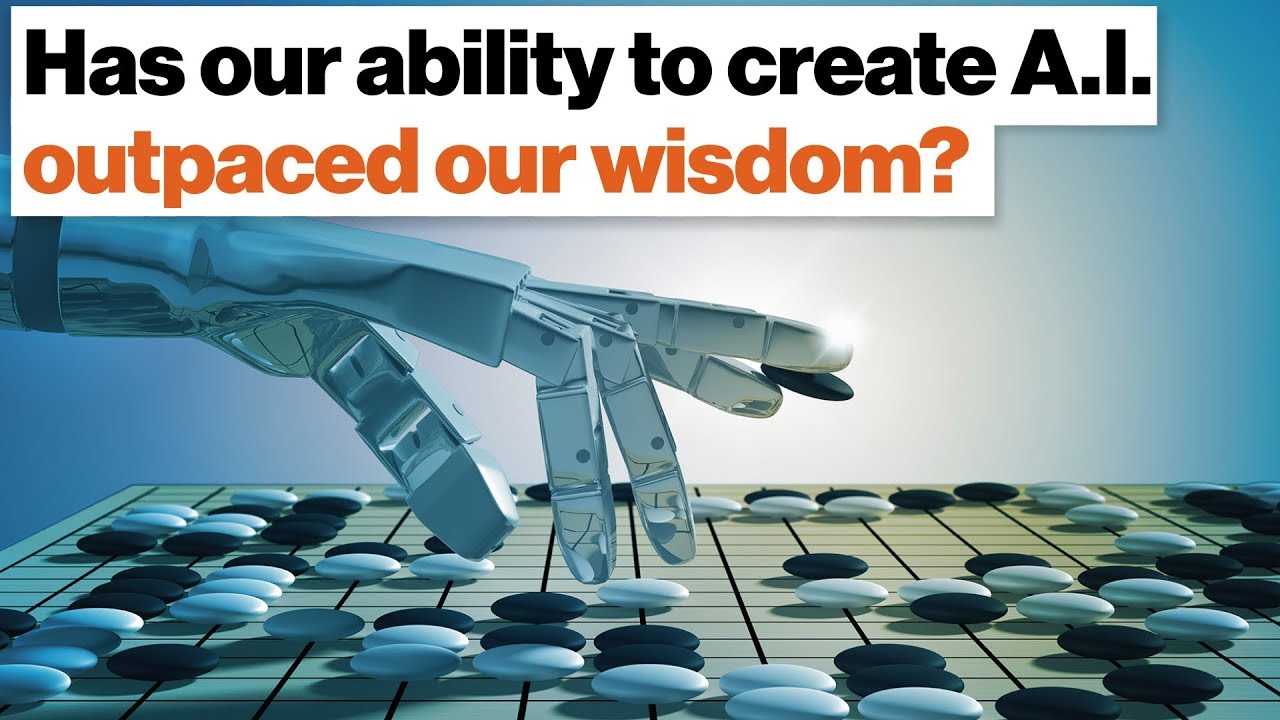
Has our ability to create intelligence outpaced our wisdom? | Max Tegmark on A.I. | Big Think
Posted
May 15, 2018
Views
16,176
Likes
574
Comments
173
Engagement
May 15, 2018
16,176
574
173
4.62%
Every word spoken in this episode is indexed. Type any phrase to jump straight to the moment it was said.
Type any word or phrase that may have been spoken. Click a result to seek the player to that exact moment.
Try a name, a topic, or a quoted line
 3:22Now Playing
Has our ability to create intelligence outpaced our wisdom?
Watch the newest video from Big Think
Join Big Think Edge for exclusive videos
----------------------------------------------------------------------------------
Some of the most intelligent people at the most highly-funded companies in the world can't seem to answer this simple question: what is the danger in creating something smarter than you? They've created AI so smart that the "deep learning" that it's outsmarting the people that made it. The reason is the "blackbox" style code that the AI is based off of—it's built solely to become smarter, and we have no way to regulate that knowledge. That might not seem like a terrible thing if you want to build superintelligence. But we've all experienced something minor going wrong, or a bug, in our current electronics. Imagine that, but in a Robojudge that can sentence you to 10 years in prison without explanation other than "I've been fed data and this is what I compute"... or a bug in the AI of a busy airport. We need regulation now before we create something we can't control. Max's book Life 3.0: Being Human in the Age of Artificial Intelligence is being heralded as one of the best books on AI, period, and is a must-read if you're interested in the subject.
----------------------------------------------------------------------------------
MAX TEGMARK:
Max Tegmark left his native Sweden in 1990 after receiving his B.Sc. in Physics from the Royal Institute of Technology (he’d earned a B.A. in Economics the previous year at the Stockholm School of Economics). His first academic venture beyond Scandinavia brought him to California, where he studied physics at the University of California, Berkeley, earning his M.A. in 1992, and Ph.D. in 1994.
After four years of west coast living, Tegmark returned to Europe and accepted an appointment as a research associate with the Max-Planck-Institut für Physik in Munich. In 1996 he headed back to the U.S. as a Hubble Fellow and member of the Institute for Advanced Study, Princeton. Tegmark remained in New Jersey for a few years until an opportunity arrived to experience the urban northeast with an Assistant Professorship at the University of Pennsylvania, where he received tenure in 2003.
He extended the east coast experiment and moved north of Philly to the shores of the Charles River (Cambridge-side), arriving at MIT in September 2004. He is married to Meia-Chita Tegmark and has two sons, Philip and Alexander.
Tegmark is an author on more than two hundred technical papers, and has featured in dozens of science documentaries. He has received numerous awards for his research, including a Packard Fellowship (2001-06), Cottrell Scholar Award (2002-07), and an NSF Career grant (2002-07), and is a Fellow of the American Physical Society. His work with the SDSS collaboration on galaxy clustering shared the first prize in Science magazine’s "Breakthrough of the Year: 2003."
---------------------------------------------------------------------------------
TRANSCIPT:
Max Tegmark: I’m optimistic that we can create an awesome future with technology as long as we win the race between the growing power of the tech and the growing wisdom with which we manage the tech.
This is actually getting harder because of nerdy technical developments in the AI field.
It used to be, when we wrote state-of-the-art AI—like for example IBM’s Deep Blue computer who defeated Gary Kasparov in chess a couple of decades ago—that all the intelligence was basically programmed in by humans who knew how to play chess and then the computer won the game just because it could think faster and remember more. But we understood the software well.
Understanding what your AI system does is one of those pieces of wisdom you have to have to be able to really trust it.
The reason we have so many problems today with systems getting hacked or crashing because of bugs is exactly because we didn’t understand the systems as well as we should have.
Now what’s happening is fascinating, today’s biggest AI breakthroughs are a completely different kind where rather than the intelligence being largely programmed in an easy-to-understand code, you put in almost nothing except a little learning rule by which a simulated arc of neurons can take a lot of data and figure out how to get stuff done.
This deep learning suddenly becomes able to do things often even better than the programmers were ever able to do.
You can train a machine to play computer games with almost no hard-coded stuff at all. You don’t tell it what a game is, what the things are on the screen, or even that there is such a thing as a screen—you just feed in a bunch of data about the colors of the pixels and tell it, “Hey go ahead and maximize ....
To read the transcript, please go to
Sentinel Indexing in Progress
Metadata and chapters are available. Claim extraction for this episode is pending.
All video content is delivered via YouTube embedded players in accordance with the YouTube Terms of Service. Sentinel provides research tools that promote discovery and accountability across political media.