Bloomberg News
@Bloomberg-News·2.8M subscribers·40.1K videos
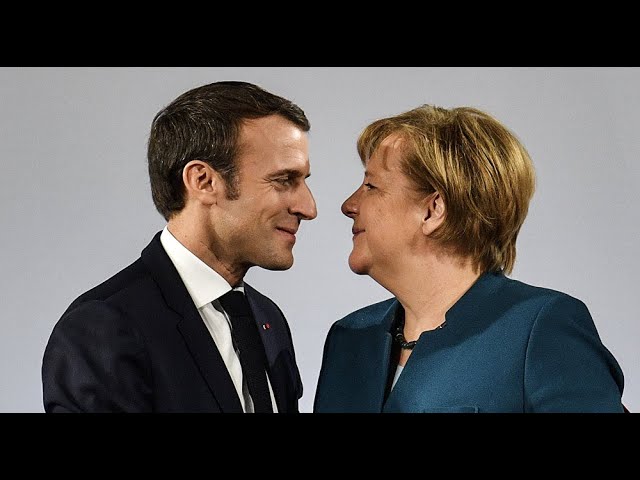
Angela Merkel, Emmanuel Macron At Odds Over How to Choose Next European Commission President
Posted
May 28, 2019
Views
3,805
Likes
26
Comments
16
Engagement
May 28, 2019
3,805
26
16
1.10%
Every word spoken in this episode is indexed. Type any phrase to jump straight to the moment it was said.
Type any word or phrase that may have been spoken. Click a result to seek the player to that exact moment.
Try a name, a topic, or a quoted line
 22:15Now Playing
The battle for the European Union’s top jobs is getting underway after last week’s parliamentary elections. The fragmented result of that vote will complicate an already tricky process.
The fight has three dimensions: A personality clash among top European leaders, a coalition-building drama in the new parliament, and a tug-of-war between the two EU institutions with the most political legitimacy over which should decide these appointments.
The process begins on Tuesday at a dinner of national leaders. The outcome will be a barometer of how much power outgoing German Chancellor Angela Merkel still has. But, more importantly, it will determine whether the EU can punch its weight in the growing trade battles between the U.S. and China.
At stake is the European Commission presidency, now occupied by wily Luxembourger Jean-Claude Juncker. The post, the closest the EU has to a prime minister, controls the EU’s regulatory agenda, oversees its enforcement, and leads key trade negotiations. The Commission also drafts the EU budget. The president must be proposed by the European Council, made up of the leaders of member states, and then confirmed by the elected members of the European Parliament.
In 2014, Juncker was elevated to the post through the so-called spitzenkandidaten process, whereby the chosen candidate of the political party that gets the most seats in the European Parliament is the first to be considered for the job. National leaders are then expected to approve that decision before the parliament confirms the choice. This pits the otherwise relatively ineffectual parliament against national leaders, most notably French President Emmanuel Macron, who want to scrap the spitzenkandidaten process.
If the same procedure were followed as in 2014, the choice would be straightforward: Manfred Weber, the lead candidate of the center-right European People’s Party. The Bavarian enjoys the public backing of Merkel and her (for now) chosen successor, Annegret Kramp-Karrenbauer, head of the Christian Democratic Union. The EPP, of which the CDU is a member, secured 180 seats out of 751 in the European election, more than any other grouping.
There are, however, two problems with Weber’s candidacy. One is that he is widely unloved. A lackluster speaker without big ideas, he is the epitome of a boring conservative. He failed to shine during the spitzenkandidaten debates before the election and looks like the status quo candidate.
That helps to explain why Macron, an EU visionary, is so opposed to his candidacy. He has been trying to drum up support from other national leaders in Spain and eastern Europe to find another candidate.
The other problem is institutional. In 2014, the EPP had 217 seats in parliament and was the biggest group by a relatively wide margin. Now, with less than 24 percent of the seats, it has far less power, even if no majority coalition could be constructed without it.
The EPP thus needs to strike an alliance with the center-left Socialists and Democrats and then with either the pro-business liberals (among them Macron’s own party) or the Greens, who rode a wave of support in the election. A four-group alliance would be even more stable.
The increasingly fragmented nature of the coalition makes Weber an even less obvious choice to lead it. So far, the other parties have rebuffed his attempts to start the coalition-building process by virtue of leading the biggest faction.
Simply put, the three conflicts are: Macron’s drive for visionary leadership versus Merkel’s insistence that the rules be upheld; the centrist parliamentary factions’ desire for an equitable distribution of EU jobs; and the tension between the parliament and the European Council on who should play first fiddle in picking the Commission president.
The best way to resolve all three would be if the centrist groups in parliament find on a compromise candidate acceptable to both Merkel and Macron. Michel Barnier, the EU’s top Brexit negotiator, looks to me to be the closest to such a figure.
Barnier himself appears to have run something of a shadow campaign in recent weeks, making speeches on EU priorities in various cities and meeting with national leaders.
Subscribe to our YouTube channel
TICTOC ON SOCIAL:
Follow TicToc on Twitter
Like TicToc on Facebook
Follow TicToc on Instagram
Watch all of TicToc’s videos
Listen to TicToc’s podcast
Subscribe to our newsletter
TicToc by Bloomberg is global news for the life you lead. We are a 24/7 news network that covers breaking news, politics, technology, business and entertainment stories from around the globe, supported by a network of Bloomberg’s 2,700 journalists across 120 countries.
Sentinel Indexing in Progress
Metadata and chapters are available. Claim extraction for this episode is pending.
All video content is delivered via YouTube embedded players in accordance with the YouTube Terms of Service. Sentinel provides research tools that promote discovery and accountability across political media.