Bloomberg News
@Bloomberg-News·2.8M subscribers·40.1K videos
Trump Awards Presidential Medal of Freedom to Economist Art Laffer
Posted
June 19, 2019
Views
991
Likes
14
Comments
7
Engagement
June 19, 2019
991
14
7
2.12%
Every word spoken in this episode is indexed. Type any phrase to jump straight to the moment it was said.
Type any word or phrase that may have been spoken. Click a result to seek the player to that exact moment.
Try a name, a topic, or a quoted line
 14:48Now Playing
History hasn’t exactly put the “Laffer Curve” on a pedestal, but Donald Trump nonetheless bestowed the nation’s highest civilian honor on its namesake on Wednesday, the inspiration behind decades of Republican tax proposals.
The president awarded the Medal of Freedom to economist Arthur Laffer, an economic adviser to Trump’s 2016 campaign and co-author of “Trumponomics: Inside the America First Plan to Revive Our Economy.”
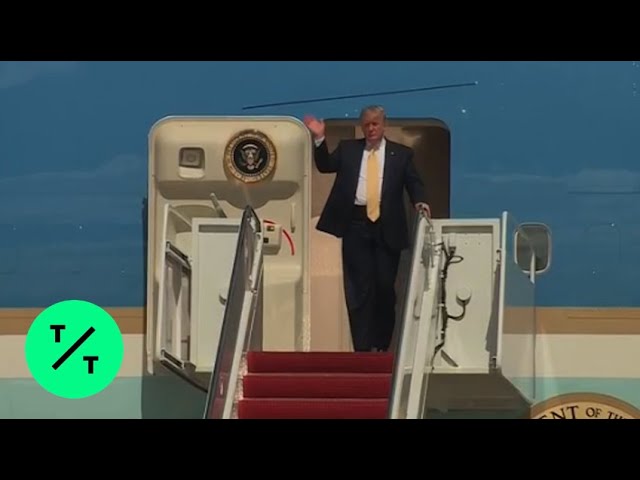
“Few people in history have revolutionized” economic thought and policy like Laffer, Trump said. He hosted the event shortly after returning from a trip to Florida where he officially launched his 2020 re-election campaign.
Laffer, 78, who was an aide to President Ronald Reagan, is known for his eponymous “curve,” which supposes that taxation rates beyond a certain level can prove counterproductive by discouraging work. The argument is frequently cited by Republican lawmakers, including Trump, in support of tax cuts.
“Generally, the idea that lowering tax rates will increase revenue has been disproven time and time again,” said Joel Slemrod, professor of business economics and public policy and director of the Office of Tax Policy Research at the University of Michigan’s Ross School of Business.
“It certainly makes tax cuts look more attractive if you claim you won’t lose revenue, so it’s very attractive politically to claim it -- but it’s almost never true,” he said.
Republican tax cuts, including Trump’s overhaul in 2017, are usually followed by increases in budget deficits. The U.S. budget deficit widened to $739 billion in the first eight months of the 2019 fiscal year, the Treasury Department said this month -- a $206 billion increase from a year earlier.
But Laffer’s curve accurately points to the need to consider how businesses and ordinary people will react to tax rates, Slemrod said, because it’s usually true that “the more you tax something, the less you get of it.”
Trump administration officials have repeatedly claimed the president’s tax cut will eventually yield more revenue for the federal government. And Laffer’s defenders say his model has never truly been tested.
Economist Douglas Holtz-Eakin, the president of American Action Forum, a centrist-right advocacy group, said that just because Laffer’s famous curve has never transpired in the real world doesn’t mean it can’t ever happen.
“We’ve never had a real-world experiment like the one he discussed” in his model, Holtz-Eakin said. “Academics like to sneer because he’s not an academic researcher. And he’s not a politician. But if you wanted to find a person you could associate with major tax cuts, you’d find Art Laffer.”
In 2012, the state of Kansas hired Laffer to advise then-Governor Sam Brownback as he prepared his own tax cut proposal. The economist, who was paid $75,000 according to the Kansas City Star, argued that deep tax cuts would spur growth that would create more jobs and bring in more payroll tax revenue during a series of appearances in Topeka.
“More employment, more output, more production,” he said in an interview with NPR at the time.
Laffer was assisted in his Kansas campaign by the co-author of his Trump book, Stephen Moore, whom the president tried to place on the Federal Reserve’s board of governors this year. Moore attended the Medal of Freedom ceremony on Wednesday.
In fact, Brownback’s cuts -- which he described as a “real-life experiment” for the school of supply-side economics espoused by Laffer -- led to job growth far below expectations and a massive budget shortfall. Private sector job growth in Kansas following the cut was lower than all of the state’s neighbors except Oklahoma, and less than half the national growth rate, according to the liberal Center on Budget and Policy Priorities. Steep declines in state revenues led to deficits of hundreds of millions of dollars annually.
Subscribe to our YouTube channel
TICTOC ON SOCIAL:
Follow TicToc on Twitter
Like TicToc on Facebook
Follow TicToc on Instagram
Watch all of TicToc’s videos
Listen to TicToc’s podcast
Subscribe to our newsletter
TicToc by Bloomberg is global news for the life you lead. We are a 24/7 news network that covers breaking news, politics, technology, business and entertainment stories from around the globe, supported by a network of Bloomberg’s 2,700 journalists across 120 countries.
Sentinel Indexing in Progress
Metadata and chapters are available. Claim extraction for this episode is pending.
All video content is delivered via YouTube embedded players in accordance with the YouTube Terms of Service. Sentinel provides research tools that promote discovery and accountability across political media.