Bloomberg News
@Bloomberg-News·2.8M subscribers·40.1K videos
SpaceX Launches Falcon Heavy Rocket From Florida, Its ‘Most Difficult’ Ever
Posted
June 25, 2019
Views
4,389
Likes
11
Comments
2
Engagement
June 25, 2019
4,389
11
2
0.30%
Every word spoken in this episode is indexed. Type any phrase to jump straight to the moment it was said.
Type any word or phrase that may have been spoken. Click a result to seek the player to that exact moment.
Try a name, a topic, or a quoted line
 1:13Now Playing
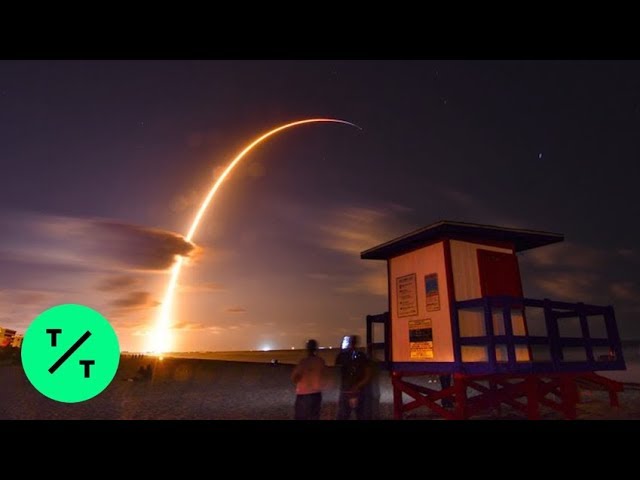
Elon Musk’s Space Exploration Technologies Corp. launched its Falcon Heavy rocket for the U.S. military early Tuesday in a spectacular night time liftoff that Musk described as the company’s toughest yet.
The rocket and payload rumbled aloft at 2:30 a.m. local time from NASA’s Kennedy Space Center in Florida after a three-hour delay. SpaceX then recovered the rocket’s two side boosters -- which flew in April as part of the Arabsat-6A mission -- at Cape Canaveral Air Force Station in Florida. The center core failed to land on a drone ship in the Atlantic Ocean.
Falcon Heavy was carrying 24 satellites for the space agency, Department of Defense research labs and other partners. SpaceX fought for the right to compete for Air Force launches, and Tuesday’s liftoff marks a huge milestone for the company’s relationship with the U.S. military.
“It’s the first multi-mission, multi-payload deployment for the Falcon Heavy and that’s really exciting for everybody,” Col. Robert Bongiovi, director of the Launch Systems Enterprise Directorate at the U.S. Air Force Space Command, said in a statement before the launch.
The mission, known as STP-2, was to place the 24 spacecraft in three different orbits. The payload includes an Air Force Research Laboratory Demonstration and Science Experiments (DSX) satellite; the National Oceanic and Atmospheric Administration-sponsored Constellation Observing System for Meteorology, Ionosphere and Climate-2 (COSMIC-2) and four NASA experiments, according to SpaceX’s website. The final deployment was scheduled to take place more than 3 1/2 hours after the launch. Shortly before 3 a.m. local time, SpaceX’s Twitter feed began confirming deployment of the first satellites.
SpaceX set a company record last year with 21 launches for customers. Last month, the Hawthorne, California-based company sent up the first batch of its own satellites, a key step toward creating a space-based constellation that beams broadband to under-served areas across the globe.
Much of the focus in 2019 has been on the first flight with humans on board. SpaceX and Boeing Co. have contracts with NASA to ferry American astronauts to the International Space Station as part of the agency’s Commercial Crew program.
SpaceX completed the Demo-1 flight of its Crew Dragon spacecraft in March without humans on board. But in late April, the capsule was engulfed in flames and destroyed during a test, a mishap that probably will push back the commercial crew schedule. NASA and SpaceX are reevaluating target test dates.
Subscribe to our YouTube channel
TICTOC ON SOCIAL:
Follow TicToc on Twitter
Like TicToc on Facebook
Follow TicToc on Instagram
Watch all of TicToc’s videos
Listen to TicToc’s podcast
Subscribe to our newsletter
TicToc by Bloomberg is global news for the life you lead. We are a 24/7 news network that covers breaking news, politics, technology, business and entertainment stories from around the globe, supported by a network of Bloomberg’s 2,700 journalists across 120 countries.
Sentinel Indexing in Progress
Metadata and chapters are available. Claim extraction for this episode is pending.
All video content is delivered via YouTube embedded players in accordance with the YouTube Terms of Service. Sentinel provides research tools that promote discovery and accountability across political media.