
Bloomberg News
@Bloomberg-News·2.8M subscribers·40.1K videos
LIVE: Could Feeding Cows Seaweed Help Fight Climate Change? | Top News
Posted
April 23, 2021
Views
2,059
Likes
25
Comments
8
Engagement
April 23, 2021
2,059
25
8
1.60%
Every word spoken in this episode is indexed. Type any phrase to jump straight to the moment it was said.
Type any word or phrase that may have been spoken. Click a result to seek the player to that exact moment.
Try a name, a topic, or a quoted line
 11:54:56Now Playing
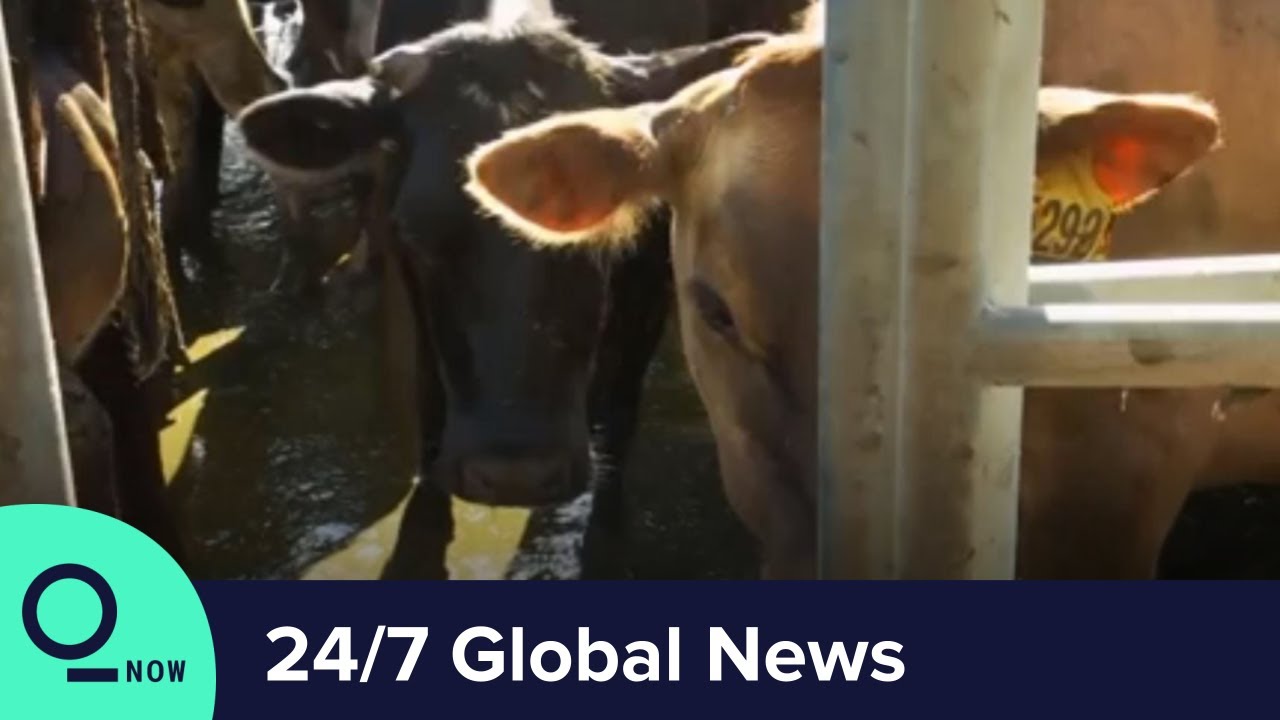
(Apr. 22) Feeding livestock Australian native seaweed has been touted as a possible solution to reducing emissions. A small amount of asparagopsis (taxiformis) seaweed when fed to livestock gets rid of over 80 percent of their emissions of the greenhouse gas, methane, say researchers.
"This is very exciting. This is asparagopsis seaweed in canola oil and in my mind this is the future of the livestock industry worldwide," says Tasmanian dairy farmer Richard Gardner.
Gardner is part of a trial being run by milk processor Frontera Australia to test the effect of the seaweed supplement on a real life dairy operation.
He and his daughter Molly Gardner are optimistic it will reduce nearly two thirds of the farms emissions.
"There was 6,000 tonnes of CO2 equivalence coming from the dairy farm and 4,000 tonnes of that was from enteric methane which comes straight from the cow's mouth," says Molly Gardner.
A recent report by Australia's rural research corporation, AgriFutures, suggests that asparagopsis will be part of a billion dollar seaweed industry in Australia by 2040.
But a leading seaweed expert is cautious about how rapidly that could happen.
"Technologically it works but does the business case work? And that's where the challenge is when not on top of how to propagate it. So there's years of technology to get to the point where we can start to farm it," says seaweed scientist Pian Winberg.
A marine farming trial in Tasmania is showing promise.
Sam Elsom's company Sea Forest is growing asparagopsis on land and at sea, at a former mussel farm on the state's east coast.
"We're getting around about a kilogram a metre of rope so quite a lot, far more than we had expected," says Elsom.
This seaweed is being used as part of farm trials with sheep and dairy producers.
The company is in the process of scaling up with the help of a million Australian dollar Federal Government grant.
"It's definitely going to be commercially viable, we've developed some super exciting methods for both marine and land based farming so it's not as far away as we think," says Elsom.
Questions remain about how to grow asparagopsis and best feed it to animals but with Australia's red meat and livestock industries committed to becoming carbon neutral, there's hope this special seaweed will help the farming world achieve its targets.
---
Subscribe to our YouTube channel
Bloomberg Quicktake brings you to live global news and original shows spanning business, technology, politics, and culture. Make sense of the stories changing your business and your world.
To watch complete coverage on Bloomberg Quicktake 24/7, visit or watch on Apple TV, Roku, Samsung Smart TV, Fire TV and Android TV on the Bloomberg app.
Connect with us on…
Breaking News on YouTube
Sentinel Indexing in Progress
Metadata and chapters are available. Claim extraction for this episode is pending.
All video content is delivered via YouTube embedded players in accordance with the YouTube Terms of Service. Sentinel provides research tools that promote discovery and accountability across political media.