
Biden at G7 Summit: "You'll See Straight Dealings" with China
June 13, 2021
1,203
19
43
5.15%
Search the Record
IndexedEvery word spoken in this episode is indexed. Type any phrase to jump straight to the moment it was said.
Type any word or phrase that may have been spoken. Click a result to seek the player to that exact moment.
Try a name, a topic, or a quoted line
Bloomberg News Episodes Around June 13, 2021
See what was published immediately before and after this episode.


 1:50Now Playing
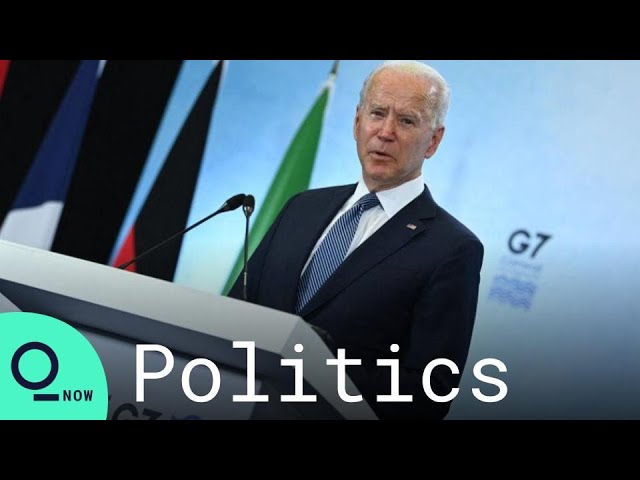
Biden at G7 Summit: "You'll See Straight Dealings" with China


YouTube Description
as posted by the channel“I think you will see straight-forward dealings,” Biden said about China as democracies compete with autocrats around the world.
Group of Seven leaders debated how strongly to respond to China’s effort to win influence around the world and rebuke it over alleged forced labor practices -- with U.S. President Joe Biden taking a more hawkish stance and some other leaders wary of the risk the group is seen as an outright anti-China bloc.
Saturday’s talks at the G-7 summit on the Cornish coast of southern England have focused in part on China. During that session Biden, along with U.K. host Boris Johnson and Canada’s Justin Trudeau, pushed for specific, action-oriented measures to counter Beijing, according to a U.S. official.
Italian Prime Minister Mario Draghi and German Chancellor Angela Merkel, however, talked more about the cooperative nature of the G-7’s relationship with China, the U.S. official said. The leaders all discussed setting up a working group or task force on China.
Merkel told reporters later Saturday that she welcomed a task force, but didn’t want to frame it as an anti-China effort.
“This is not about being against something, but for something,” she said.
A European official familiar with the discussions said that all countries had toughened their stance toward China compared to previous G-7 meetings. This official said that Merkel and Draghi had pushed to define what Johnson’s task force would actually do, with the German chancellor suggesting that it needed a positive agenda focused on climate and trade if it is to be embraced by other countries. The person said that that the other leaders, including Johnson, agreed with the points Merkel raised.
The U.S. official downplayed any budding divide, saying the countries all agree on key principles and values. Saturday’s discussion was more about just how forcefully to push back against China, the official said.
More broadly, the G-7 has undergone a notable shift on China compared to a few years ago, another U.S. official told reporters later on Saturday.
The leaders agree on working together to respond to what they consider to be non-market economic practices by China, as well as speaking out on human rights abuses and forced labor in supply chains, including in Xinjiang, that official said.
The G-7 is expected to release the final summit communique midday on Sunday in the U.K., said the official, who declined to say if the word “China” would appear in it.
Biden, along with Johnson, Trudeau and French President Emmanuel Macron, pushed for plans more explicitly aimed at blunting China’s influence, the U.S. official said. Biden is asking the gathering to condemn what he calls China’s use of forced labor, including the treatment of its Uyghur Muslim minority in the western Xinjiang region.
The leaders plan a coordinated infrastructure initiative for developing countries, as China gains leverage by financing projects beyond its borders. The to-and-fro on Saturday leaves it unclear how strongly the summit’s final communique will speak about China.
The G-7 will launch a green alternative to China’s Belt and Road trade and infrastructure initiative at the summit, Bloomberg News reported previously. That would provide a framework to support sustainable development and the green transition in developing countries, people familiar with the matter said at the time.
Biden has touted the measure, but Germany is hesitant about the proposal, arguing there are already western actions around the world working to limit China’s advance, one European official said. Germany is also reluctant to pledge a concrete sum for such a project, the official said.
For advocates, the various proposals are designed to offer an explicit contrast between Beijing’s approach to foreign relations and the alternative offered by industrialized democracies, according to two other U.S. officials who briefed reporters on the plans on the condition of anonymity. Biden has in recent months argued the world is at an “inflection point” in a struggle between autocracies and democracies.
“We’re going to make it clear that the United States is back and democracies of the world are standing together to tackle the toughest challenges and the issues that matter most to our future,” Biden said Wednesday upon arriving in the U.K.
According to one U.S. official, Saturday’s debut session also included a discussion of how to jointly address an increase in cyber crimes and ransomware, including on whether or not ransoms should be paid. The leaders also discussed how China is engaging in the World Trade Organization and other international organizations, and how forcefully the G-7 should object to some of its actions, the official said.
Another foreign policy session later in the day will cover issues in other countries, including Russia, Ethiopia, Afghanistan, Iraq and Belarus, the official said.
Guests & Subjects Covered
Sentinel Indexing in Progress
Metadata and chapters are available. Claim extraction for this episode is pending.
All video content is delivered via YouTube embedded players in accordance with the YouTube Terms of Service. Sentinel provides research tools that promote discovery and accountability across political media.