
Bloomberg News
@Bloomberg-News·2.8M subscribers·40.1K videos
Japan Offers Disabled a Stage for Paralympic Glory But Few Jobs
Posted
September 3, 2021
Views
33
September 3, 2021
33
Every word spoken in this episode is indexed. Type any phrase to jump straight to the moment it was said.
Type any word or phrase that may have been spoken. Click a result to seek the player to that exact moment.
Try a name, a topic, or a quoted line
 2:58Now Playing
Japanese wheelchair racer Tomoki Sato’s last-gasp surge down the home straight landed him a gold medal in his 400 meters race at the Paralympic Games in Tokyo. Many of his disabled compatriots may feel a similar effort is required to land a job in Japan.
While the country will share some reflected glory from the Paralympics for raising the visibility of disabled sporting excellence, its track record for integrating people with disabilities into the workforce lags many of its peers.
The proportion of working-age disabled people with a job in Japan is around 19%, based on a Bloomberg calculation, compared with 30% in the U.S. The government raised its target for companies employing workers with disabilities to 2.3% of staff in March, but that is still less than half the goals set in France and Germany.
While progress is being made, around half of businesses in Japan are failing to meet this target, instead finding it easier to pay a monthly fine of $450 for each disabled person they should be employing, but aren’t.
“I’m hoping the Paralympics provides a good opportunity to change the mindset of Japanese people,” said gold-medalist Sato, who also won the 1500 meters race in the T52 class. More employment for disabled people is one way to build mutual understanding that leads to a richer, more diverse society, he added.
Integrating more people into the work force also makes sense for a country with a tight labor market and a shrinking population.
Charlotte V. McClain-Nhlapo, global disability adviser at the World Bank, says that in the past, staging the Paralympic Games has been a pivotal catalyst for accelerating socioeconomic inclusion. The decision to have broadcasters hire people with disabilities at the 2012 games in London challenged common misconceptions, she adds.
“Further back, if you look at Barcelona, it is one of the most accessible cities in the world, and in large part, it is the legacy of their hosting of the Paralympics,” McClain-Nhlapo said. “Many of these investments are long-term changes that will benefit local residents and tourists beyond the games themselves.”
To speed up the integration process, she cites the need for anti-discrimination legislation and a grievance mechanism, support for companies to accommodate the needs of disabled workers, and equal access to education and training.A very broad measure of spending on incapacity among Organisation for Economic Cooperation and Development nations, shows Japan coming in at 30th out of 39 countries for the relative amount it spends. The figures include sick leave, disability benefits and payments of occupational injuries.
McClain-Nhlapo warns that it is always difficult to compare statistics across countries given the variance in how disabilities are defined and how information is collected.
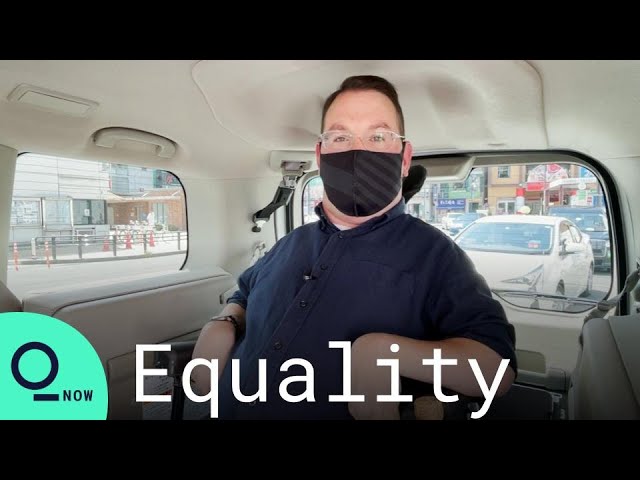
Josh Grisdale, an advocate for disabled people and founder of Accessible Japan, believes more support is needed for disabled people looking for work.
He says he was shocked to be rejected for jobs because of his disability status when he first came to Japan. Previously he worked for a large company in Canada that hadn’t found his disability or wheelchair use a problem.
“But then when I came here, all the time they would say, ‘We like your resume, but we won’t be able to provide your needs.’ So that was a polite way to say: ‘No,’” he said. “It’s frustrating to meet the requirements of the job but because of something I can’t change I wasn’t able to get the job.”
Grisdale says the biggest structural difference between Canada and Japan is that personal care attendants can’t join him in the workplace in Japan. “That means it’s up to the company to take care of those kind of things,” he said.
Subscribe to our YouTube channel
Subscribe to our newest channel Quicktake Explained
Bloomberg Quicktake brings you live global news and original shows spanning business, technology, politics and culture. Make sense of the stories changing your business and your world.
To watch complete coverage on Bloomberg Quicktake 24/7, visit or watch on Apple TV, Roku, Samsung Smart TV, Fire TV and Android TV on the Bloomberg app.
Have a story to tell? Fill out this survey for a chance to have it featured on Bloomberg Quicktake
Connect with us on…
Breaking News on YouTube
Sentinel Indexing in Progress
Metadata and chapters are available. Claim extraction for this episode is pending.
All video content is delivered via YouTube embedded players in accordance with the YouTube Terms of Service. Sentinel provides research tools that promote discovery and accountability across political media.