Bloomberg News
@Bloomberg-News·2.8M subscribers·40.1K videos
World Population Hits 8 Billion, Creating Many Challenges
Posted
November 15, 2022
Views
14,821
Likes
140
Comments
143
Engagement
November 15, 2022
14,821
140
143
1.91%
Every word spoken in this episode is indexed. Type any phrase to jump straight to the moment it was said.
Type any word or phrase that may have been spoken. Click a result to seek the player to that exact moment.
Try a name, a topic, or a quoted line
See what was published immediately before and after this episode.
 0:19Now Playing
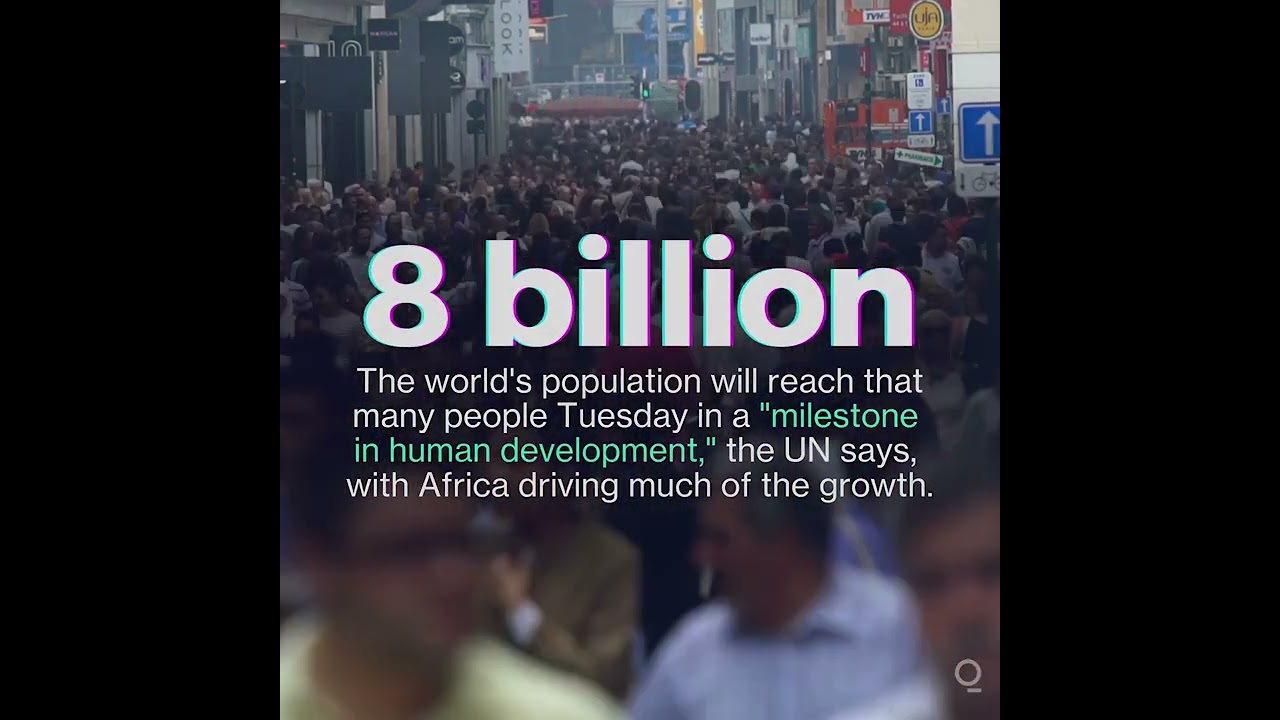
The world's population will likely hit an estimated 8 billion people on Tuesday, according to a United Nations projection, with much of the growth coming from developing nations in Africa.
Among them is Nigeria, where resources are already stretched to the limit. More than 15 million people in Lagos compete for everything from electricity to light their homes to spots on crowded buses, often for two-hour commutes each way in this sprawling megacity. Some Nigerian children set off for school as early as 5 a.m.
And over the next three decades, the West African nation's population is expected to soar even more: from 216 million this year to 375 million, the U.N. says. That will make Nigeria the fourth-most populous country in the world after India, China and the United States.
“We are already overstretching what we have — the housing, roads, the hospitals, schools. Everything is overstretched," said Gyang Dalyop, an urban planning and development consultant in Nigeria.
The U.N.'s Day of 8 Billion milestone Tuesday is more symbolic than precise, officials are careful to note in a wide-ranging report released over the summer that makes some staggering projections.
The upward trend threatens to leave even more people in developing countries further behind, as governments struggle to provide enough classrooms and jobs for a rapidly growing number of youth, and food insecurity becomes an even more urgent problem.
Nigeria is among eight countries the U.N says will account for more than half the world's population growth between now and 2050 — along with fellow African nations Congo, Ethiopia and Tanzania.
“The population in many countries in sub-Saharan Africa is projected to double between 2022 and 2050, putting additional pressure on already strained resources and challenging policies aimed to reduce poverty and inequalities,” the U.N. report said.
It projected the world's population will reach around 8.5 billion in 2030, 9.7 billion in 2050 and 10.4 billion in 2100.
Other countries rounding out the list with the fastest growing populations are Egypt, Pakistan, the Philippines and India, which is set to overtake China as the world's most populous nation next year.
In Congo's capital, Kinshasa, where more than 12 million people live, many families struggle to find affordable housing and pay school fees. While elementary pupils attend for free, older children's chances depend on their parents' incomes.
“My children took turns" going to school, said Luc Kyungu, a Kinshasa truck driver who has six children. "Two studied while others waited because of money. If I didn't have so many children, they would have finished their studies on time.”
Rapid population growth also means more people vying for scarce water resources and leaves more families facing hunger as climate change increasingly impacts crop production in many parts of the world.
“There is also a greater pressure on the environment, increasing the challenges to food security that is also compounded by climate change,” said Dr. Srinath Reddy, president of the Public Health Foundation of India. “Reducing inequality while focusing on adapting and mitigating climate change should be where our policy makers’ focus should be."
Still, experts say the bigger threat to the environment is consumption, which is highest in developed countries not undergoing big population increases.
Subscribe to our YouTube channel
Subscribe to our newest channel Quicktake Explained
Bloomberg Quicktake brings you live global news and original shows spanning business, technology, politics and culture. Make sense of the stories changing your business and your world.
To watch complete coverage on Bloomberg Quicktake 24/7, visit or watch on Apple TV, Roku, Samsung Smart TV, Fire TV and Android TV on the Bloomberg app.
Have a story to tell? Fill out this survey for a chance to have it featured on Bloomberg Quicktake
Connect with us on…
Breaking News on YouTube
Sentinel Indexing in Progress
Metadata and chapters are available. Claim extraction for this episode is pending.
All video content is delivered via YouTube embedded players in accordance with the YouTube Terms of Service. Sentinel provides research tools that promote discovery and accountability across political media.