Bloomberg Podcasts
@bloombergpodcasts·503K subscribers·32.4K videos
Supreme Court Extends Halt of Trump Venezuelan Deportations
Posted
May 16, 2025
Views
13,407
Likes
199
Comments
131
Engagement
May 16, 2025
13,407
199
131
2.46%
Every word spoken in this episode is indexed. Type any phrase to jump straight to the moment it was said.
Type any word or phrase that may have been spoken. Click a result to seek the player to that exact moment.
Try a name, a topic, or a quoted line
 1:52Now Playing
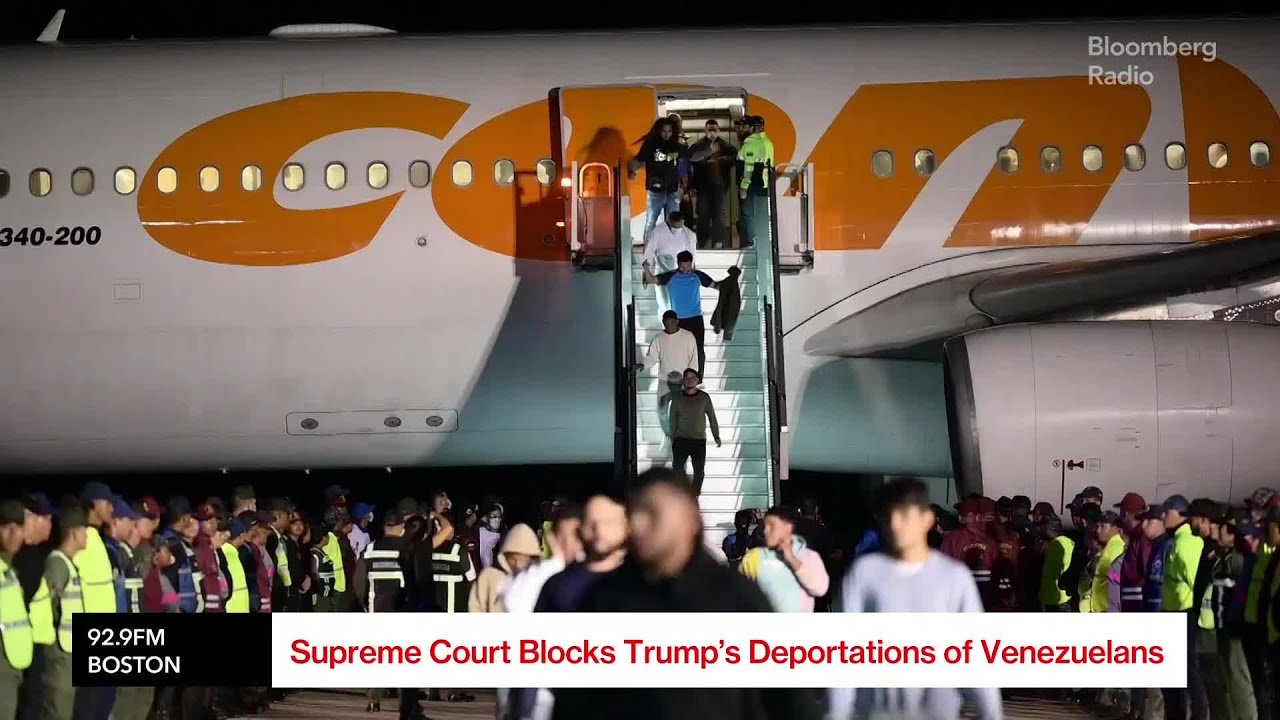
The US Supreme Court blocked the Trump administration from using a wartime law to send about 176 Venezuelans to a notorious Salvadoran prison, faulting the government for not giving the men adequate notice about its deportation plans.
Over two dissents, the court extended an earlier order barring Trump from using the 1798 Alien Enemies Act to deport alleged gang members being held in a Texas detention facility. That interim order, released around 1 a.m. on April 19, came hours after lawyers said detainees were being put on buses and told they faced imminent deportation.
The court’s unsigned decision Friday pointed to the administration’s insistence that it is unable to bring back Kilmar Abrego Garcia, a man wrongly deported to El Salvador in March. The Supreme Court told the government last month to try to return Abrego Garcia.
“The detainees’ interests at stake are accordingly particularly weighty,” the Supreme Court majority said. “Under these circumstances, notice roughly 24 hours before removal, devoid of information about how to exercise due process rights to contest that removal, surely does not pass muster.”
The Supreme Court declined to say how much notice is constitutionally required, kicking the case back to the 5th US Circuit Court of Appeals to take the first crack at that issue. The order will remain in force through the 5th Circuit proceedings and any subsequent Supreme Court appeal.
The detainees allegedly had been given an English-only notice that didn’t explain how they could contest their deportation or say how much time they had to do so. Their lawyers said that the men got less than 24 hours notice and none of their attorneys were notified.
Justices Samuel Alito and Clarence Thomas dissented, saying the Supreme Court got involved prematurely. “It has plucked a case from a district court and decided important issues in the first instance,” Alito wrote for the pair.
The majority said high court intervention was warranted because a federal district judge in Texas failed to act on an April 18 emergency request for more than 14 hours. That inaction “had the practical effect of refusing an injunction to detainees facing an imminent threat of severe, irreparable harm,” the majority said.
Trump blasted the decision, posting on social media, “THE SUPREME COURT WON’T ALLOW US TO GET CRIMINALS OUT OF OUR COUNTRY!”
Trump’s three Supreme Court appointees — Justices Neil Gorsuch, Brett Kavanaugh and Amy Coney Barrett — all at least seemingly backed the decision. Kavanaugh said in a concurring opinion he agreed with the ruling, while Gorsuch and Barrett gave no indication they were dissenting.
The lead lawyer for the detainees, Lee Gelernt of the American Civil Liberties Union, called the ruling “a powerful rebuke to the government’s attempt to hurry people away to a Gulag-type prison in El Salvador.”
‘Invasion’ Cited
The Supreme Court said Friday it wasn’t resolving whether Trump had legally invoked the Alien Enemies Act, a law that previously had been used only during declared wars. The measure lets the president bypass federal immigration law to deport “alien enemies” when the US is involved in a declared war or a foreign nation has started or threatened an “invasion or predatory incursion.”
Trump says he is invoking the law because of the national security threat posed by an “invasion” of members of the Venezuelan Tren de Aragua gang.
“We recognize the significance of the government’s national security interests as well as the necessity that such interests be pursued in a manner consistent with the Constitution,” the Supreme Court majority said. “In light of the foregoing, lower courts should address AEA cases expeditiously.”
In his separate opinion, Kavanaugh said he would have immediately granted review to decide whether Trump can invoke the AEA and, if so, how much notice is required before deportation.
“The injunction simply ensures that the judiciary can decide whether these Venezuelan detainees may be lawfully removed under the Alien Enemies Act before they are in fact removed,” he wrote.
--------
Watch Bloomberg Radio LIVE on YouTube
Weekdays 7am-6pm ET
Follow us on X
Subscribe to our Podcasts:
Bloomberg Daybreak
Bloomberg Surveillance
Bloomberg Intelligence
Balance of Power
Bloomberg Businessweek
Listen on Apple CarPlay and Android Auto with the Bloomberg Business app:
Apple CarPlay
Android Auto
Visit our YouTube channels:
Bloomberg Podcasts
Bloomberg Television
Bloomberg Originals
Sentinel Indexing in Progress
Metadata and chapters are available. Claim extraction for this episode is pending.
All video content is delivered via YouTube embedded players in accordance with the YouTube Terms of Service. Sentinel provides research tools that promote discovery and accountability across political media.