Bloomberg Podcasts
@bloombergpodcasts·503K subscribers·32.4K videos
Apple Slumps as Trump Threatens ‘Absurd’ Tariffs
Posted
May 23, 2025
Views
3,884
Likes
78
Comments
39
Engagement
3.01%
May 23, 2025
3,884
78
39
3.01%
Every word spoken in this episode is indexed. Type any phrase to jump straight to the moment it was said.
Type any word or phrase that may have been spoken. Click a result to seek the player to that exact moment.
Try a name, a topic, or a quoted line
See what was published immediately before and after this episode.
 4:59Now Playing
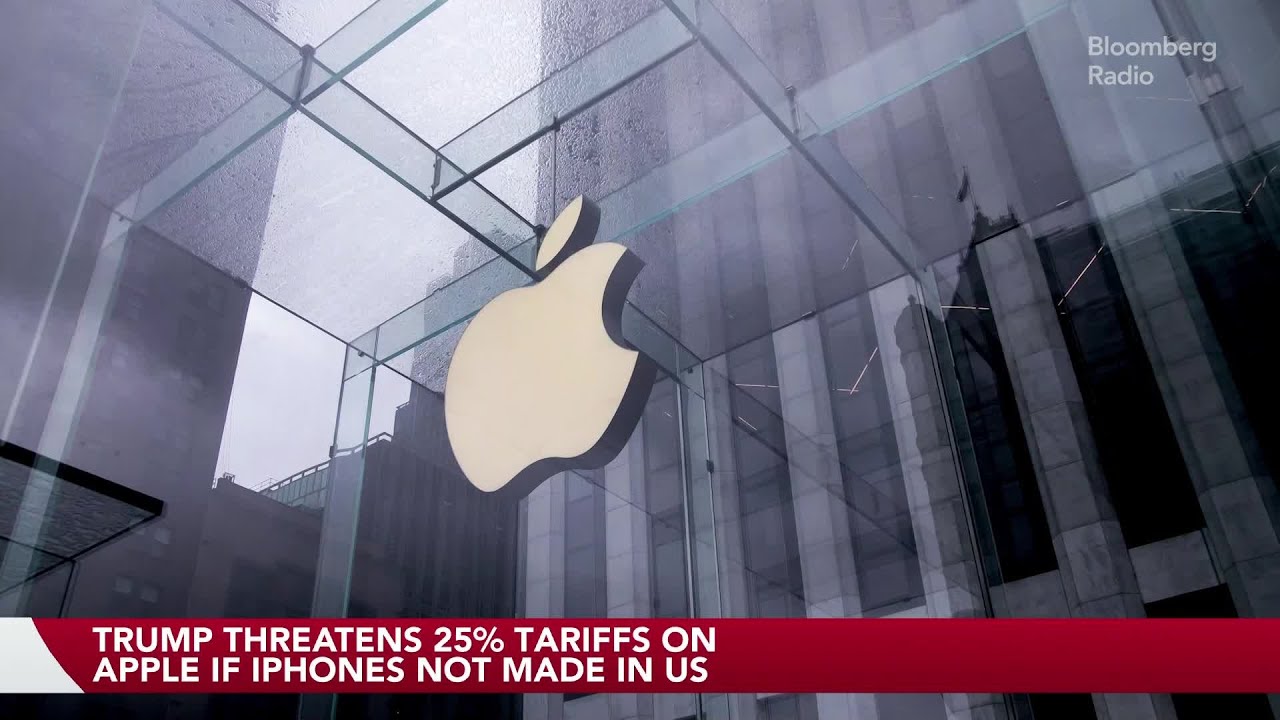
-- Apple shares are slumping 3.4% in premarket trading on Friday after President Donald Trump threatened to levy a 25% tariff on Apple if it doesn’t make its iPhones in the US. Such a change in the company’s global manufacturing process is seen as extremely difficult. President Donald Trump threatened Apple with a tariff of at least 25% if it does not manufacture its iPhones in the US, ramping up pressure on the tech giant to secure more domestic production.
“I have long ago informed Tim Cook of Apple that I expect their iPhone’s that will be sold in the United States of America will be manufactured and built in the United States, not India, or anyplace else,” Trump said in a post on Truth Social on Friday. “If that is not the case, a Tariff of at least 25% must be paid by Apple to the U.S.”
The president’s demands for US-based manufacturing pose a stark challenge to the company, whose supply chains for its popular phones have been concentrated in China for years. The US lacks the rich ecosystem of Apple suppliers, manufacturing and engineering know-how that — for now — can only be found in Asia.
Apple, which has become a frequent Trump target, didn’t immediately respond to a request for comment on the president’s threat. Earlier this month, the company warned that it would face $900 million in higher costs from tariffs in the current quarter.
Last week, during his trip to the Middle East, Trump said he had asked Apple Chief Executive Officer Tim Cook to stop building plants in India to make devices for the US, pushing the iPhone maker to add domestic production as it pivots away from China.
“I had a little problem with Tim Cook yesterday,” Trump said of his conversation. “He is building all over India. I don’t want you building in India.”
Apple said earlier this year that it plans to spend $500 billion in the US over the next four years, which will include work on a new server manufacturing facility in Houston, a supplier academy in Michigan and additional spending with its existing suppliers in the country.
But that stops short of the full shift to US-based production envisioned by Trump. Moving manufacturing of its signature iPhone and other devices to the US would be an enormous undertaking for the Cupertino, California-based company.
Apple’s biggest FATP facilities — short for final assembly, test and pack-out — are massive and incomprehensible to many people outside of Asia. They are almost towns themselves, with several hundred thousand people, schools, gyms, medical facilities and dormitories. One major iPhone factory, a complex in Zhengzhou, has even been dubbed iPhone City.
Development of new iPhones and other products still starts at Apple’s labs in Silicon Valley. But working with Asia-based component suppliers and other partners begins long before a product actually hits the market. Apple engineers and operations experts spend months or years working closely with Foxconn Technology Group, Pegatron Corp. and other suppliers to customize assembly of new devices.
One popular counterpoint is that Apple should use its cash hoard to buy thousands of acres in the US and create a fully robotic and automated iPhone manufacturing facility. That would remove any human-related challenges from the manufacturing process, but supply chain experts say that is not realistic due to frequently changing demands. Also, much of the manufacturing equipment is made in China.
Cook was one of several Big Tech executives and billionaires who attempted to court Trump following his comeback election victory in November.
The Apple CEO had traveled to Trump’s Mar-a-Lago estate in Florida for a series of private meetings and dinners. He also sat behind the president at the inauguration in January along with Elon Musk, Alphabet Inc.’s Sundar Pichai, Meta Platforms Inc.’s Mark Zuckerberg and Amazon.com Inc. founder Jeff Bezos.
--------
Watch Bloomberg Radio LIVE on YouTube
Weekdays 7am-6pm ET
Follow us on X
Subscribe to our Podcasts:
Bloomberg Daybreak
Bloomberg Surveillance
Bloomberg Intelligence
Balance of Power
Bloomberg Businessweek
Listen on Apple CarPlay and Android Auto with the Bloomberg Business app:
Apple CarPlay
Android Auto
Visit our YouTube channels:
Bloomberg Podcasts
Bloomberg Television
Bloomberg Originals
Sentinel Indexing in Progress
Metadata and chapters are available. Claim extraction for this episode is pending.
All video content is delivered via YouTube embedded players in accordance with the YouTube Terms of Service. Sentinel provides research tools that promote discovery and accountability across political media.