Bloomberg Podcasts
@bloombergpodcasts·503K subscribers·32.4K videos
Trump Trade Strategy Roiled by Court Block
Posted
May 29, 2025
Views
4,469
Likes
61
Comments
23
Engagement
1.88%
May 29, 2025
4,469
61
23
1.88%
Every word spoken in this episode is indexed. Type any phrase to jump straight to the moment it was said.
Type any word or phrase that may have been spoken. Click a result to seek the player to that exact moment.
Try a name, a topic, or a quoted line
See what was published immediately before and after this episode.
 3:56Now Playing
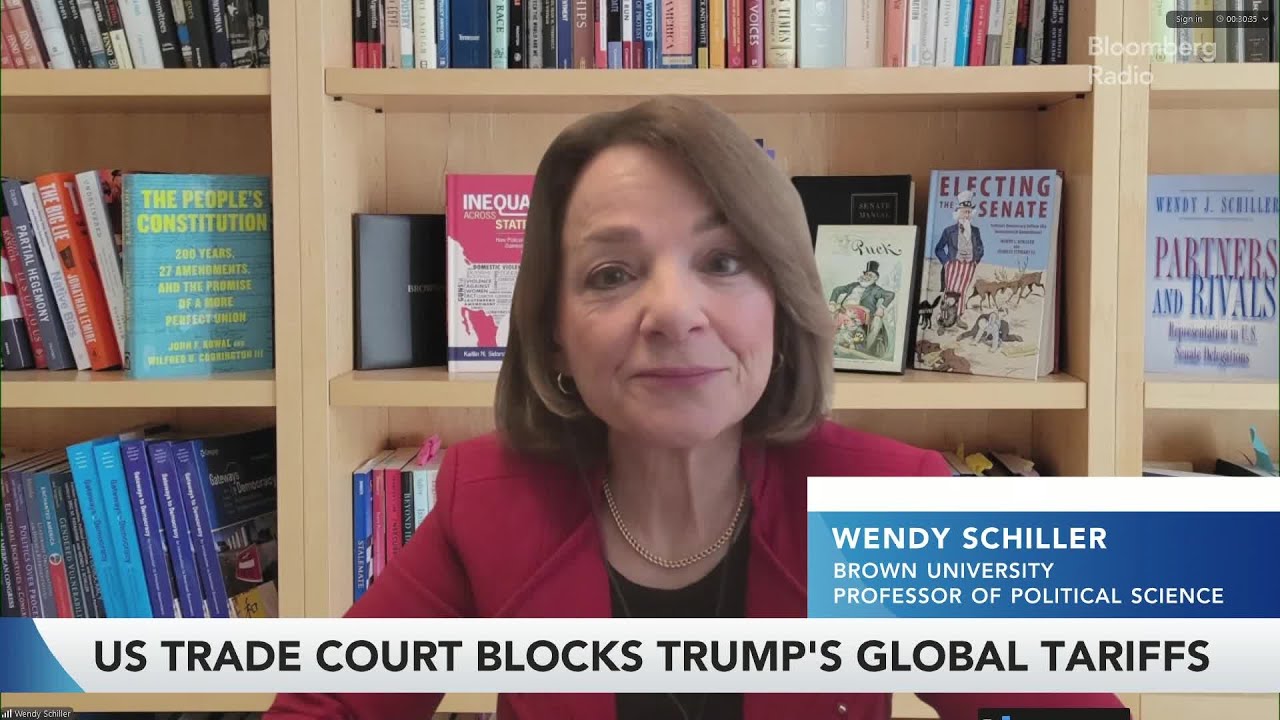
Wendy Schiller, professor at Brown University, discusses the latest DC headlines and how a US court blocking President Trump's tariff policy could affect his presidency and potentially his legacy.
President Donald Trump’s tariff strategy has been thrown into turmoil after a US court issued a rare rebuke blocking many of the import taxes he has threatened and imposed on other countries.
In a ruling issued late Wednesday, a three-judge panel for the US Court of International Trade declared that the Trump administration had wrongly invoked a 1977 law in imposing his “Liberation Day” tariffs on dozens of countries and they were therefore illegal. It also extended that ruling to previous tariffs levied on Canada, Mexico and China over the security of the US border and trafficking in fentanyl.
President Donald Trump’s appetite for new tariffs remains undeterred, even after a pair of court decisions hit his signature duties with their most devastating blow yet.
White House officials quickly signaled Thursday that Trump will aggressively pursue legal challenges and, if they fail, move forward with many of the same levies through other authorities.
The administration said it would go to the US Supreme Court as soon as Friday if a federal appeals court does not keep the initial order from taking effect while its appeal continues. The Court of International Trade on Wednesday blocked the president’s sweeping global tariffs, citing his reliance on the International Emergency Economic Powers Act, or IEEPA.
“America cannot function if President Trump — or any other president, for that matter — has their sensitive diplomatic or trade negotiations railroaded by activist judges,” White House Press Secretary Karoline Leavitt said Thursday. “Ultimately, th Supreme Court must put an end to this for the sake of our Constitution and our country.”
Later Thursday, a second federal judge declared a number of Trump’s tariffs enacted using emergency powers unlawful, but limited his decision to the family-owned business that sued and delayed the order from taking effect for 14 days to allow the Justice Department time to appeal.
But for a president eager to use trade policy to reshape global commerce, other policy options are far from a quick fix.
Some of the other powers are laborious to use and would take months or more to execute, while others are capped in scope and duration. Administration officials made clear they intend to restore the levies one way or another, even as the government appeals
“We’ve got a very strong case with IEEPA, but the court basically tells us if we lose that, we just do some other things,” White House trade adviser Peter Navarro told Bloomberg Television on Thursday. “So nothing’s really changed. I want to say this to the world: ‘You’re cheating us. We’re coming after you. Deal, and let’s make this right.’”
For all of the confidence on Trump’s team, Wednesday’s court ruling marked one of the biggest setbacks of the president’s second term. Trump campaigned on using tariffs to combat what he calls other nation’s unfair treatment of the US, and the emergency law gave him the fastest avenue to deliver on his pledge.
The ruling would reduce the effective US tariff rate to below 6% from a high of almost 27% last month, according to Bloomberg Economics calculations, an astronomical level that risked stagflation for the US.
The legal order also injected even more uncertainty into a world economy already rattled by Trump’s ever-changing posture on import taxes. It may sap Trump’s leverage as his team negotiates with numerous trading partners seeking tariff relief.
The decision blocked tariffs on Mexico, Canada, China as well as a flat import tax on almost every US trading partner. Trump invoked the law on the grounds that fentanyl and trade deficits are each emergencies necessitating the broad use of executive power. The court ruled he went too far.
The White House on Thursday said it is looking at other options, but advisers acknowledged the potential for them being more time-consuming. .
--------
Watch Bloomberg Radio LIVE on YouTube
Weekdays 7am-6pm ET
Follow us on X
Subscribe to our Podcasts:
Bloomberg Daybreak
Bloomberg Surveillance
Bloomberg Intelligence
Balance of Power
Bloomberg Businessweek
Listen on Apple CarPlay and Android Auto with the Bloomberg Business app:
Apple CarPlay
Android Auto
Visit our YouTube channels:
Bloomberg Podcasts
Bloomberg Television
Bloomberg Originals
Sentinel Indexing in Progress
Metadata and chapters are available. Claim extraction for this episode is pending.
All video content is delivered via YouTube embedded players in accordance with the YouTube Terms of Service. Sentinel provides research tools that promote discovery and accountability across political media.