
Israel, Iran Attacks Escalate on Fourth Day
June 16, 2025
14,557
107
41
1.02%
Search the Record
IndexedEvery word spoken in this episode is indexed. Type any phrase to jump straight to the moment it was said.
Type any word or phrase that may have been spoken. Click a result to seek the player to that exact moment.
Try a name, a topic, or a quoted line
Bloomberg Podcasts Episodes Around June 16, 2025
See what was published immediately before and after this episode.

 4:10
4:10Marathon Petroleum Gains; Palantir Higher; US Steel Rallies | Stock Movers


 4:03Now Playing
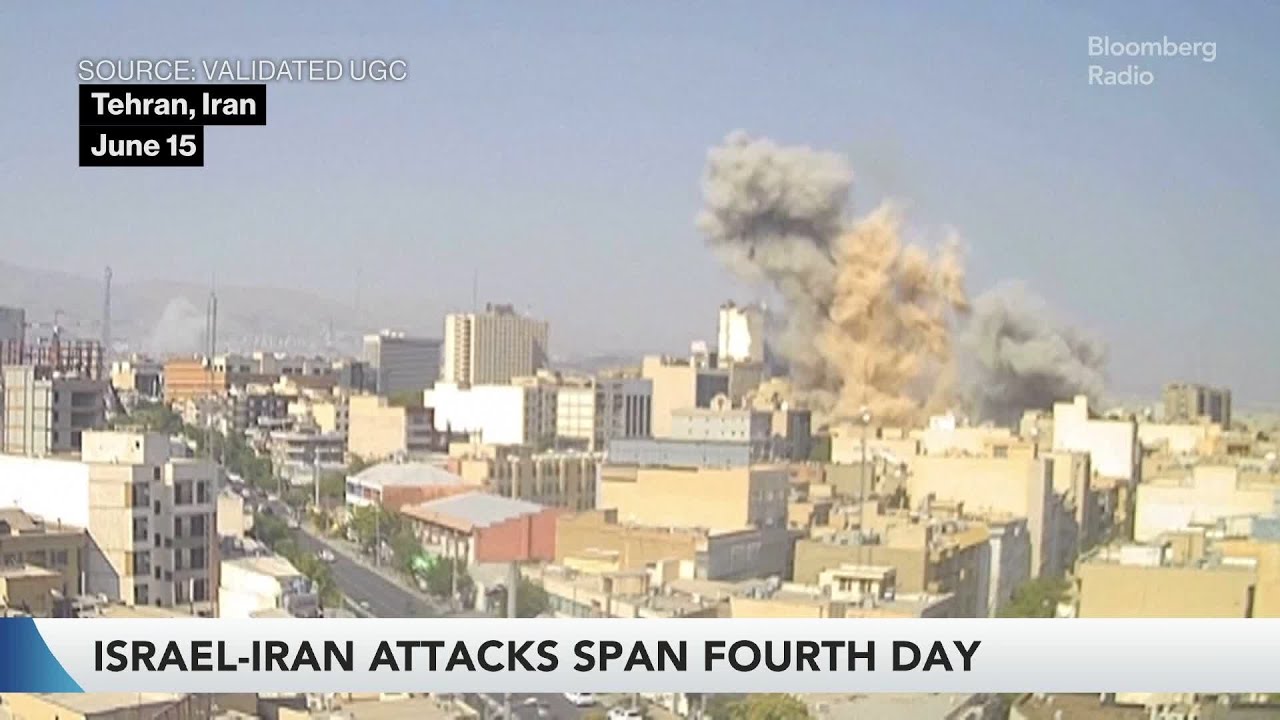
Israel, Iran Attacks Escalate on Fourth Day




YouTube Description
as posted by the channelBloomberg News Reporter Dan Williams discusses the latest on conflict between Israel and Iran and the potential for escalation in the region.
Israel and Iran exchanged fire for the fourth consecutive day on Monday, stoking fears of an all-out war with the potential to drag in others in the oil-rich region and force the US into a more hands-on stance.
Iran fired several waves of drones and missiles over the last 24 hours, while Israel continued hitting the Islamic Republic’s capital, Tehran, and killing one more senior military official.
Since Friday, 224 people have been killed in Iran, according to the government, which said most of the casualties were civilians. Iranian attacks killed 24 people in Israel, according to the Israeli government press office, and injured 592.
The exchange of missile salvos between Israel and Iran is the most serious escalation after years of shadow war. Analysts fear it might push the Middle East into a regional conflict, causing wider human loss and potentially disrupting energy flows and vital trade routes.
One missile landed near the US consulate in central Tel Aviv, causing minor material damages but no injuries to personnel, the ambassador to Israel, Mike Huckabee, said Monday. Many cars were crushed and buildings damaged in the area of the city where the strike happened.
For Iran, the showdown poses an existential dilemma. It can’t risk appearing weak, yet its options are shrinking. Proxy forces across the region, which regularly rallied to its support in the past, have been debilitated by Israeli action over the past 20 months. Hezbollah, the Lebanese militia the US and others designate as a terrorist group, is noticeably absent from the conflict and hasn’t signaled it will start attacks on Israel.
Tensions between the arch-enemies erupted into full-blown conflict on Friday, when Israel attacked Iranian military and nuclear sites, and killed several top generals and atomic scientists. Since then, it has achieved air superiority over large parts of Iran, including Tehran, and degraded the ability of the Islamic Republic to defend against its strikes.
Iran has countered by firing drones and ballistic missiles at the Jewish state. Israel believes Iran still has thousands of missiles left, according to National Security Adviser Tzachi Hanegbi, who spoke in an interview with the Army Radio.
US President Donald Trump has sent contradicting signals since the onset of the Israeli attacks. He first urged Iran to reach a nuclear deal and, on Sunday, added it and Israel “should make a deal, and will make a deal.”
“We will have PEACE, soon, between Israel and Iran!” he said on Truth Social. “Many calls and meetings now taking place.”
Yet, shortly after, he also said “but sometimes they have to fight it out.”
The potential for disruption of key shipping routes if strikes continue will give policymakers trying to forecast risks to inflation pause. Navigation signals from hundreds of vessels in the Strait of Hormuz and the Persian Gulf went awry over the weekend, forcing seafarers to rely on less precise mechanisms which increase the risk of collisions.
Iran reported an explosion at one of its natural gas plants linked to the giant South Pars field on Saturday. While the country exports little gas and Israel appears not to have targeted its oil fields or crude-shipment facilities, the move risks pushing up global energy prices — which soared on Friday — even more.
The United Nations atomic watchdog convened an emergency meeting to assess Israel’s attacks on Iranian nuclear facilities and disrupted monitoring of the Islamic Republic’s stockpile of near-bomb grade uranium. The International Atomic Energy Agency’s board meets Monday in Vienna, just days after a divisive vote found Iran in non-compliance with its legal obligations.
The IAEA said multiple strikes on Iran’s uranium-conversion facility at Isfahan, south of Tehran, resulted in serious damage.
Iran’s deputy foreign minister, Kazem Gharibabadi, told state television that “we will no longer cooperate with the agency as we did before.”
--------
Watch Bloomberg Radio LIVE on YouTube
Weekdays 7am-6pm ET
Follow us on X
Subscribe to our Podcasts:
Bloomberg Daybreak
Bloomberg Surveillance
Bloomberg Intelligence
Balance of Power
Bloomberg Businessweek
Listen on Apple CarPlay and Android Auto with the Bloomberg Business app:
Apple CarPlay
Android Auto
Visit our YouTube channels:
Bloomberg Podcasts
Bloomberg Television
Bloomberg Originals
Guests & Subjects Covered
Sentinel Indexing in Progress
Metadata and chapters are available. Claim extraction for this episode is pending.
All video content is delivered via YouTube embedded players in accordance with the YouTube Terms of Service. Sentinel provides research tools that promote discovery and accountability across political media.