
Ken Rogoff on Risks Facing US Fiscal Health
September 5, 2025
8,228
101
6
1.30%
Search the Record
IndexedEvery word spoken in this episode is indexed. Type any phrase to jump straight to the moment it was said.
Type any word or phrase that may have been spoken. Click a result to seek the player to that exact moment.
Try a name, a topic, or a quoted line
Bloomberg Podcasts Episodes Around September 5, 2025
See what was published immediately before and after this episode.



 5:40Now Playing
Ken Rogoff on Risks Facing US Fiscal Health




YouTube Description
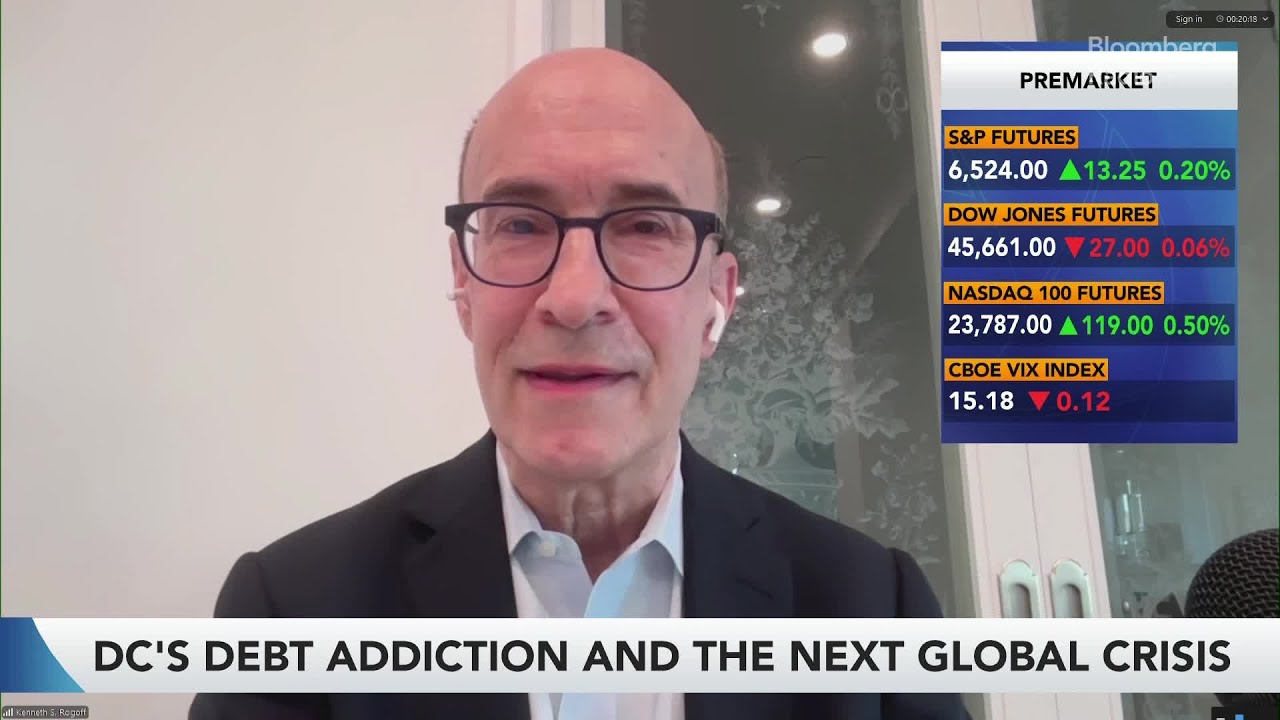
as posted by the channelKen Rogoff, professor at Harvard University, former IMF Chief economist, and author of "Our Dollar, Your Problem," joins to discuss the US economy and jobs market, as well as his book on the dollar and Washington DC's spending crisis.
Disappointing employment data released Friday validated fears that the US labor market may be on the brink of a downturn and lifted expectations for how much the Federal Reserve will lower interest rates this year.
Investors are now fully pricing in a quarter-point rate cut at the Fed’s Sept. 16-17 policy gathering. They also pushed closer to anticipating a total of three rate cuts this year, according to futures contracts. Some Fed watchers said the weak jobs data could spur officials to consider a larger-than-typical half-point this month, though inflation data due next week could temper those expectations.
“There’s no question they’re going to cut a quarter point,” said Diane Swonk, chief economist for KPMG. “This underscores that the cracks in the labor market are getting wider and that is problematic.”
The reaction came after the Bureau of Labor Statistics said employers added 22,000 jobs in August and the unemployment rate rose to 4.3%. The figures — including revisions that showed payrolls were negative in June for the first time since December 2020 — locked down expectations that officials will need to intervene this month to support the labor market, even as inflation remains above the Fed’s 2% target and may head higher because of tariffs.
After this month, Fed officials will meet twice more in 2025, on Oct. 28-29 and Dec. 9-10.
Even prior to the latest jobs report, a substantial slowdown in payroll growth over the summer had prompted comments from Fed Chair Jerome Powell and other policymakers that the balance of risks was shifting away from inflation and toward unemployment.
Powell hinted at a coming rate cut in an Aug. 22 speech in Jackson Hole, Wyoming. And on Thursday, New York Fed President John Williams said it would be appropriate to cut rates “over time,” also nodding to the shifting balance of risks.
“The weakness in payroll data can no longer be ignored or chalked up as a one-off,” said George Catrambone, head of fixed income at DWS Americas.
But policymakers ready to lower rates may be in for a heated discussion at their next gathering. Some officials, including Cleveland Fed President Beth Hammack and Kansas City’s Jeff Schmid, have expressed concerns about the risk that tariffs and other policies could reignite persistent price pressures.
Conflicted Mandate
The divergence of the Fed’s two mandates — with the labor market weakening while inflation remains above its 2% target — is a dreaded situation for central bankers, but also one they forecast a few months ago.
In June, the last time Fed officials released economic projections, they forecast climbing unemployment and inflation around 3%. At the time, they signaled that would warrant two rate cuts this year, based on the median projection of 19 policymakers.
What’s played out since then — nearly exactly what they forecast save for somewhat stronger growth — argues for keeping to that same projected path for policy, said Brett Ryan, senior US economist at Deutsche Bank AG.
“That is the anchor here,” Ryan said of the June projections. “You could be revising growth and inflation up but your unemployment rate is the same, so why are you adding to cuts in that world?”
But the Fed has also changed since June. At the July meeting, when officials left rates unchanged, two governors dissented in favor of a cut. A new vacancy on the board and a fast-tracked confirmation process for a Trump-appointed replacement means there will be even more support for a faster pace of rate cuts. The president has repeatedly urged the Fed to lower rates quickly and aggressively.
Trump’s pick to fill the vacancy on the Fed’s Board of Governors, Stephen Miran, is expected by some to push for a half-point cut if he’s confirmed by the Senate in time for the Sept. 16-17 gathering.
--------
Watch Bloomberg Radio LIVE on YouTube
Weekdays 7am-6pm ET
Follow us on X
Subscribe to our Podcasts:
Bloomberg Daybreak
Bloomberg Surveillance
Bloomberg Intelligence
Balance of Power
Bloomberg Businessweek
Listen on Apple CarPlay and Android Auto with the Bloomberg Business app:
Apple CarPlay
Android Auto
Visit our YouTube channels:
Bloomberg Podcasts
Bloomberg Television
Bloomberg Originals
Guests & Subjects Covered
Sentinel Indexing in Progress
Metadata and chapters are available. Claim extraction for this episode is pending.
All video content is delivered via YouTube embedded players in accordance with the YouTube Terms of Service. Sentinel provides research tools that promote discovery and accountability across political media.