Bloomberg Podcasts
@bloombergpodcasts·503K subscribers·32.4K videos
Hurricane Melissa Nears Jamaica as Island’s Worst-Ever Storm
Posted
October 28, 2025
Views
3,289
Likes
22
Comments
1
Engagement
October 28, 2025
3,289
22
1
0.70%
Every word spoken in this episode is indexed. Type any phrase to jump straight to the moment it was said.
Type any word or phrase that may have been spoken. Click a result to seek the player to that exact moment.
Try a name, a topic, or a quoted line
See what was published immediately before and after this episode.
 2:57Now Playing
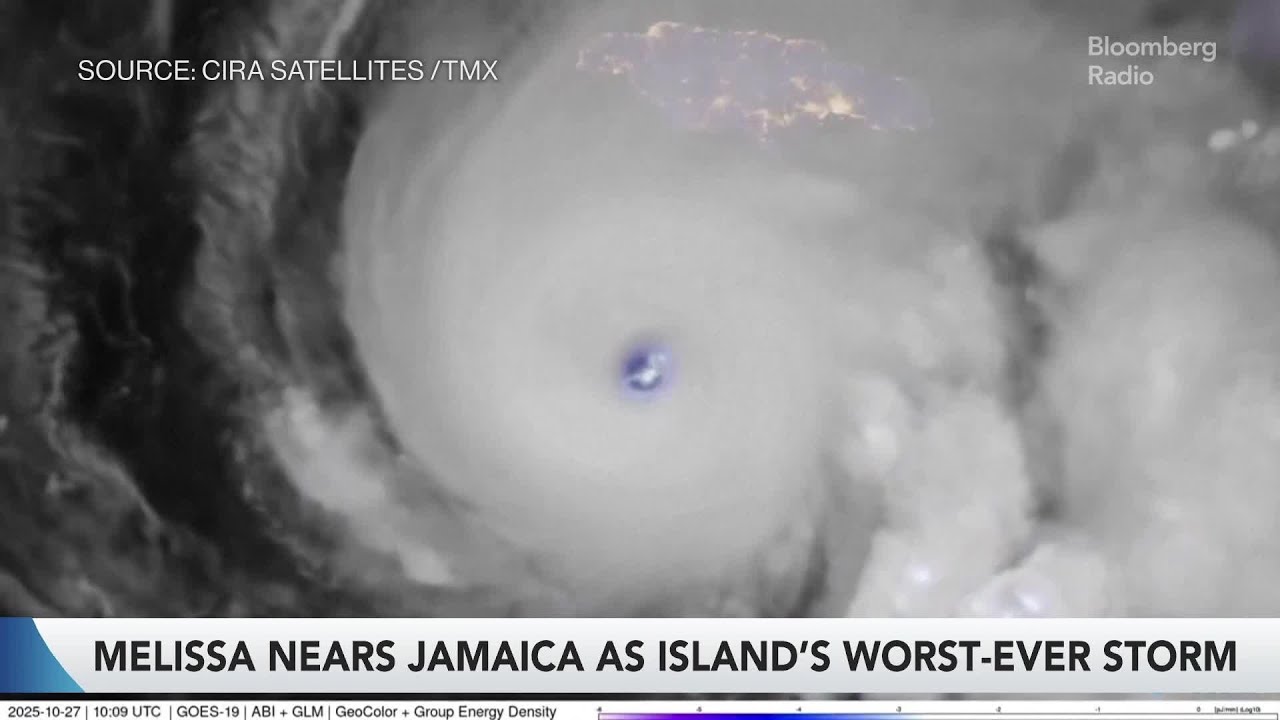
Hurricane Melissa is churning toward Jamaica as the island’s worst-ever storm, with high winds and flooding rains already pummeling coastal areas in the hours before landfall.
Melissa’s top winds reached 180 miles (290 kilometers) per hour, making it a Category 5 storm, the highest level on the five-step Saffir-Simpson scale. Bloomberg's Rob Carolan reports.
Hurricane Melissa became the first recorded Category 5 storm to strike Jamaica, coming ashore as one of the most powerful landfalls ever observed in the Atlantic.
The storm had estimated maximum sustained winds of 185 miles (298 kilometers) per hour, according to a 1 p.m. New York time advisory from the US National Hurricane Center. The high winds and flooding rains put at risk the country’s residents and at least 25,000 tourists still on the island.
“This is an extremely dangerous and life-threatening situation,” the hurricane center said.
Jamaica faces historic devastation, with local emergency managers ordering evacuations across the island and urging residents to stockpile drinking water for as long as three days. Authorities warned that the deadly weather conditions will also cause widespread damage to power and transport infrastructure.
The hurricane’s slow crawl amplified its destruction and raised the risk of days with torrential rain, flooding and landslides. That combination could prove especially destructive for a small island like Jamaica, where most people and critical infrastructure are located near the low-lying coastal areas, according to Leanne Archer, a climate extremes researcher at the University of Bristol.
“This means the impacts of flooding from storm surge and extreme rainfall have a higher risk of impacting a large percentage of the population,” she said.
While the data is spotty in places, there is no record of a storm this strong ever hitting Jamaica since 1851, said Phil Klotzbach, a hurricane researcher at Colorado State University. Before Melissa, the most powerful storm to hit the island was Gilbert in 1988, as a Category 4 with winds of about 132 mph.
Officials say that more than 6,000 people are now taking refuge in 382 of the 800 shelters that have been opened.
Buildings where Melissa comes ashore may be completely destroyed, according to the hurricane center.
Melissa has already led to at least seven deaths across the Caribbean, including three in Haiti. The storm is endangering roughly 3.5 million people across the region, according to estimates from the United Nations’ and European Union’s Global Disaster Alert and Coordination System.
Melissa is forecast to hit Cuba next and then rip through the Bahamas later this week.
--------
Watch Bloomberg Radio LIVE on YouTube
Weekdays 7am-6pm ET
Follow us on X
Subscribe to our Podcasts:
Bloomberg Daybreak
Bloomberg Surveillance
Bloomberg Intelligence
Balance of Power
Bloomberg Businessweek
Listen on Apple CarPlay and Android Auto with the Bloomberg Business app:
Apple CarPlay
Android Auto
Visit our YouTube channels:
Bloomberg Podcasts
Bloomberg Television
Bloomberg Originals
Sentinel Indexing in Progress
Metadata and chapters are available. Claim extraction for this episode is pending.
All video content is delivered via YouTube embedded players in accordance with the YouTube Terms of Service. Sentinel provides research tools that promote discovery and accountability across political media.