
Bloomberg Podcasts
@bloombergpodcasts·503K subscribers·32.4K videos
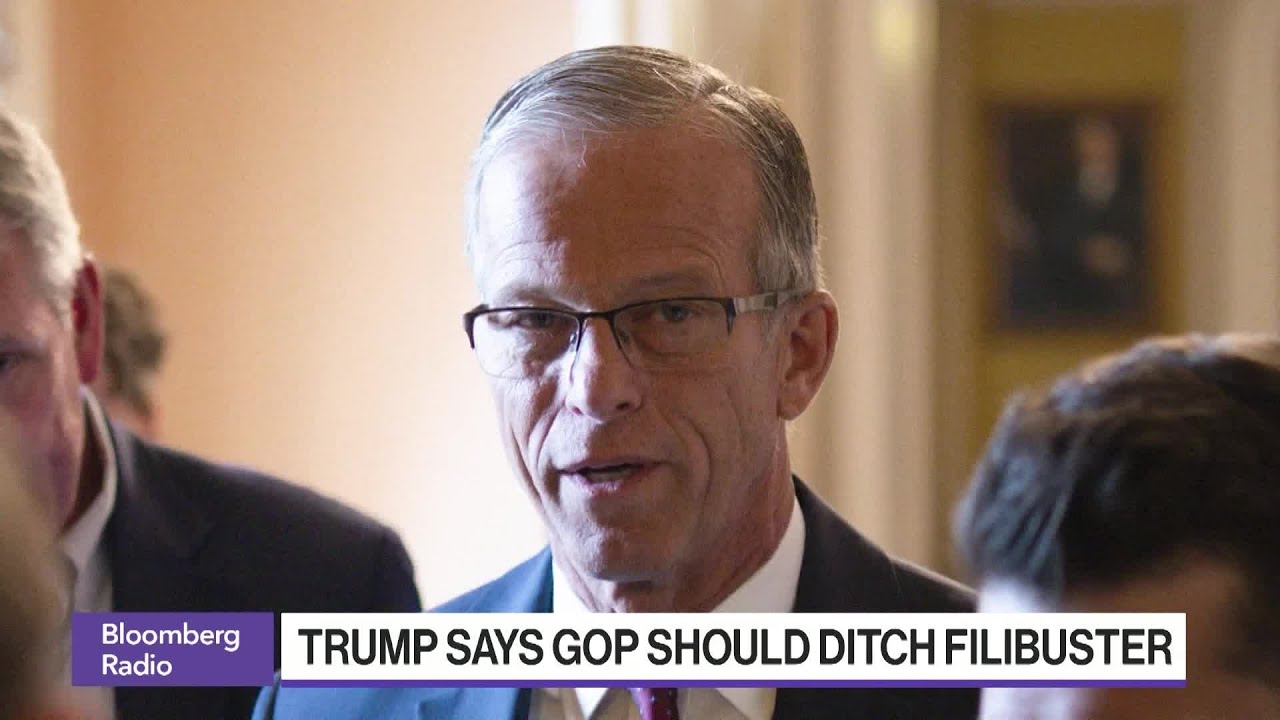
Trump Breaks From Thune, Doubles Down on Call to Ditch Filibuster
Posted
November 3, 2025
Views
22,673
Likes
217
Comments
191
Engagement
November 3, 2025
22,673
217
191
1.80%
Every word spoken in this episode is indexed. Type any phrase to jump straight to the moment it was said.
Type any word or phrase that may have been spoken. Click a result to seek the player to that exact moment.
Try a name, a topic, or a quoted line
See what was published immediately before and after this episode.
 6:33Now Playing
Bill Hoagland, SVP at the Bipartisan Policy Center and former Senate staffer, said that the Senate needs the 'higher standard' of the filibuster to prompt legislative compromise after President Trump doubled down on effort to get Republicans to do away with the rule.
President Donald Trump’s latest call to kill the legislative filibuster faces a largely unwelcome reception from his allies in the Senate.
Key Republican senators have long been against removing the rule that requires 60 votes — and therefore some degree of bipartisan support — to advance most legislation, and Majority Leader John Thune (R-S.D.) reaffirmed his opposition to removing it on Friday. While Trump‘s post calling for the partisan tactic during the month-long government shutdown renews pressure to act, it’s likely not enough to change Senate rules.
“GET RID OF THE FILIBUSTER AND, MAKE AMERICA GREAT AGAIN,” Trump wrote on social media late Thursday night.
Sen. John Curtis (R-Utah) responded on X, saying, “The filibuster forces us to find common ground in the Senate. Power changes hands, but principles shouldn’t. I’m a firm no on eliminating it.”
The debate over the filibuster could also scramble attempts to reopen the government. Senators left for the long weekend with some optimism about bipartisan talks to pass funding after weeks of little movement.
Key Difference
The Senate filibuster — the concept of blocking legislation that doesn’t have 60 votes with unending floor debate — has drawn scrutiny in recent decades. It’s a key difference with the House, where legislation moves by simple majority.
Thune pledged to preserve the filibuster when he assumed the top role in the chamber. In the midst of the shutdown, he told reporters he remained opposed to changing it.
“There’s always a lot of swirl out there, as you know, from social media, etc., but no, I have not had that conversation,” Thune said earlier this month when asked by reporters if the White House was pressing for change.
Thune’s spokesman Ryan Wrasse said in a statement Friday that “Leader Thune’s position on the importance of the legislative filibuster is unchanged.”
The Senate has voted more than a dozen times on the same House-passed funding stopgap during the shutdown. House and Senate GOP leaders have sought to stay united in their strategy amid the shutdown — and Speaker Mike Johnson (R-La.) continued that unity on Friday when asked about the filibuster.
“It’s not my call. I don’t have a say in this,” Johnson said at a press conference. “But the filibuster has traditionally been viewed as a very important safeguard. If the shoe was on the other foot, I don’t think our team would like it.”
Non-Starter
Senate Democrats — who have previously tried to eliminate or reform the filibuster — have accused Republicans of eroding the filibuster by repeatedly setting new precedents since taking the majority this year, including using a simple majority to overturn California’s vehicle emissions law and lowering the threshold to confirm nominees in batches.
But the filibuster remains intact. Even in the thick of the shutdown, many key Republican senators have said they don’t support killing it. Sen. John Cornyn (R-Texas) told reporters this month it was a non-starter.
It’s also not the first time Trump has called to end the filibuster. He did so during his first term to no avail, and getting the 51 votes needed to ‘go nuclear'—the language often used by senators to describe the effect the change would have on the legislative body—would be a challenge among the more tradition-bound chamber.
Though top Senate Republicans have said it’s off the table, it has gained traction among some.
Rep. Marjorie Taylor Greene (R-Ga.) has pushed Senate Republicans to use the nuclear option, like they did for nominees, to reopen the government. Sen. Bernie Moreno (R-Ohio) said, if the shutdown continues, it’s “probably an option that should be considered.”
Trump’s latest post renewed that trend of support. The length of the shutdown and how hard Trump pushes will test whether Senate Republicans stay united against the change.
--------
Watch Bloomberg Radio LIVE on YouTube
Weekdays 7am-6pm ET
Follow us on X
Subscribe to our Podcasts:
Bloomberg Daybreak
Bloomberg Surveillance
Bloomberg Intelligence
Balance of Power
Bloomberg Businessweek
Listen on Apple CarPlay and Android Auto with the Bloomberg Business app:
Apple CarPlay
Android Auto
Visit our YouTube channels:
Bloomberg Podcasts
Bloomberg Television
Bloomberg Originals
Sentinel Indexing in Progress
Metadata and chapters are available. Claim extraction for this episode is pending.
All video content is delivered via YouTube embedded players in accordance with the YouTube Terms of Service. Sentinel provides research tools that promote discovery and accountability across political media.