Bloomberg Podcasts
@bloombergpodcasts·503K subscribers·32.4K videos
American Consumer Remains Resilient, Says LA Port Executive Director Gene Seroka
Posted
December 9, 2025
Views
1,817
Likes
7
Comments
4
Engagement
December 9, 2025
1,817
7
4
0.61%
Every word spoken in this episode is indexed. Type any phrase to jump straight to the moment it was said.
Type any word or phrase that may have been spoken. Click a result to seek the player to that exact moment.
Try a name, a topic, or a quoted line
 5:08Now Playing
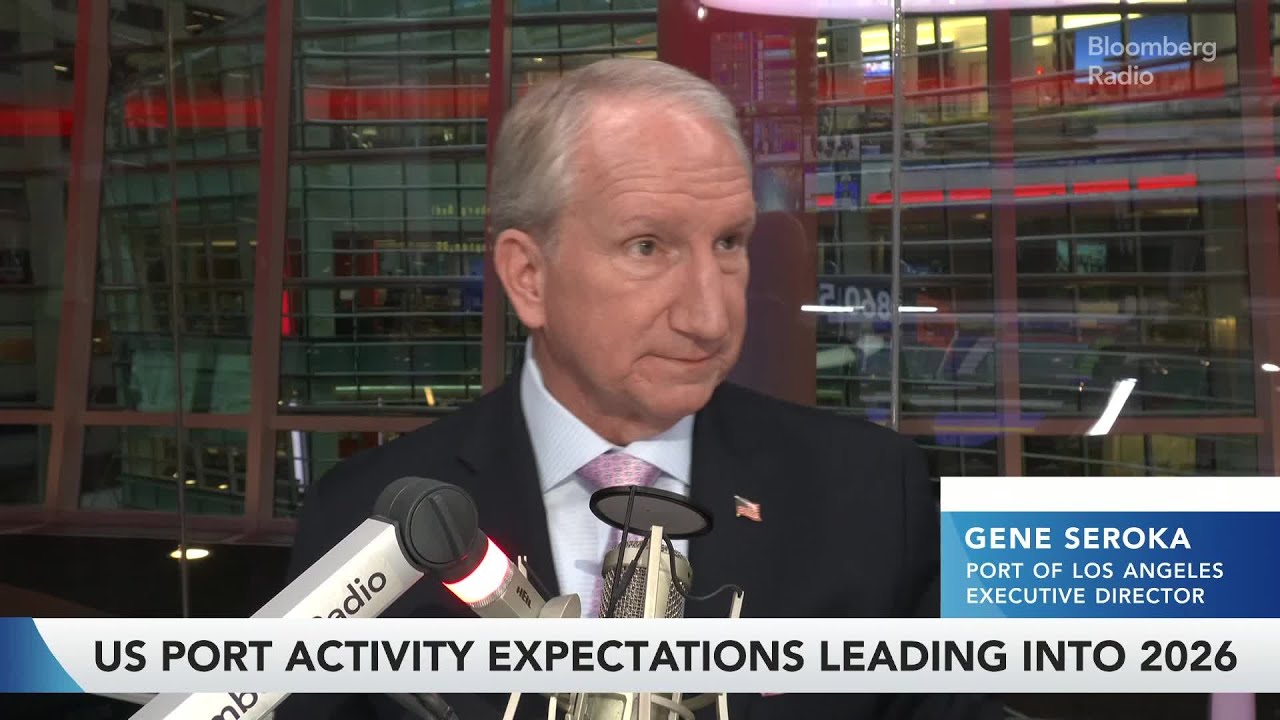
Gene Seroka, Executive Director of the Port of Los Angeles, discusses the current state of shipping at America's ports and the impact tariffs have had on the US consumer.
US seaborne imports are poised to stabilize in 2026, as cargo owners facing President Donald Trump’s trade barriers seek to further diversify global supply chains and adapt to American consumers increasingly worried about the cost of living.
According to the Global Port Tracker report released Monday by the National Retail Federation and and Hackett Associates, 2.07 million 20-foot container units were unloaded in October. That’s down 1.8% from September and a nearly 8% drop from the previous October.
The report projects November will be down 11.6% and December will be off 12.7%. While the fourth quarter is typically slower, the steep declines partly reflects the frontloading by importers last year ahead of Trump’s then-threatened tariffs and concern back then over port labor strikes.
“Stores are stocked up and ready for a record holiday season but there is still a great deal of uncertainty about what will happen in 2026 with trade policy,” said Jonathan Gold, the National Retail Federation’s vice president for supply chain and customs policy.
Weaker Than 2024
The NFR/Hackett report forecasts US import volume at 25.2 million TEUs for the full year, down 1.4% from 25.5 million in 2024.
Heading into next year, tariffs — and lingering uncertainty surrounding Trump’s trade policies that are subject to a pending challenge before the Supreme Court — are weighing on projections.
January’s forecast for 2 million TEU would be the first month-over-month increase in six months but would still be down 10.3% year over year. February is forecast to drop 8.5% from a year earlier, March is seen falling 16.8% and April sliding 10.9%.
“It’s been an unbelievable rollercoaster of a year,” Port of Los Angeles Executive Director Gene Seroka told Bloomberg TV on Tuesday, adding that exports “have really lagged.” The nation’s busiest gateway for maritime trade is seeing solid flows from Southeast Asia pick up the slack from weaker Chinese shipments to the US West Coast, he said.
- US consumer inflation expectations were stable in November while perceptions about job prospects improved, according to a survey from the Federal Reserve Bank of New York.
Expected inflation a year ahead was little changed at 3.2% last month, while expected inflation three and five years ahead remained at 3%, according to median responses in the New York Fed’s monthly Survey of Consumer Expectations, published Monday. The perceived probability of losing one’s job fell to 13.8%, marking the lowest reading this year.
Fed officials are widely expected to cut their benchmark interest rate for a third straight time on Wednesday at the conclusion of a two-day policy meeting, in a bid to safeguard against worsening labor market conditions. Still, several officials have also voiced concerns that tariffs could result in long-lasting price increases, and are closely following estimates of expected inflation.
The New York Fed survey showed consumers largely were more optimistic about the labor market in November than a month earlier, marking down the chances of a higher unemployment rate a year from now and reporting better odds of finding a job if they were to lose theirs.
But with job prospects still worse than last year and inflation still elevated, a greater share of households also reported deterioration in their personal finances. The percentage of respondents saying their current financial situation was worse than a year ago rose to 39%, the highest in two years.
--------
Watch Bloomberg Radio LIVE on YouTube
Weekdays 7am-6pm ET
Follow us on X
Subscribe to our Podcasts:
Bloomberg Daybreak
Bloomberg Surveillance
Bloomberg Intelligence
Balance of Power
Bloomberg Businessweek
Listen on Apple CarPlay and Android Auto with the Bloomberg Business app:
Apple CarPlay
Android Auto
Visit our YouTube channels:
Bloomberg Podcasts
Bloomberg Television
Bloomberg Originals
Sentinel Indexing in Progress
Metadata and chapters are available. Claim extraction for this episode is pending.
All video content is delivered via YouTube embedded players in accordance with the YouTube Terms of Service. Sentinel provides research tools that promote discovery and accountability across political media.