Bloomberg Podcasts
@bloombergpodcasts·503K subscribers·32.4K videos
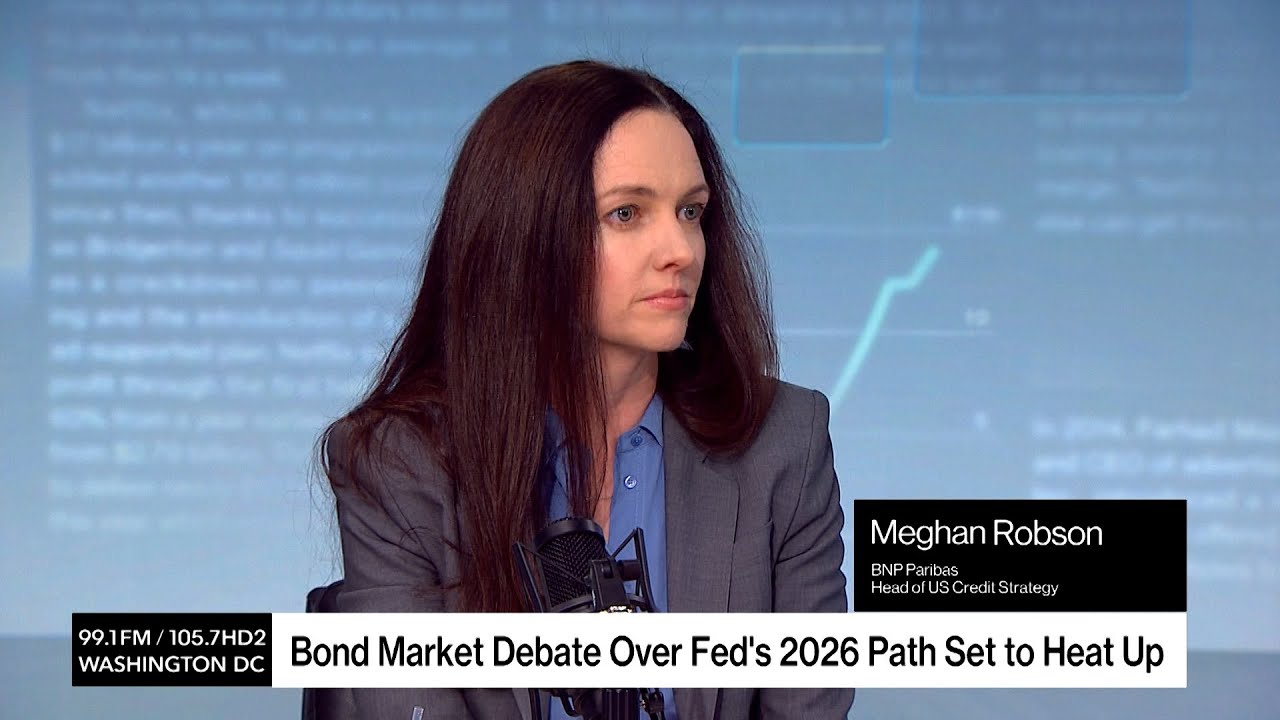
Inflation Will Prevent Extended Cutting Cycle, Says BNP Paribas' Robson
Posted
December 15, 2025
Views
1,841
Likes
19
Comments
1
Engagement
December 15, 2025
1,841
19
1
1.09%
Every word spoken in this episode is indexed. Type any phrase to jump straight to the moment it was said.
Type any word or phrase that may have been spoken. Click a result to seek the player to that exact moment.
Try a name, a topic, or a quoted line
 11:40Now Playing
Meghan Robson, Head of US Credit Strategy at BNP Paribas, expects inflation to accelerate a bit in 2026 due to pressure on goods inflation. She sees one more rate cut next year but inflation will prevent the Federal Reserve from extending its cutting cycle. She speaks to Bloomberg's Carol Massar, Tim Stenovec, and Michael McKee on 'Bloomberg Businessweek Daily.'
Federal Reserve Bank of New York President John Williams said monetary policy is well positioned for next year following last week’s interest-rate reduction, amid increased risks to employment and somewhat-lessened inflation risk.
“Monetary policy is very focused on bringing these risks into balance. To that end, the FOMC has moved the modestly restrictive stance of monetary policy toward neutral,” Williams said Monday in remarks prepared for an event in Jersey City, New Jersey, referring to the Federal Open Market Committee. “With these actions, monetary policy is well positioned as we head into 2026.”
Policymakers’ divided views have been on full display since Fed officials lowered rates by a quarter-point last week. The third straight rate reduction of the year brought the Fed’s benchmark rate to a target range of 3.5% to 3.75%.
The move faced three dissents from policymakers, including two from regional Fed presidents who preferred to hold rates steady and one from Fed Governor Stephen Miran, who favored a larger half-point reduction.
Williams said economic growth should accelerate next year to about 2.25% — from an estimated 1.5% in 2025 — thanks to support from fiscal policy, “favorable financial conditions” and investments in artificial intelligence. He said he also expects inflation to decline to slightly below 2.5% next year before reaching the Fed’s 2% target in 2027.
Answering questions after his speech, the New York Fed chief indicated monetary policy is now calibrated to address either key risk to the central bank’s main goals — inflation being too high or the job market being too weak.
Roughly Balanced
“This year we’ve — based on the data, based on the outlook — adjusted interest rates down in a way that we think positions us really well to have these two competing kind of risks be roughly in balance,” Williams said. “We can’t know exactly what’s going to happen with trade policy, inflation or the economy next year, but I think we‘re well positioned for that.”
He was speaking a day before key employment figures, with the Bureau of Labor Statistics set to publish data for each of of the last two months, after the releases were delayed by the government shutdown that spanned all of October and much of November.
Williams told reporters after the event that he expects the report to be “basically consistent with what we’ve seen — relatively slow job growth, and signs of a labor market that has been gradually cooling.”
He added that it was too soon to discuss possible options for the Fed’s next policy meeting in January, though he “was very supportive” of last week’s rate cut.
Also speaking Monday, Boston Fed President Susan Collins said her decision to support the December rate cut was a “close call.”
“While my analysis in November had leaned toward holding policy steady, by the December meeting, available information suggested the balance of risks had shifted a bit,” Collins said Monday in a post on LinkedIn.
Governor Stephen Miran also reiterated his view that current policy remains overly restrictive. In an interview with CNBC he also revealed he’ll likely remain at the central bank after his term expires, until a new appointee is confirmed to fill his seat.
Miran’s term ends on Jan. 31, but he’s entitled to remain in the job until a replacement is confirmed by the US Senate. President Donald Trump is expected to replace Miran on the Board of Governors with whomever he selects to succeed Jerome Powell as the head of the central bank when Powell’s term as chair expires in May. Miran is on unpaid leave from his post as chair of the
--------
Watch Bloomberg Radio LIVE on YouTube
Weekdays 7am-6pm ET
Follow us on X
Subscribe to our Podcasts:
Bloomberg Daybreak
Bloomberg Surveillance
Bloomberg Intelligence
Balance of Power
Bloomberg Businessweek
Listen on Apple CarPlay and Android Auto with the Bloomberg Business app:
Apple CarPlay
Android Auto
Visit our YouTube channels:
Bloomberg Podcasts
Bloomberg Television
Bloomberg Originals
Sentinel Indexing in Progress
Metadata and chapters are available. Claim extraction for this episode is pending.
All video content is delivered via YouTube embedded players in accordance with the YouTube Terms of Service. Sentinel provides research tools that promote discovery and accountability across political media.