Bloomberg Podcasts
@bloombergpodcasts·503K subscribers·32.4K videos
Bitcoin Market Decline a 'Healthy Retracement,' Says MARA's Thiel
Posted
December 16, 2025
Views
1,875
Likes
23
Comments
6
Engagement
December 16, 2025
1,875
23
6
1.55%
Every word spoken in this episode is indexed. Type any phrase to jump straight to the moment it was said.
Type any word or phrase that may have been spoken. Click a result to seek the player to that exact moment.
Try a name, a topic, or a quoted line
 5:26Now Playing
Bitcoin is headed for the fourth annual decline in its history, and the first one that didn’t coincide with a major scandal or industry meltdown.
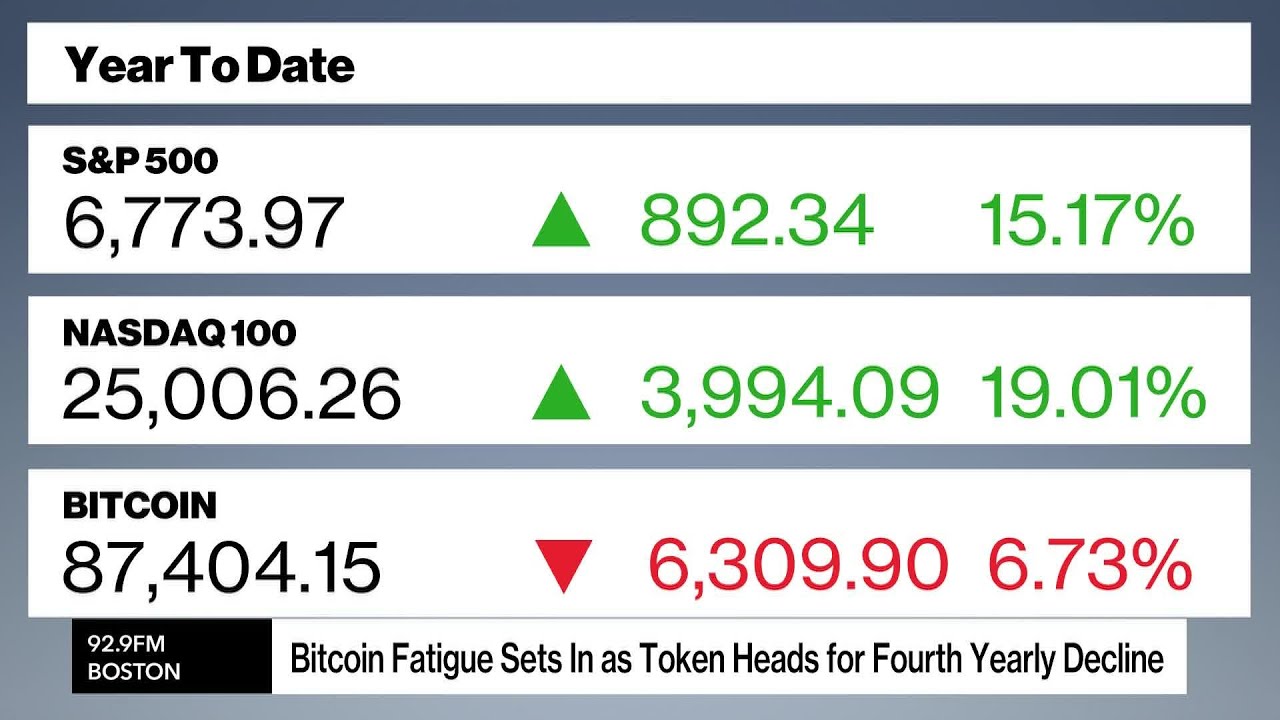
The latest leg down came Monday, with a sharp selloff that sent the original cryptocurrency falling as much as 3.7% during New York hours. Bitcoin is now about 7% lower for the year. It was climbing again on Tuesday, up roughly 1.5% by early afternoon.
While the latest decline is a much milder correction than in the previous three down years, it’s happened against a vastly different backdrop. Since the last major crypto crash in 2022, institutional adoption has widened, regulation has matured, and the industry has found its arguably most important champion in US President Donald Trump.
The rapid lurch lower since Bitcoin hit a record of over $126,000 in early October has confounded bulls and left cryptoassets struggling to find a footing. Volumes are low, investors are bailing on Bitcoin ETFs and derivatives markets are showing a lack of appetite for betting on a rebound. Even massive buying from the dominant Bitcoin whale — Michael Saylor’s Strategy Inc. — hasn’t been enough to turn things around.
“Most are surprised by the lack of follow-through despite so many positive catalysts,” said Pratik Kala, a portfolio manager at hedge fund Apollo Crypto.
The bear market means Bitcoin has decoupled from stocks. The S&P 500 closed at a record earlier this month and is up 16% for the year. Tech stocks, with which Bitcoin has often tended to move in sync, have done even better. He joined Carol Massar and Tim Stenovec on 'Bloomberg Businessweek Daily' to break it down.
Bitcoin’s first three annual drawdowns since it started trading on exchanges in 2010 were marked by events that, briefly at least, shattered market confidence.
In 2014, the hack and subsequent collapse of Bitcoin exchange Mt. Gox exposed significant gaps in crypto’s nascent infrastructure and showed early traders that their funds weren’t necessarily safe on a centralized platform. Bitcoin swooned 58% that year.
Four years later, a bubble in so-called initial coin offerings burst spectacularly after authorities cracked down, sending Bitcoin and other tokens spiraling. The 2018 decline of 74% still stands as the biggest ever.
The 2022 meltdown was perhaps the most significant, in part because the crypto market had grown much larger by then but also because it led to the demise of several major companies — notably Sam Bankman-Fried’s FTX — and triggered a broad crackdown by President Joe Biden’s administration.
Until October’s peak, it looked like nothing could stop Bitcoin’s ascent. Trump had declared crypto a national priority, the US Congress had passed landmark stablecoin legislation and Bitcoin exchange-traded funds were raking in billions of dollars. The value of acquisitions was skyrocketing, as was fundraising. And several enforcement cases against crypto outfits initiated under Biden were withdrawn.
But under the surface, vulnerabilities were piling up, most notably extreme leverage. The brittleness of the rally exploded into public view on Oct. 10, when $19 billion of leveraged bets were liquidated, sending crypto markets into a tailspin.
Bitcoin “whales” — wallets holding large amounts of the token — started selling, keeping pressure on prices even after most leverage was cleared out. Turnover slumped, with volumes dropping in November from the previous month by the most since early 2024, according to CoinDesk Data.
A range of market metrics indicate traders are staying on the sidelines, at least for now.
Investors have pulled more than $5.2 billion from US-listed spot Bitcoin ETFs since Oct. 10. Market depth, a measure of the ability to absorb large trades without big price swings, has dropped roughly 30% from the year’s high, data from researcher Kaiko show.
“Old whales selling really dampened momentum,” Kala said. “The industry got everything it asked for on the regulatory front — even ETFs with staking — but the price failed to follow.”
--------
Watch Bloomberg Radio LIVE on YouTube
Weekdays 7am-6pm ET
Follow us on X
Subscribe to our Podcasts:
Bloomberg Daybreak
Bloomberg Surveillance
Bloomberg Intelligence
Balance of Power
Bloomberg Businessweek
Listen on Apple CarPlay and Android Auto with the Bloomberg Business app:
Apple CarPlay
Android Auto
Visit our YouTube channels:
Bloomberg Podcasts
Bloomberg Television
Bloomberg Originals
Sentinel Indexing in Progress
Metadata and chapters are available. Claim extraction for this episode is pending.
All video content is delivered via YouTube embedded players in accordance with the YouTube Terms of Service. Sentinel provides research tools that promote discovery and accountability across political media.