Bloomberg Podcasts
@bloombergpodcasts·503K subscribers·32.4K videos
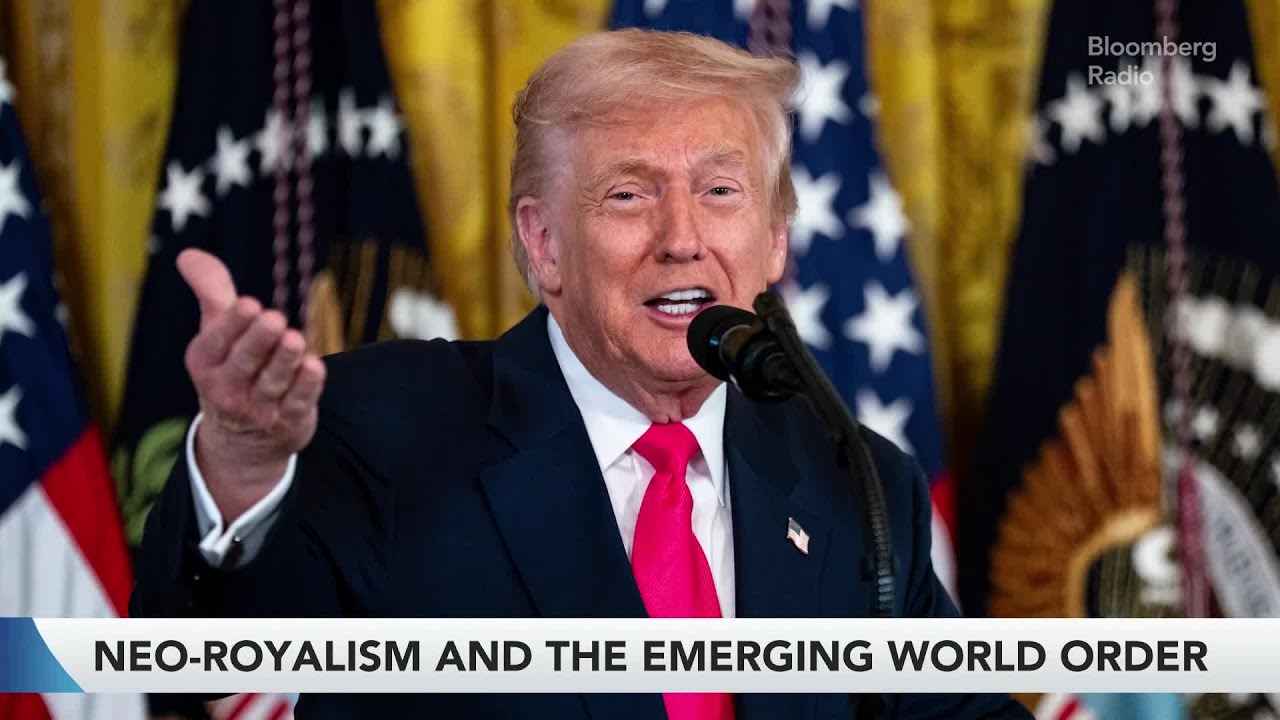
Neo-Royalism and Trump's New World Order
Posted
February 6, 2026
Views
4,151
Likes
52
Comments
16
Engagement
1.64%
February 6, 2026
4,151
52
16
1.64%
Every word spoken in this episode is indexed. Type any phrase to jump straight to the moment it was said.
Type any word or phrase that may have been spoken. Click a result to seek the player to that exact moment.
Try a name, a topic, or a quoted line
 6:34Now Playing
Historians have long searched for a framework to understand the state of world affairs since Donald Trump took office, and neo-royalism may be a strong contender.
Andreas Kluth, Bloomberg Opinion Columnist, writes:
"The search continues for a framework to make sense of, or at least label, the baffling state of world affairs since Donald Trump took his second oath of office as president of the United States. And now we have a new contender: Neo-royalism. At first — and even second — glance, I’d say it fits.
First, a recap of some of the “isms” that have clearly failed. Trump is obviously not an isolationist because, for starters, he keeps bombing foreign countries — provided they’re weak enough not to return more than token fire. Currently, he’s considering a second go at Iran.
Nor is he a realist, because too many things he does — from waging random trade wars to insulting allies or letting China have state-of-the-art American microchips — hurt rather than help the national interests of the United States.
Trump definitely is a transactionalist. But that label just implies that he thinks in short-term deals rather than strategy — as one of his former national-security advisors puts it, that his foreign policy is “an archipelago of dots, unconnected by chords of logic.” While the description fits, it has little analytic value.
Some -isms that do pack a punch come from the field of psychology rather than international relations and also have limited utility. Narcissism, for instance.1It explains much about Trump’s leadership: his constant projection of grandiosity and need for flattery, among other things. But other world leaders and American presidents have also exhibited signs of narcissism, and we generally don’t name eras after the trait.
Enter Stacie Goddard at Wellesley College and Abraham Newman at Georgetown University with their framing of current world politics as neo-royalist. Their premise is that international-relations scholars are flailing in part because they’re trained to think of their field, as its name implies, as affairs between and among states. They contend instead that the proper unit of analysis in the era of Trump (and his counterparts in Russia, India, Turkey and other places) is the leader and his clique.
“Clique” is their word for what historians of the Middle Ages and early modern era call dynasties, houses, khanates and the like. The clique extends to family, supporters (campaign donors, say) and other friends. The foreign policy of the Trump clique, the argument goes, would easily have been recognized by, say, Tudors, Habsburgs, Bourbons, Romanovs or Medicis.
These dynasties, as Goddard and Newman put it, were networks of family and patronage around a leader “seeking to generate durable material and status hierarchies based on the extraction of financial and cultural tributes.”
Suddenly a lot of contradictions make more sense. Trade and commercial policy, for example. Despite his America First rhetoric, Trump does not use tariffs, or the threat of them, as way of mobilizing state power but as “a rent-seeking strategy, a regime based on arbitrary decisions, aimed at extracting maximum wealth for the clique.”
In this regime, the leaders of countries he targets have to offer special access to him or his family and associates. The tithes and tributes can range from gold crowns (South Korea) to fast-tracked Trump-branded golf courses (Vietnam, for instance), luxury jets (Qatar) or crypto-currency deals with the Trump family (United Arab Emirates).
One aspect of explicit tribute-seeking by the neo-royalist clique is of course the accumulation of vast riches. The Trump clan’s businesses apparently made at least $4 billion since he returned to the White House. Non-family members of the clique are also doing well, as Trump re-channels, say, the oil riches of Venezuela, a country that he recently attacked and subdued.
But neo-royalism is about status as much as money.
--------
Watch Bloomberg Radio LIVE on YouTube
Weekdays 7am-6pm ET
Follow us on X
Subscribe to our Podcasts:
Bloomberg Daybreak
Bloomberg Surveillance
Bloomberg Intelligence
Balance of Power
Bloomberg Businessweek
Listen on Apple CarPlay and Android Auto with the Bloomberg Business app:
Apple CarPlay
Android Auto
Visit our YouTube channels:
Bloomberg Podcasts
Bloomberg Television
Bloomberg Originals
Sentinel Indexing in Progress
Metadata and chapters are available. Claim extraction for this episode is pending.
All video content is delivered via YouTube embedded players in accordance with the YouTube Terms of Service. Sentinel provides research tools that promote discovery and accountability across political media.