
Bloomberg Podcasts
@bloombergpodcasts·503K subscribers·32.4K videos
Trump Weighs Limited Iran Strike Ahead of Further Talks
Posted
February 23, 2026
Views
5,259
Likes
37
Comments
22
Engagement
February 23, 2026
5,259
37
22
1.12%
Every word spoken in this episode is indexed. Type any phrase to jump straight to the moment it was said.
Type any word or phrase that may have been spoken. Click a result to seek the player to that exact moment.
Try a name, a topic, or a quoted line
 7:34Now Playing
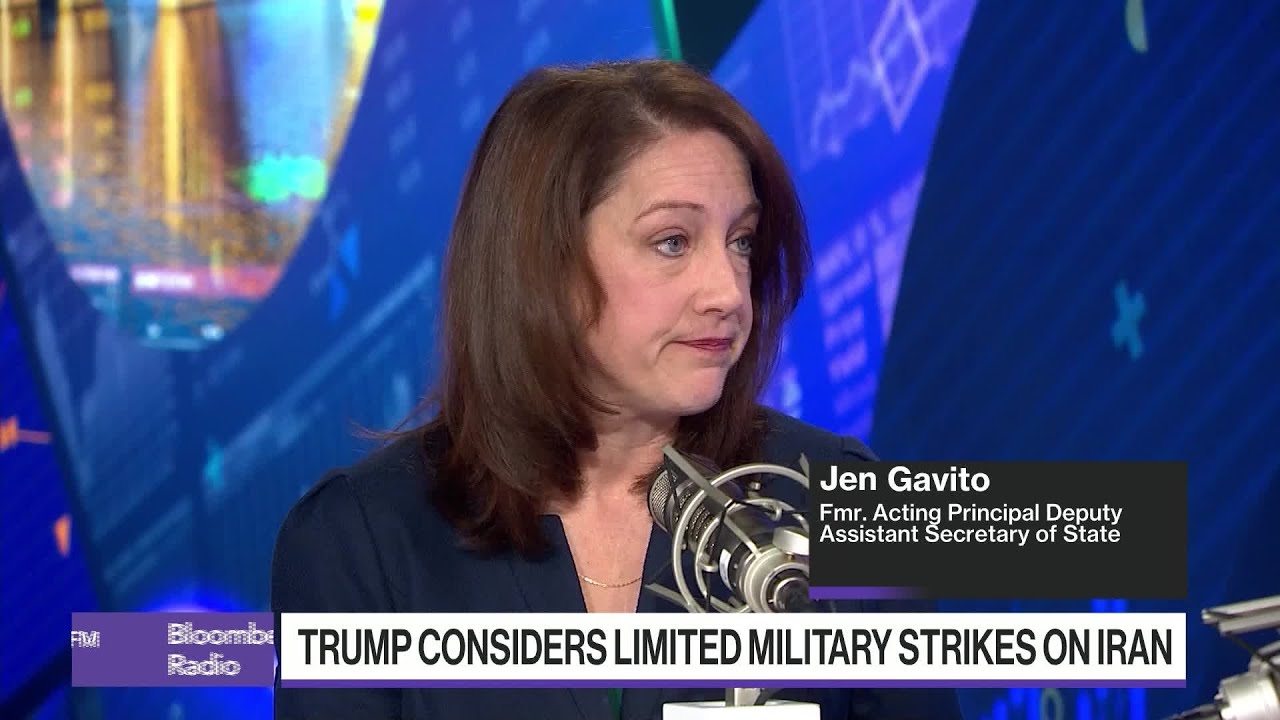
Jen Gavito, former acting principal deputy assistant secretary of state and senior advisor to The Cohen Group, said that she is 'deeply skeptical' of the logic that a limited strike would push Iran towards a nuclear deal at the negotiating table. Gavito said that the risk in a strike is that it could set off a 'cycle of escalation' if Iran retaliates.
The State Department ordered the evacuation of non-emergency personnel at the US embassy in Beirut on Monday, amid expectations that President Donald Trump could order airstrikes on Iran even with another round of diplomatic talks this week.
An assessment of the security environment in the region led the US government to reduce its footprint to only essential personnel, a senior State Department official said on condition of anonymity. The embassy remains operational and the measure is temporary, the official added, without mention of Iran.
The US military is assembling a vast array of forces in the Middle East — likely the largest US deployment in the region since the 2003 invasion of Iraq — including two aircraft carriers, fighter jets and refueling tankers. Trump said on Friday that he’s “considering” limited strikes on Iran and has said Tehran has around two weeks to strike a deal over its nuclear program.
US and Iranian diplomats have been attempting to negotiate a new nuclear deal in recent weeks after Trump pressured Iran into participating with threats of military action.
The president’s special envoy Steve Witkoff and son-in-law Jared Kushner plan to travel to Geneva this week for a new round of US-Iran talks on Thursday, a US official said. The US military is stationing a vast array of forces in the Middle East, including two aircraft carriers, fighter jets and refueling tankers, with President Donald Trump saying that Iran had 10 to 15 days at most to strike a deal over its nuclear program.
“We’re either going to get a deal, or it’s going to be unfortunate for them,” Trump told reporters Thursday aboard Air Force One. On a deadline, Trump said he thought 10 to 15 days was “pretty much” the “maximum” he would allow for negotiations to continue.
“I would think that would be enough time,” he said. The deployment is unlike anything the US has done since 2003, when it amassed forces before the invasion of Iraq. It dwarfs the military buildup that Trump ordered off the coast of Venezuela in the weeks before he ousted President Nicolas Maduro.
While the US isn’t likely to deploy ground troops, the buildup suggests Trump is giving himself discretion to launch a sustained campaign lasting many days, in cooperation with Israel. While discussions have focused on a sustained campaign far more sweeping than the overnight strikes the US launched against Iran’s nuclear program last June, the president is also weighing a limited early strike designed to drive Tehran to the negotiating table, the Wall Street Journal reported Thursday.
“Maybe we’re going to make a deal,” Trump said in a speech on Thursday morning. “You’re going to be finding out over the next probably 10 days.” Heightened geopolitical worries over US-Iran tensions sent stocks lower and extended a surge in oil, with Brent crude, the global benchmark, rising above $71 a barrel on Thursday.
The open question is whether Iran can possibly satisfy Trump’s demands and whether, by positioning so much military hardware to the region, Trump may feel compelled to use it rather than backing down.
Tracking site FlightRadar24’s data shows a surge of flight activity by US military transport, aerial tankers, surveillance aircraft and drones to bases in Qatar, Jordan, Crete and Spain.
The aircraft, whose transponders make them visible over land to the tracking site, include KC-46 and KC-135 air-to-air refuelers and C-130J cargo planes used to move troops and heavy equipment.
It also includes E-3 Sentry jets equipped with airborne warning and control system radar, which provide “all-altitude and all-weather surveillance” of potential battle zones, as well as RQ-4 Global Hawk surveillance drones.
--------
Watch Bloomberg Radio LIVE on YouTube
Weekdays 7am-6pm ET
Follow us on X
Subscribe to our Podcasts:
Bloomberg Daybreak
Bloomberg Surveillance
Bloomberg Intelligence
Balance of Power
Bloomberg Businessweek
Listen on Apple CarPlay and Android Auto with the Bloomberg Business app:
Apple CarPlay
Android Auto
Visit our YouTube channels:
Bloomberg Podcasts
Bloomberg Television
Bloomberg Originals
Sentinel Indexing in Progress
Metadata and chapters are available. Claim extraction for this episode is pending.
All video content is delivered via YouTube embedded players in accordance with the YouTube Terms of Service. Sentinel provides research tools that promote discovery and accountability across political media.