Bloomberg Podcasts
@bloombergpodcasts·503K subscribers·32.4K videos
Hegseth Says the US Has No Shortage of Munitions for Iran War (Full Press Conference)
Posted
March 5, 2026
Views
1,785
Likes
26
Comments
9
Engagement
March 5, 2026
1,785
26
9
1.96%
Every word spoken in this episode is indexed. Type any phrase to jump straight to the moment it was said.
Type any word or phrase that may have been spoken. Click a result to seek the player to that exact moment.
Try a name, a topic, or a quoted line
See what was published immediately before and after this episode.
 20:39Now Playing
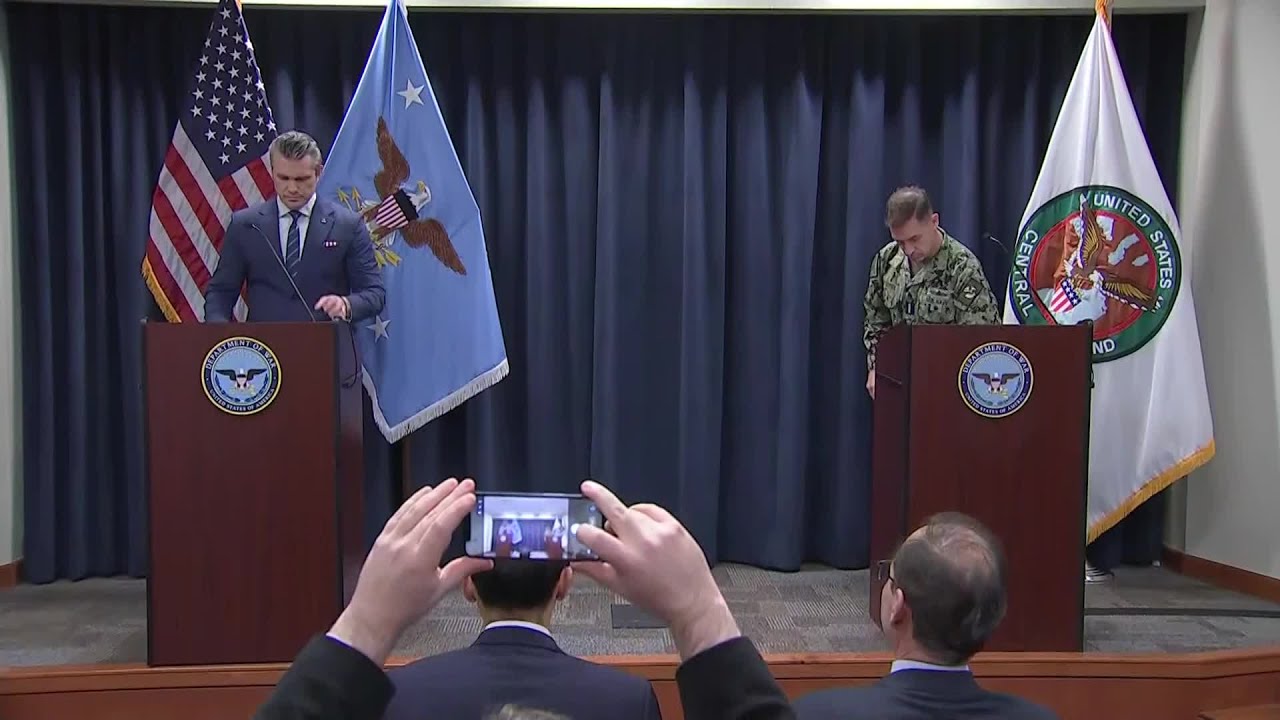
Defense Secretary Pete Hegseth said the US has “no shortage” of munitions to carry out its campaign in Iran, seeking to rebut concerns that the US military is burning through interceptors and other missiles at an unsustainable rate.
“Our stockpiles of defensive and offensive weapons allow us to sustain this campaign as long as we need to,” Hegseth told reporters at US Central Command in Tampa, Florida. “Our munitions status only increases as our advantage increases.”
“Iran is hoping we cannot sustain this,” Hegseth continued. “Our capabilities are overwhelming and gathering still, as are those of our Israeli partners. Our munitions are full up.”
The US submarine strike on an Iranian warship in the Indian Ocean marked a sharp escalation in the war between the two nations, raising fresh security and economic risks across the Indo-Pacific.
By striking the warship IRIS Dena about 40 nautical miles off Sri Lanka’s coast, Washington signaled no Iranian vessel is beyond reach. The move has drawn India and Sri Lanka closer to the fray. With Tehran vowing retaliation, the risk of naval clashes is rising along sea lanes vital to global commerce.
The sinking occurred far from Iran along a major shipping artery linking Asia, the Middle East and Europe. The presence of a US submarine conducting lethal operations near friendly nations such as India raises questions about how insulated Asia’s sea lanes are from external threats.
The incident “is likely to further unnerve Indo-Pacific nations, both friend and foe alike,” said Derek Grossman, a former US intelligence official who is now a professor of international relations at the University of Southern California. “Some will look elsewhere for their security needs, while others may hedge and hope for the best.”
Sri Lanka intervened with a second Iranian naval vessel in its waters and moved it to the northeastern port of Trincomalee, partly for safety reasons. And there are more vessels out there. Bloomberg maritime data show that over the past 30 days, ships linked to Iran have operated from Africa to Sri Lanka, Southeast Asia and China. Potential targets could include what the US calls a “shadow fleet” transporting Iranian oil. The State Department last month blocked 14 shadow fleet vessels and in November designated 17 entities, individuals and vessels linked to the arms and oil trade for sanctions.
The US rarely discloses submarine deployments for security reasons but maintains a formidable fleet. The Navy operates about 50 nuclear-powered attack submarines in three classes: Los Angeles, Virginia and Seawolf. Designed for stealth, they can tail enemy vessels undetected. It was not clear which submarine fired the torpedo.
Balancing Act
The conflict comes at a delicate moment for Asian governments balancing ties with their two most important partners, the US and China. Many remain unsettled by economic pressure from Washington since President Donald Trump’s return in 2025. The war has lifted energy prices and added inflationary strain to economies already hit by US trade measures.
US treaty allies including Japan, South Korea and the Philippines have sought trade deals to ease tariff pressure and now could see some American military assets in the region, which are there for their protection, being moved to the Middle East for the war.
--------
Watch Bloomberg Radio LIVE on YouTube
Weekdays 7am-6pm ET
Follow us on X
Subscribe to our Podcasts:
Bloomberg Daybreak
Bloomberg Surveillance
Bloomberg Intelligence
Balance of Power
Bloomberg Businessweek
Listen on Apple CarPlay and Android Auto with the Bloomberg Business app:
Apple CarPlay
Android Auto
Visit our YouTube channels:
Bloomberg Podcasts
Bloomberg Television
Bloomberg Originals
Sentinel Indexing in Progress
Metadata and chapters are available. Claim extraction for this episode is pending.
All video content is delivered via YouTube embedded players in accordance with the YouTube Terms of Service. Sentinel provides research tools that promote discovery and accountability across political media.