Bloomberg Podcasts
@bloombergpodcasts·503K subscribers·32.4K videos
Tech-Savvy Spies Step Out of the Shadows and Into the Boardroom
Posted
March 13, 2026
Views
1,153
Likes
22
Comments
4
Engagement
March 13, 2026
1,153
22
4
2.25%
Every word spoken in this episode is indexed. Type any phrase to jump straight to the moment it was said.
Type any word or phrase that may have been spoken. Click a result to seek the player to that exact moment.
Try a name, a topic, or a quoted line
See what was published immediately before and after this episode.
 8:23Now Playing
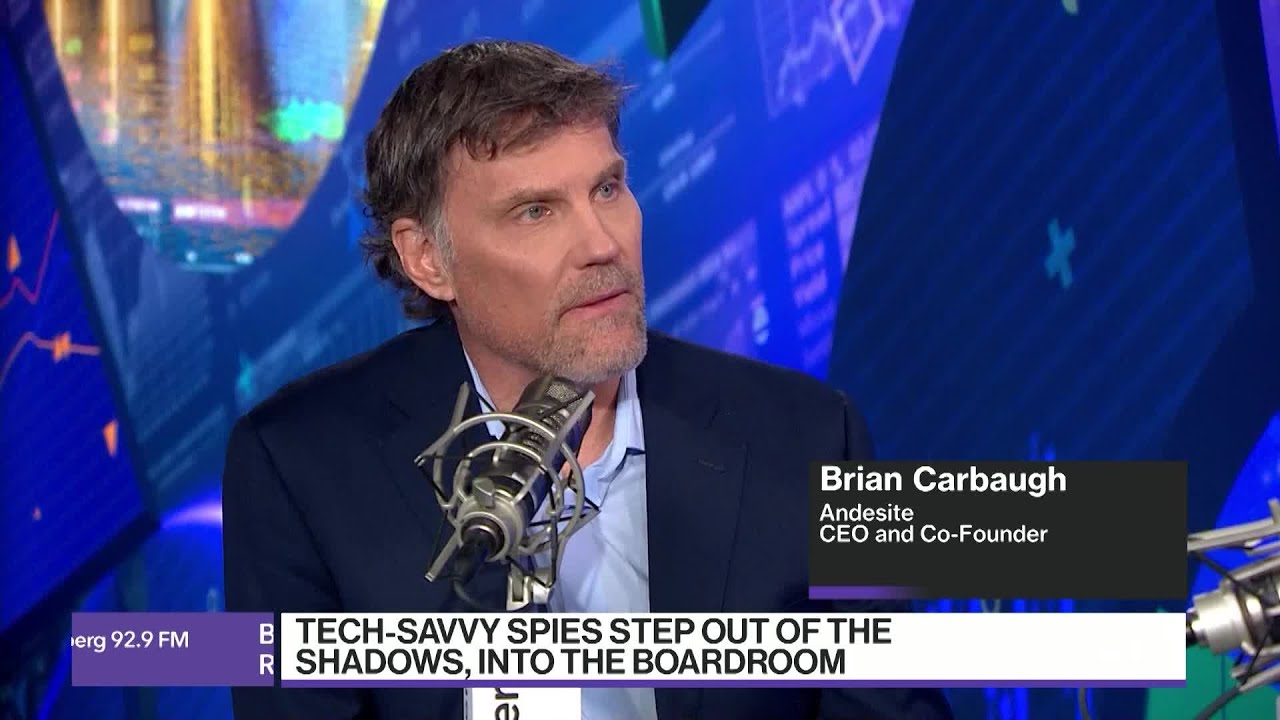
Brian Carbaugh spent years living and traveling abroad in a variety of alias personas as a CIA officer. Now he’s fronting investor meetings and raising capital as CEO of Andesite, a Virginia-based data analytics startup, one of several recently retired spies taking their field experience from the CIA to the C-suite.
It’s a fortuitous time for these founders. President Donald Trump is trying to swell the national defense budget to a staggering $1.5 trillion next year, a roughly 50% spending hike that would be a boon for artificial intelligence and other emerging technologies. The war with Iran only strengthens their footing as the sophistication of Iran’s cyber and electronic warfare capabilities reinforces the need for quickly deploying new tech.
Trump’s dissatisfaction with the cumbersome bureaucracies and slow delivery times at established defense companies opens the door to shift more of that funding to startups. And Carbaugh and other former spies, who used cutting-edge tech in the field, may be best positioned to capitalize on a market for security-focused tech firms that, according to Bloomberg Intelligence, is expected to reach $338 billion by 2033.
This ex-spy cohort includes former CIA counterterrorism officer Aaron Brown, who founded Lumbra, an emerging technology firm focused on developing advanced artificial intelligence architecture, as well as Ryan Joyce, an Arabic-speaking former CIA operations officer who founded GenLogs Corp., which tracks trucks for supply chain security. They’ve all come to market in the past year or so.Former CIA officer Brian Carbaugh, co-founder of the data analytics startup Andesite joined to discuss on Balance of Power. These officers-turned-founders are calculated risk takers and problem solvers, with “exquisite domain experience,” said Juliane Gallina, who until last December was the deputy director of the CIA’s digital innovation directorate.
“They’re really well equipped to go into industry and really wrestle very challenging technology problems to the ground,” added Gallina, who is now with Lavrock Ventures, an Arlington-headquartered venture capital firm. Creating Tech They Wished the CIA Had
For these founders, those problems were directly related to their experiences during operations while at the agency.
Carbaugh was on the ground in Afghanistan in October 2001, weeks after the 9/11 attacks and ahead of the official US-led invasion of the country.
“We were chasing disconnected leads to al-Qaeda, the intelligence would lead us in different directions all over Afghanistan, from village to village, from province to province,” he recalled in his first public comments regarding his role in the CIA’s Jawbreaker team hunting al-Qaeda and Taliban leaders. The information would come in fragments and “often without context from a variety of sources, the technology wasn’t fast enough or coalesced in a way that combined these threads into more meaningful actionable information,” he said.
Andesite’s platform, he says, “uses AI to race at machine speed to sift each haystack for needles, when it finds them, it immediately surfaces them in the form of insight, truth and context, to the analyst.”
Brown, meanwhile, faced similar challenges while serving as deputy branch chief running counter terrorism operations in the CIA’s Pakistan-Afghanistan department and working on the years-long hunt for al-Qaeda leader Osama bin Laden.
“During my career, I was regularly confronted with massive volumes of data, and I knew with certainty that buried within it were clues to terrorist networks, emerging leaders, and active plots,” Brown said. “We always knew we were missing something.” He says he never planned to become Lumbra’s CEO but it quickly became clear to him that he needed to do more than make the technology his sole focus.
“I had to be the one drawing the map, setting the strategy, and growing the culture to bring it all into existence,” he said.
CIA Skills That Work in the Boardroom That’s not to say there haven’t been cultural differences.
--------
Watch Bloomberg Radio LIVE on YouTube
Weekdays 7am-6pm ET
Follow us on X
Subscribe to our Podcasts:
Bloomberg Daybreak
Bloomberg Surveillance
Bloomberg Intelligence
Balance of Power
Bloomberg Businessweek
Listen on Apple CarPlay and Android Auto with the Bloomberg Business app:
Apple CarPlay
Android Auto
Visit our YouTube channels:
Bloomberg Podcasts
Bloomberg Television
Bloomberg Originals
Sentinel Indexing in Progress
Metadata and chapters are available. Claim extraction for this episode is pending.
All video content is delivered via YouTube embedded players in accordance with the YouTube Terms of Service. Sentinel provides research tools that promote discovery and accountability across political media.