Casual Historian
@casualhistorian·151K subscribers·268 videos
What are differences between a Presidential Republics and Parliamentary Democracy | Casual Historian
Posted
March 31, 2015
Views
120,743
Likes
1,462
Comments
102
Engagement
March 31, 2015
120,743
1,462
102
1.30%
Every word spoken in this episode is indexed. Type any phrase to jump straight to the moment it was said.
Type any word or phrase that may have been spoken. Click a result to seek the player to that exact moment.
Try a name, a topic, or a quoted line
 3:37Now Playing
I explain the differences between Presidential Republics and Parliamentary Democracies.
Governments, if you live anywhere in this vicinity you are most likely living under one.
Sorry Anarchists
There are many different principles for government to be based on;
military force,
Divine right,
the distribution of magical swords;
but it looks like democracy is our choice, until our reptillian illuminati overlords choose to usher in the new world order.
And though there are as many variations on democracy as there are countries who practice it,
they tend to fall under one of two systems.
In red we have Presidential Republics which pretty much dominate former colonies in the Americas and Sub-saharan Africa,
and in Blue we have Parliamentary Democracies, mostly in Western Europe and everywhere the British brought their sheep and oh so tasty cuisine.
We also have these monstrocities known as "Semi-Presidential" systems, popular in places like France and Russia, which we will look at some other time.
Both Presidential and Parliamentary Systems have multi-branch governments containing
a legislative branch that makes the laws, an executive branch that enforces them, and a judiciary that interprets it.
In a Presidential System the lines that separate these branches are solid and well defined,
while in a Parliamentary System they tend to be a bit blurred.
So who receives a disproportionate amount of attention in these systems? The executive.
Who is the executive?
In Presidential systems it is as the name suggests, the President.
In a Parliamentary system there are two, a Prime Minister,and if the country is a monarchy than this other executive position is filled by a King or Queen,
or in the case of Commonwealth nations, a Governor-General.
However if this country does not have a monarch, than the other executive position is usually a president,
A President in a Parliamentary system and one in a Presidential system are very different.
In a Presidential system a President holds most of the powers, while in Parliamentary systems a President is mostly a ceremonial role,
however they often posses reserve powers in case the Prime Minister really screws up.
In a Parliamentary System it is the Prime Minister who holds executive power.
In this system the PM is thought of as the "Head of Government" while the President or other executive is thought of as "Head of State".
How are these offices selected?
If it were up to me it would be trial by combat, But instead we are stuck with the barbarity that is the democratic process.
A Prime Minister is usually selected by a majority coalition in Parliament,
and although they are not required to be a member of Parliament at the time of their selection they are expected to seek a seat in Parliament at their earliest convenience.
They can also be removed from their position by a vote of no-confidence if they don't have the support of Parliament.
A president on the other hand is usually elected outside of a national legislature,
and can only be removed from office through an impeachment process,
which is much more involved than a vote of no confidence
because you are not just demoting them back the legislature, but putting them on trial.
Executives are not all knowing and so they have people who help them in decision making and administrative tasks.
In the western world we call these groups of advisors cabinets.
No, not those cabinets, these cabinets. So how are cabinets selected you ask?
In a Presidential system the President is allowed to choose any citizen they want to be in the cabinet.
However their choice must be approved by the legislature,
so it is probably best for him or her to pick people with experience in the position they are being picked for.
Similarly in a Parliamentary system the Prime Minister can pick any citizen to be cabinet minister, though just like the Prime Minister, they are expected to seek a seat in Parliament at the earliest convenience.
Are we done yet? Not quite.
The last major difference has to do with elections.
In a Presidential system elections have a set date that can be projected infinitely into the future,
assuming no major changes in law or a collapse of civilization.
In a Parliamentary system elections can be a bit more sporadic,
being held at the whim of the Prime Minister,
with consultation from the monarch or other executive.
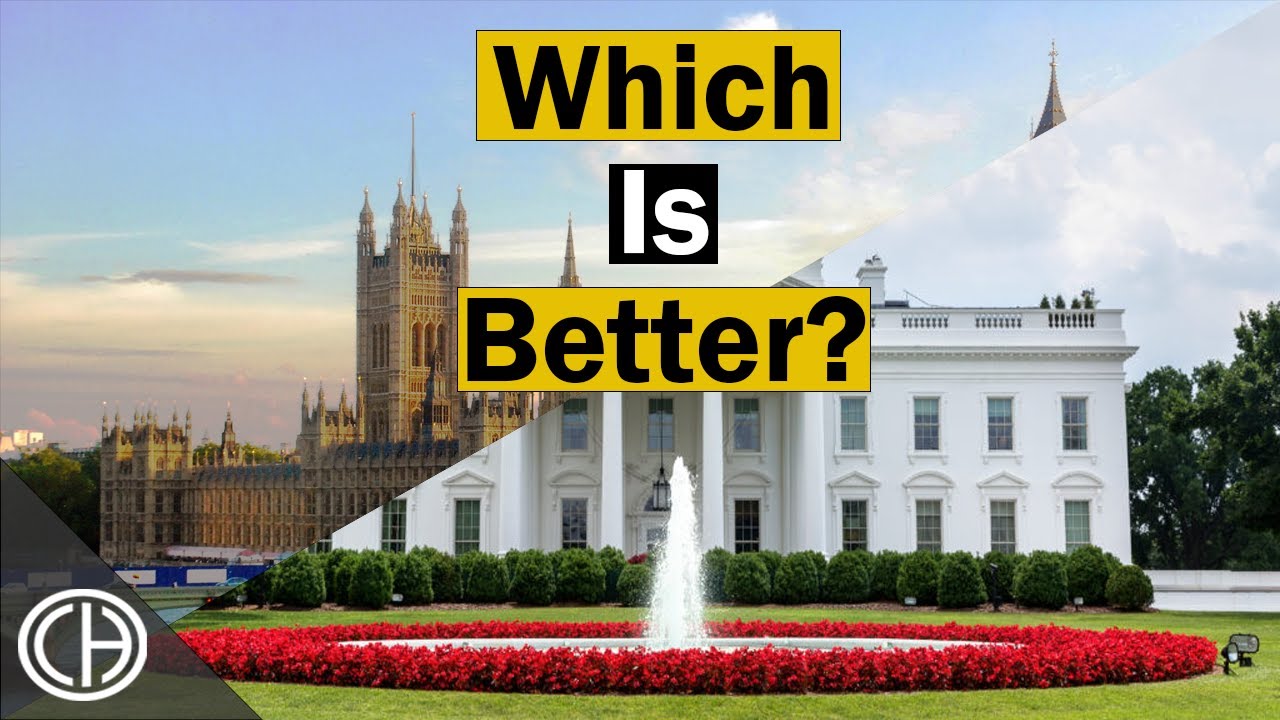
So which one is better? We'll answer that next time.
Sentinel Indexing in Progress
Metadata and chapters are available. Claim extraction for this episode is pending.
All video content is delivered via YouTube embedded players in accordance with the YouTube Terms of Service. Sentinel provides research tools that promote discovery and accountability across political media.