
Cnbc
@cnbc·4.2M subscribers·16.1K videos
$440,000 Flying Jet Suit – Secret Lives Of The Super Rich
Posted
October 23, 2018
Views
2,135
Likes
34
Comments
1
Engagement
1.64%
October 23, 2018
2,135
34
1
1.64%
Every word spoken in this episode is indexed. Type any phrase to jump straight to the moment it was said.
Type any word or phrase that may have been spoken. Click a result to seek the player to that exact moment.
Try a name, a topic, or a quoted line
See what was published immediately before and after this episode.
 2:27Now Playing
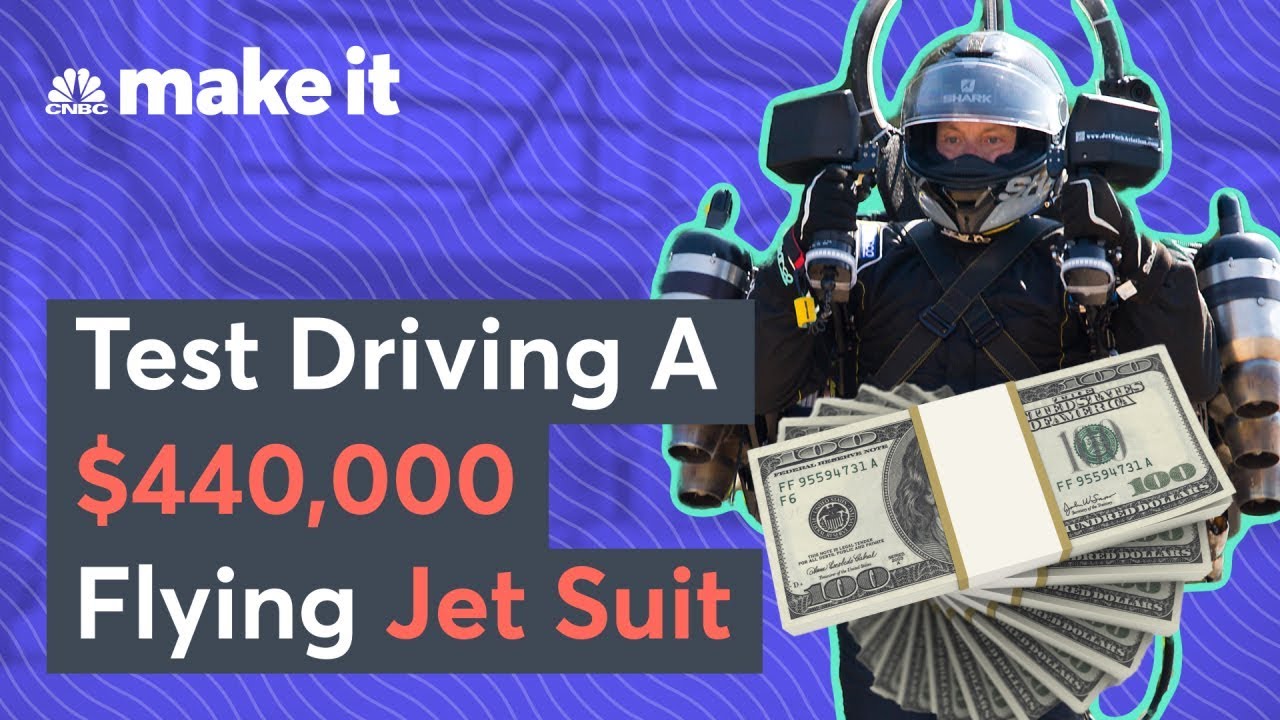
CNBC's senior executive producer Ray Parisi test flies Gravity Industries' $440,000 jet suit.
» Subscribe to CNBC Make It.
I'm a huge fan of Iron Man, so when the real-life opportunity to suit up like Tony Stark presented itself, I didn't hesitate to book a flight from JFK airport to Heathrow to test-drive a flying jet suit.
The invitation to fly like a superhero came via Richard Browning, CEO of Gravity Industries and the inventor of the Gravity Jet Suit. If you haven't seen the viral videos of Browning flying through the sky in his insane invention (I had), then let me give you a little bit of background.
Browning is a former British Royal Marine and oil trader who set out on a mission in early 2016 to make human flight a reality. By October that year, he had a suit that could fly. He's constantly enhancing his invention, and today the suit is propelled by two mini jet engines strapped to each forearm and a slightly larger jet attached on your back.
Total propulsion: 1,050 horsepower. "That's more than a Bugatti Veyron. Nearly one and a half Indy cars. It's phenomenal," says Browning.
When you see Browning effortlessly zoom across the sky like a comic book hero, you'll understand why I was so excited to "work" on this assignment. The suit sells for $440,000, so unless I hit the lottery, this is my one and only chance to fly like Iron Man.
Browning asked me to meet him two-and-a-half hours northeast of London at a former U.S. Air Force airfield deep in the English countryside. When I pull up to the security gates, the Gravity team directs me by phone down an old runway toward a 1970s R.A.F. T4 jet, parked in front of a giant aircraft hangar.
The corrugated steel doors emblazoned with the letters "gravity" suddenly begin to slide open revealing Browning's fog-filled test-flight facility. When the haze dissipates, a steel platform comes into focus. Behind it is a red crane with a 30-foot arm that extends to the rafters. On one side of the platform sits two massive decommissioned jet engines, on the other, three of Browning's suits, which have a total retail value about $1.32 million.
When I meet Browning, his excitement for his invention is palpable, "The vision, was really to go and tackle a challenge that was largely considered to be impossible: the idea that human beings could fly. Having gone and achieved it, it's opened the door into a whole new realm of human capability, really, human possibility," Browning tells me. His achievement: the first wearable jet-suit technology.
He also has dozens of jet suit stories to share, like the time he impressed Tom Cruise by landing a few feet away from the movie star on the set of a European TV show.
The CEO is on a mission to get the word out about his invention, which is why he's suiting up a few lucky journalists this week and I'm first on the list.
Browning sits me down on an old military crate where his team suits me up. Two men carry over the Gravity Jet Suit. It's made up of a black 3D-printed aluminum shoulder harness with lots of straps, tubes and electronics all rigged to five jet engines.
The first part of the suit is hoisted over my shoulders placing the largest of the five jets squarely at the center of my back. It feels like a bulky knapsack with a scuba diving oxygen tank attached.
When they explain the plastic tubes running from the engine go to the fuel reservoir now pressed firmly against my back, my excitement turns to anxiety. Browning assures me that the 5-gallon reservoir filled with jet fuel, is way less combustible than gasoline.
"It's probably safer than, riding a motorbike around on public roads," Browning says.
Now protective sleeves are being pulled over each of my forearms so that a pair of jets, each a little bigger than a Nutribullet blender, can be strapped on. The team tightens the straps around my chest, shoulders and groin, locking it all in place with half a dozen buckles. The suit is so tight around my chest and crotch that I'm starting to feel claustrophobic.
While I've never had an anxiety attack before, this sure feels like the beginning of one. I silently consider backing out of the test drive but talk myself into staying the course.
Just as I think the suit couldn't get any tighter they tug, pull and tighten it some more. The final buckles are fastened and I'm essentially fused to the suit.
About CNBC Make It.: CNBC Make It. is a new section of CNBC dedicated to making you smarter about managing your business, career, and money.
Connect with CNBC Make It. Online
Get the latest updates
Find CNBC Make It. on Facebook
Find CNBC Make It. on Twitter
Find CNBC Make It. on Instagram
Find CNBC Make It. on LinkedIn
#CNBC
#CNBCMakeIt
I got to test drive a $440,000 flying jet suit — it was terrifying and totally addictive | CNBC Make It.
Sentinel Indexing in Progress
Metadata and chapters are available. Claim extraction for this episode is pending.
All video content is delivered via YouTube embedded players in accordance with the YouTube Terms of Service. Sentinel provides research tools that promote discovery and accountability across political media.