Faithful Politics Podcast
@faithfulpolitics·6.2K subscribers·1.9K videos
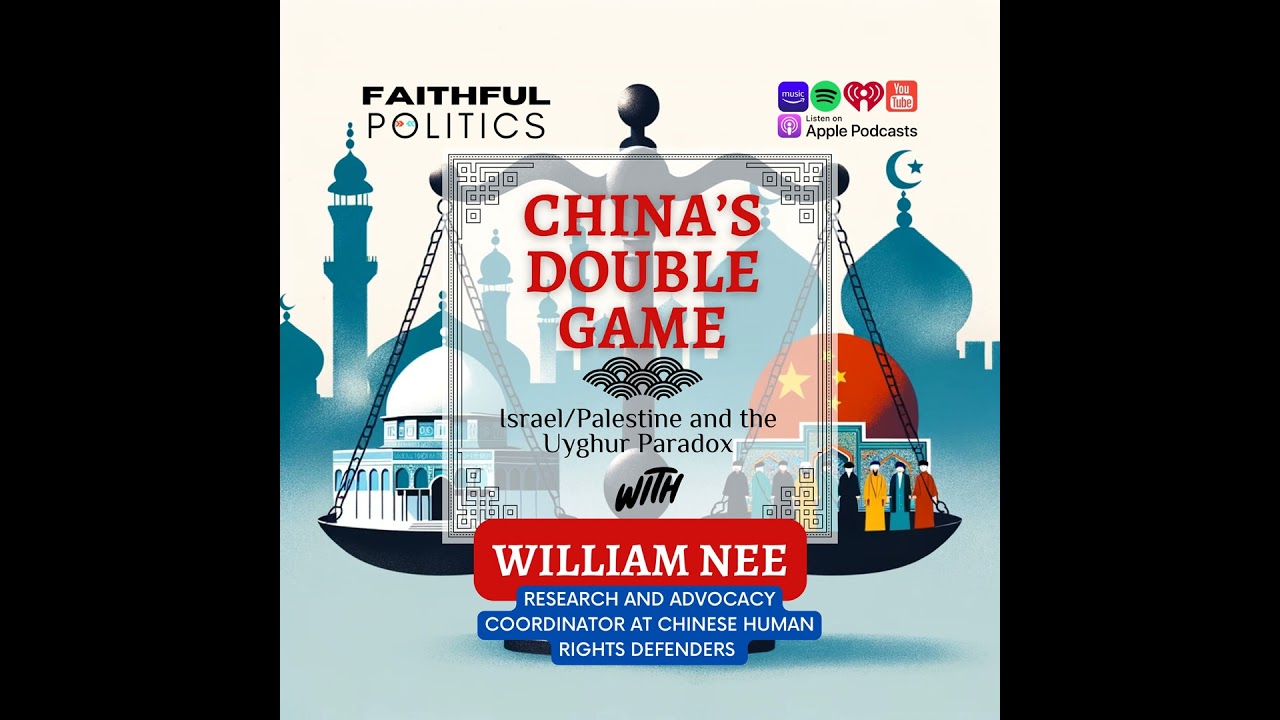
"China's Double Game: Israel/Palestine and the Uyghur Paradox" w/William Nee
Posted
November 17, 2023
Views
97
Comments
1
Engagement
1.03%
November 17, 2023
97
1
1.03%
Every word spoken in this episode is indexed. Type any phrase to jump straight to the moment it was said.
Type any word or phrase that may have been spoken. Click a result to seek the player to that exact moment.
Try a name, a topic, or a quoted line
 1:03:32Now Playing
Have a comment? Send us a text! (We read all of them but can't reply). Email usWill@faithfulpoliticspodcast.com ()
In today's episode, we're diving headfirst into the geopolitical labyrinth of China's role in the Israel/Palestine conflict with William Nee, the research and advocacy coordinator for the Network of Chinese Human Rights Defenders. As China positions itself as a neutral peacemaker while aligning with Palestine and Arab States, we explore the implications of this stance. We'll dissect China's media narratives that blame the U.S. for hostilities in the Middle East and contrast this with China's own human rights record, particularly concerning the Uyghurs in Xinjiang.
In our second segment, we'll delve deeper into China's global ambitions. We'll discuss their new global initiatives like the GSI, GDI, GCI, and BRI, and what these mean for the international order. We'll also touch on the psychological mechanisms that make people susceptible to narratives that may not align with reality. How does public sentiment develop, and how do governments and media play into this? We'll explore these questions and more, providing you with a nuanced understanding of the situation.
China Resources Mentioned by William Nee
• Great podcast on Chinese issues, Sinica
• The best Chinafocused newsletter, Sinocism (requires subscription)()
• The China-Global South Project's X feed: @ChinaGSProject
• The Network of Chinese Human Rights Defenders X feed: @CHRDnet
Uyghur region:
• Human Rights Watch report“Break Their Lineage, Break Their Roots”China’s Crimes against Humanity Targeting Uyghurs and Other Turkic Muslims, ()
William Nee recent op-ed:
• A UN Body Sheds Light on the Fate of Disappeared UyghursThe Working Group on Arbitrary Detention has provided more evidence of China’s use of enforced disappearances in Xinjiang. ()
• OHCHR Assessment of human rights concerns in the Xinjiang Uyghur Autonomous Region, People’s Republic of China ()
Guest Bio:
William Nee is the Research and Advocacy Coordinator at Chinese Human Rights Defenders (CHRD), where he carries out research regarding a wide array of human rights concerns impacting human rights defenders in China. Previously, Nee worked as a Business and Human Rights Analyst and China Researcher at Amnesty International, where he researched human rights abuses caused by multinational companies and focused on freedom of expression, censorship, criminal justice developments, and the death penalty in China. Before that, he was Development Director at China Labour Bulletin. Nee’s commentary has appeared in The Diplomat, Hong Kong Free Press, and Open Democracy.
Support Sarah Stankorb’s work and preorder Damned If She DoesWhy Women Quit Church and What It Means for the Future of Religion, Releases September 15, 2026. Bookshop.org
Support the show ()
Keep the conversation going.
Want to learn more about Faithful Politics, suggest a future guest, or connect with us directly?
Visit our website:
faithfulpoliticspodcast.com
Browse our bookstore, featuring books from many of our guests:
faithfulpoliticspodcast.com/bookstore
Support the show and help us keep these conversations going:
patreon.com/cw/FaithfulPolitics
Subscribe for behind-the-scenes content, reflections, and updates:
faithfulpolitics.substack.com
Contact the hosts:
Josh Burtram, Faithful Host: Josh@faithfulpolitics.com
Will Wright, Political Host: Will@faithfulpolitics.com
Follow Faithful Politics:
Instagram: faithful_politics
Facebook: FaithfulPoliticsPodcast
Sentinel Indexing in Progress
Metadata and chapters are available. Claim extraction for this episode is pending.
All video content is delivered via YouTube embedded players in accordance with the YouTube Terms of Service. Sentinel provides research tools that promote discovery and accountability across political media.