Faithful Politics Podcast
@faithfulpolitics·6.2K subscribers·1.9K videos
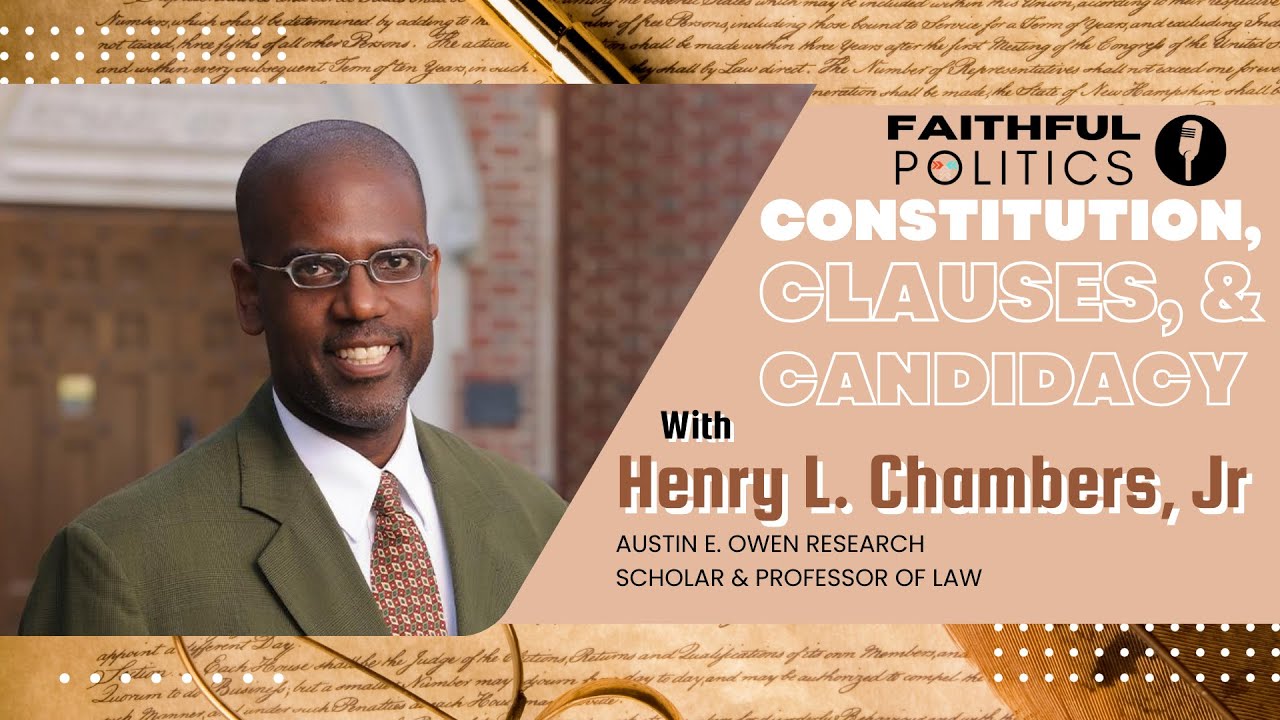
The Constitution, Clauses and Candidacy: A Deep Dive into the 14th Amendment w/Prof. Henry Chambers
Posted
January 6, 2024
Views
11
Comments
1
Engagement
9.09%
January 6, 2024
11
1
9.09%
Every word spoken in this episode is indexed. Type any phrase to jump straight to the moment it was said.
Type any word or phrase that may have been spoken. Click a result to seek the player to that exact moment.
Try a name, a topic, or a quoted line
 1:12:48Now Playing
Have a comment? Send us a text! (We read all of them but can't reply). Email usWill@faithfulpoliticspodcast.com ()
Join us as we delve into the crucial debate surrounding the exclusion of Donald Trump from the Colorado and Maine ballots, a pivotal issue in the political and legal spheres with Austin E. Owen Research Scholar & Professor of Law, Henry L. Chambers, JR. Our insightful discussion centers on the implications of the 14th Amendment, specifically Section 3, which disqualifies individuals involved in insurrection from holding office. We dissect the self-executing aspect of the 14th Amendment and analyze the diverse interpretations by states like Colorado and Maine.
Crucially, we examine the Supreme Court's role in determining Trump's eligibility, emphasizing the significance of their impending decision. Our conversation also ventures into the possibility of a write-in campaign and its extensive political ramifications.
Throughout the episode, we navigate through various dimensions of the upcoming election, focusing on bipartisan perspectives on disqualifying Trump, the urgent need for highly qualified presidential candidates, and the intense nature of presidential elections. We address the concerning lack of national discourse on multiple qualified candidates, the internal divisions plaguing the Republican Party, and the overall scarcity of meaningful dialogues and common ground in today's political landscape.
Furthermore, we discuss the anxieties surrounding the upcoming election, the ongoing court cases and state legislation pertinent to Trump's disqualification, the necessity for a national discussion on the January 6th insurrection, and the interpretation of the Constitution in the context of the Reconstruction Amendments. It was a very in-depth conversation with a wonderful mind helping us make sense of it all!
Read the publication Professor Chambers mentioned in the show
Guest Bio:
Professor Henry L. Chambers, Jr., teaches and writes in the areas of constitutional law, criminal law, law and religion, and employment discrimination. He is active in the Virginia State Bar, including serving as chair of its Section on the Education of Lawyers from 2007-2009, and has been a member of the American Law Institute since 2002. Professor Chambers served as Special Assistant Attorney General for redistricting matters for the Commonwealth of Virginia from 2011-2013. He also frequently lectures on constitutional law through the We The People program, which provides civic education instruction to school teachers and the public; at James Madison’s Montpelier; and at the Federal Executive Institute in Charlottesville.
Support Sarah Stankorb’s work and preorder Damned If She DoesWhy Women Quit Church and What It Means for the Future of Religion, Releases September 15, 2026. Bookshop.org
Support the show ()
Keep the conversation going.
Want to learn more about Faithful Politics, suggest a future guest, or connect with us directly?
Visit our website:
faithfulpoliticspodcast.com
Browse our bookstore, featuring books from many of our guests:
faithfulpoliticspodcast.com/bookstore
Support the show and help us keep these conversations going:
patreon.com/cw/FaithfulPolitics
Subscribe for behind-the-scenes content, reflections, and updates:
faithfulpolitics.substack.com
Contact the hosts:
Josh Burtram, Faithful Host: Josh@faithfulpolitics.com
Will Wright, Political Host: Will@faithfulpolitics.com
Follow Faithful Politics:
Instagram: faithful_politics
Facebook: FaithfulPoliticsPodcast
Sentinel Indexing in Progress
Metadata and chapters are available. Claim extraction for this episode is pending.
All video content is delivered via YouTube embedded players in accordance with the YouTube Terms of Service. Sentinel provides research tools that promote discovery and accountability across political media.