
From Flow to Mystical Experience
May 14, 2026
2,459
90
23
4.60%
Search the Record
IndexedEvery word spoken in this episode is indexed. Type any phrase to jump straight to the moment it was said.
Type any word or phrase that may have been spoken. Click a result to seek the player to that exact moment.
Try a name, a topic, or a quoted line
John Vervaekes Lectern Episodes Around May 14, 2026
See what was published immediately before and after this episode.



 1:26:46Now Playing
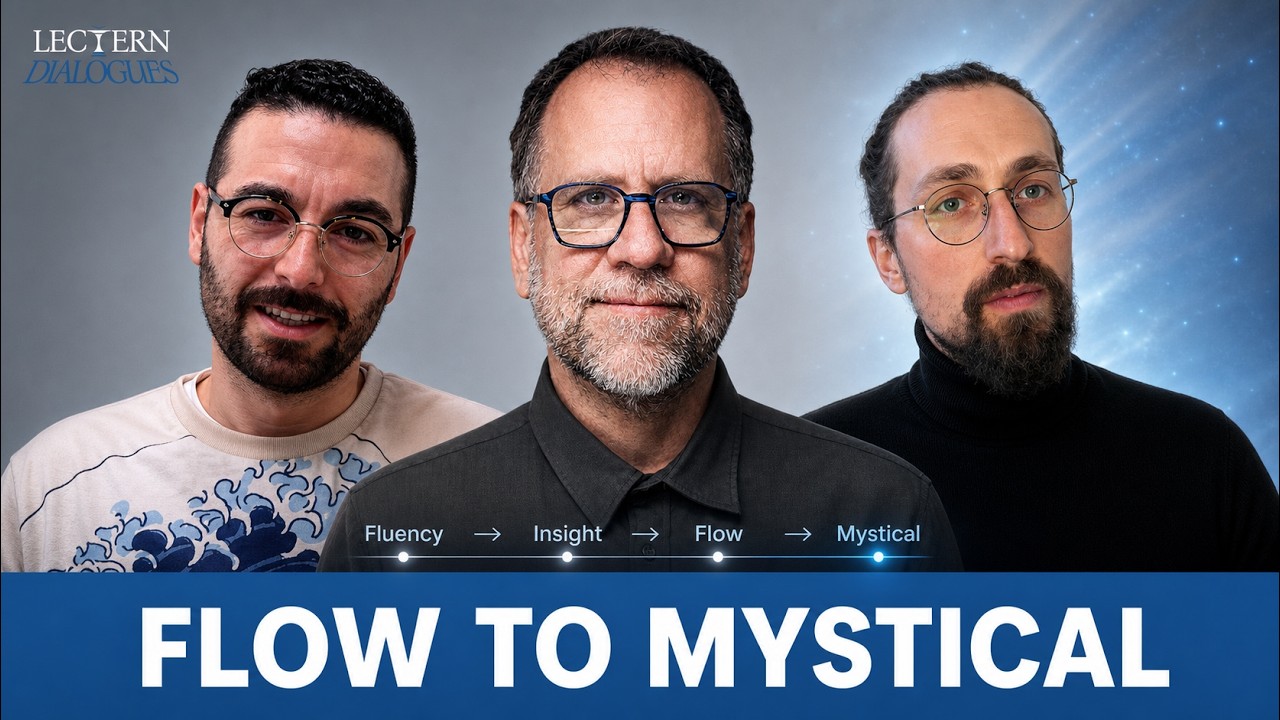
From Flow to Mystical Experience


Chapters
YouTube Description
as posted by the channelWhat if flow, insight, and mystical experience are different scales of the same underlying process?
In this standalone Lectern episode, John Vervaeke speaks with Hüseyin and Daniel about their recently published paper on the cognitive continuum: a framework that moves from fluency to insight, flow, mystical experience, and transformation. The discussion develops Vervaeke's earlier work on relevance realization by bringing it into dialogue with the enactive approach, complex dynamic systems theory, and contemporary psychedelic research.
The episode begins with the enactive critique of a simple subject-object split. Daniel explains why both self and world are groundless in the enactive sense: not nonexistent, but not pregiven independent substances either. Self and world arise relationally through embodied sensemaking. This matters because mystical experiences often involve a loosening or collapse of the ordinary self-world boundary.
Husein then walks through the paper's core argument. Fluency is reframed as a local form of attunement, not merely ease of information processing. Insight becomes a more global reorganization of the system. Flow becomes an insight cascade: a temporally extended state of metastable attunement. Mystical experience becomes the most global state on the continuum, where the deepest structures of self-world organization can be destabilized and reorganized.
The conversation also makes a strong ethical point. Experiences that loosen ordinary constraints are not automatically good. Psychedelic states, mystical experiences, contemplative practices, and mindfulness can create epistemic vulnerability. Depending on context, they can become transformative, but they can also lead to derealization, depersonalization, false insight, spiritual bypassing, narcissism, or psychosis. Integration, practices, ethical frameworks, communities, and traditions matter because transformation is not produced by the state alone.
Timestamps
Resources
Hüseyin Beyköylü, John Vervaeke, and Daniel Meling, "From Flow to Mystical ExperiencesConnecting Entropy and Fluency Along the Unifying Framework of Cognitive Continuum"
John Vervaeke, Awakening from the Meaning Crisis
John Vervaeke, Seeing God Again for the First Time
Entropic Brain Hypothesis
REBUS model
ALBUS model
Hans Jonas, The Phenomenon of Life
Stephen Batchelor, Alone with Others
William Desmond
Willoughby Britton's work on meditation-related adverse effects
Frank, Gleiser, and Thompson, The Blind Spot
Alfred North Whitehead
Follow John Vervaeke:
Guests & Subjects Covered
Sentinel Indexing in Progress
Metadata and chapters are available. Claim extraction for this episode is pending.
All video content is delivered via YouTube embedded players in accordance with the YouTube Terms of Service. Sentinel provides research tools that promote discovery and accountability across political media.