Manolis Kellis
@manoliskellis1·24.9K subscribers·255 videos
MIT Deep Learning Genomics - Lecture 3 - Convolutional Neural Networks CNNs (Spring 2020)
Posted
February 11, 2020
Views
8,494
Likes
110
Comments
4
Engagement
February 11, 2020
8,494
110
4
1.34%
Every word spoken in this episode is indexed. Type any phrase to jump straight to the moment it was said.
Type any word or phrase that may have been spoken. Click a result to seek the player to that exact moment.
Try a name, a topic, or a quoted line
See what was published immediately before and after this episode.
 1:20:49Now Playing
MIT 6.874 Lecture 3. Spring 2020
Course website
Lecture slides
Slides credit: 6.S191 (Alexander Amini, Ava Soleimany), Dana Erlich, ParamVirSingh, David Gifford, Manolis Kellis
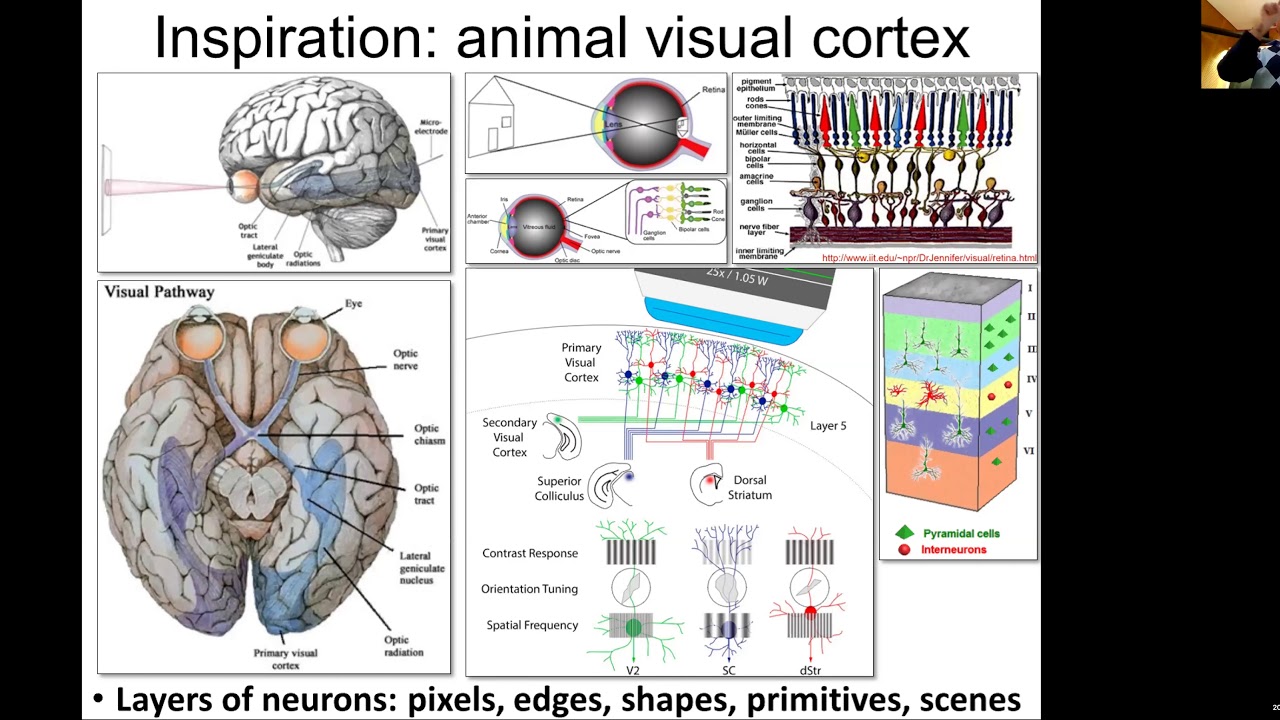
1. Scene understanding and object recognition for machines (and humans)
– Scene/object recognition challenge. Illusions reveal primitives, conflicting info
– Human neurons/circuits. Visual cortex layers==abstraction. General cognition
2. Classical machine vision foundations: features, scenes, filters, convolution
– Spatial structure primitives: edge detectors & other filters, feature recognition
– Convolution: basics, padding, stride, object recognition, architectures
3. CNN foundations: LeNet, de novo feature learning, parameter sharing
– Key ideas: learn features, hierarchy, re-use parameters, back-prop filter learning
– CNN formalization: representations(Conv+ReLU+Pool)*N layers + Fully-connected
4. Modern CNN architectures: millions of parameters, dozens of layers
– Feature invariance is hard: apply perturbations, learn for each variation
– ImageNet progression of best performers
– AlexNet: First top performer CNN, 60M parameters (from 60k in LeNet-5), ReLU
– VGGNet: simpler but deeper (8 to 19 layers), 140M parameters, ensembles
– GoogleNet: new primitive=inception module, 5M params, no FC, efficiency
– ResNet: 152 layers, vanishing gradients: fit residuals to enable learning
5. Countless applications: General architecture, enormous power
– Semantic segmentation, facial detection/recognition, self-driving, image colorization, optimizing pictures/scenes, up-scaling, medicine, biology, genomicse
Sentinel Indexing in Progress
Metadata and chapters are available. Claim extraction for this episode is pending.
All video content is delivered via YouTube embedded players in accordance with the YouTube Terms of Service. Sentinel provides research tools that promote discovery and accountability across political media.