Military1945
@m1945·37K subscribers·441 videos
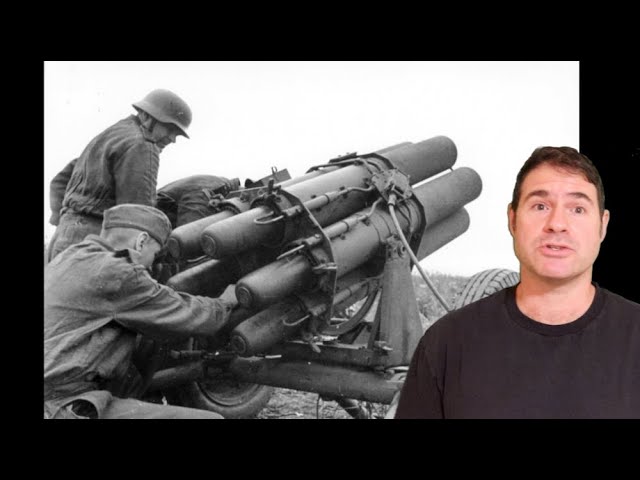
29th Infantry Division (mot.) Part 2 - Falke-Division - 88 Flak 36 Training - Guderian - Lemelsen
Posted
October 27, 2020
Views
6,395
Likes
411
Comments
75
Engagement
October 27, 2020
6,395
411
75
7.60%
Every word spoken in this episode is indexed. Type any phrase to jump straight to the moment it was said.
Type any word or phrase that may have been spoken. Click a result to seek the player to that exact moment.
Try a name, a topic, or a quoted line
 9:23Now Playing
SUPPORT THE CHANNEL
www.Patreon.com/Military1945
Oh, yeah, 88s being used in direct fire. That’s fantastic footage. This is part five of a comprehensive historical chronicle that I’m releasing about Operation Barbarossa, the German invasion of Soviet Russia. This is the second video following the 29th motorized ID in the opening weeks of battle. We’ll see Luftwaffe 88 flak crews, we’ll visit the aftermath of the divisions first engagement and get a first-person look at what soldiers experience after such a battle. I’ll introduce the 88 flak 36 and its specifications and then finally show a training film showing the teaching of tactics used for anti-aircraft weapons in direct fire operations.
These are members of Luftwaffe gun crews. You can tell by the swastika carrying eagles patches on their uniforms. Their black uniforms can easily be mistaken for tank crew or Waffen-SS uniforms.
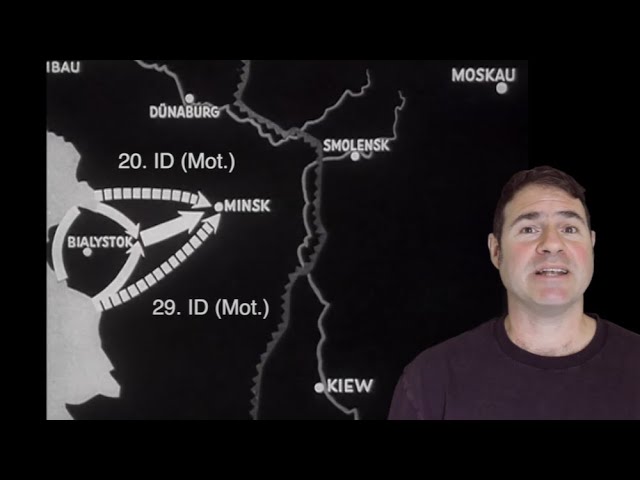
This footage of the Falke Division was taken during the massive battles of encirclement around Minsk from 22.6 - 5.7.1941. It was taken directly after combat for a town had ceased.
By the look of the battlefield, the Soviet’s put up a considerable amount of resistance. It’s likely that the burning buildings were lit by the Germans intentionally as punishment for the resistance, however it’s also possible that the fires were caused by the battle.
Watching soldiers involved in non-combat related activity is interesting. With this type of footage, seeing them cook, clean, self groom etc we can get a more wholistic understanding of what a soldier’s life was like. In this scene soldiers being paid their wage. Each soldier in the German Wehrmacht had a “Soldbuch” which was used to prove identification, rank, unit, equipment allocation and right to leave and field rations.
Here we see a group of captured Russians huddled around a field kitchen. Although chaotic, it seems that there’s enough food to go around. It’s an interesting contrast to scenes from the footage we looked at of the 20. ID. If you haven’t seen those yet there’s a link at the end of this video.
This footage of typical Russian peasants is great. Obviously they’re unsure of the German military that is everywhere however their appearance is clean and their well dressed. They don’t look intimidated. Also worthy of note is that in the family a military-age man is present. It was common practice for men and even adolescent youths to be separated from their families and treated as captured soldiers.
As its name implies the flak 88 had an 88 mm canon (3.46 in). To the allies it was called an eighty-eight.
It was produced by Krupp, and it was a beautiful and efficient piece of weaponry. During the 1940 campaign in the west the 88 was used in an anti-tank role but not until the Russian campaign did its effectiveness really become evident. This happened almost by accident. Early on, the Germans were surprised by the appearance of the Russian T-34 which was better armed and armored than the German tanks. The flak 88 was the only readily available weapon in service that had sufficient stopping power.
When arranged for anti-tank operations the 88s were organized into batteries of 4 canons. Although it was possible to fire the 88 from its wheeled carriage, aiming was difficult and the rate of fire was significantly reduced. It only took 2.5 minutes to dismount and emplace the canon. The 88s were often fitted with armored shields that provided limited protection for its crew. A skilled 88 gun crew could fire at a rate of 20 shots per minute and were capable of penetrating up to 84 mm of armor at a range of 2 km which was impressive. A complete crew had 10 operating the canon.
As the Anglo-American bombing campaign switched into high gear during 1942 a large portion of the flak 88s were removed from the East to defend the Reich. Although new generation tanks like the Tiger, which used the refined 88 canon as its main armament and helped even out the odds for the Wehrmacht, they were always at a numerical disadvantage and the removal of the Flak 88s was significant. This was a significant side effect the Anglo-American bombing campaign which helped the Russians on the Eastern Front.
These photos are from a 1942 technical manual for the flak 88 that was produced by the US War Department. If you’d like me to send the manual to you as a pdf download, please subscribe to this channel and leave your email address in the link at the bottom of this videos description page. Then message me in the comments section.
This 1943 footage is of a Luftwaffe anti-aircraft gun school dedicated to the teaching of direct fire tactics. In quick decisive order bunkers and hinderances must be eliminated from the battlefield. Coordination and cooperation with foot soldiers is key to success. The cannon is already held ready to fire and can do so within seconds.
Flak 88 36 technical manual signup
Sentinel Indexing in Progress
Metadata and chapters are available. Claim extraction for this episode is pending.
All video content is delivered via YouTube embedded players in accordance with the YouTube Terms of Service. Sentinel provides research tools that promote discovery and accountability across political media.