Military1945
@m1945·37K subscribers·441 videos
20th Panzer Division Part 3 - Heinz Guderian - Hermann Hoth - von Bock - Masha Bruskina - Partisan
Posted
March 27, 2021
Views
10,844
Likes
621
Comments
124
Engagement
March 27, 2021
10,844
621
124
6.87%
Every word spoken in this episode is indexed. Type any phrase to jump straight to the moment it was said.
Type any word or phrase that may have been spoken. Click a result to seek the player to that exact moment.
Try a name, a topic, or a quoted line
 10:27Now Playing
SUPPORT THE CHANNEL
www.Patreon.com/Military1945
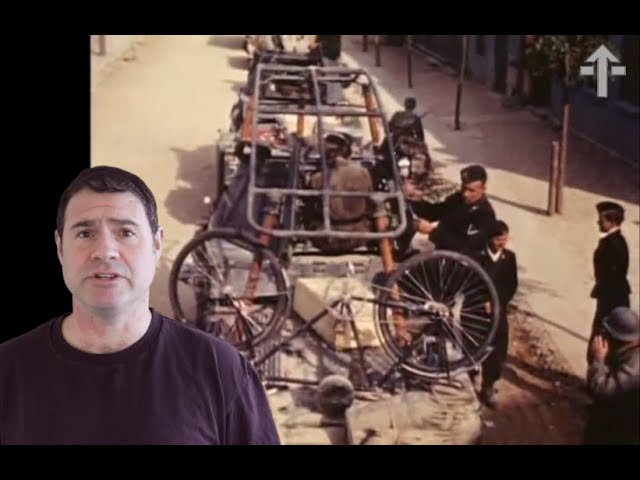
We’re back for the 3rd time embedded with the 20th Pz. Div. in a recon. unit as the division advances on Minsk and so creates the Bialystok-Minsk pocket. Finally relieved from guard duty, the division races east in preparation of taking part in an operation to cross the Dwina River at Ulla. At the end of the video, as we watch 1940 color footage of German armored car crews training, I’ll introduce a new video on demand platform that is being developed and explain why.
This is the situational map for June 29, 1941 the day the 20. PzD advancing south, closed the lid on the Soviet pocket situated to the west of Mink which was comprised of 4 Soviet armies. The wearing down of this pocket would last until July 9 and cost the Soviets 420,000 soldiers, and was the end of the Soviet Western Army. Many believed that this represented the end of the Soviet ability to resist and the approaching end of the war. If you’d like to see more detail related to the build up to and closing of this enormous pocket take a look part 2 of the 7. Pz. Div. series.
Minsk was the first large Soviet city that the 20th see. Here is the impression a grenadier from the division had: At first Minsk seemed like a town. The small wooden houses in the northern suburbs with their fences and gardens in badly need of repair remind me of polish and Belarus villages. As we roll into the center of Minsk we suddenly see large representative buildings which were intended to impress.
A few days earlier the Luftwaffe must have bombed extensively because there are ruins everywhere. The civilians swarm the streets looting the city administration buildings looking for anything at all that is of value. In addition, bodies of Red Army soldiers are lying around and nobody takes notice.
For the next couple of days the 20th was assigned to guard duty. The footage from this period puts into context the varied pace of of frontline soldiers experiences. It also reminds me of the descriptions made by a young 22 year-old German soldier in his 1942 diary written while serving on the Eastern Front.
How beautiful Russia is! Standing in knee high grass fields overflowing with wild flowers. An endless view over an open and hilly landscape is breathtaking. High above the fields of corn larks sing, nearby crows a rooster that has somehow avoided ended up in someones frying pan. . . . our tranquil hike continues on for hours without passing through a village, or even seeing a single simple hut. Then around midday, again, all hell breaks out around us.
He writes that his least favorite duty is to unload truckloads of birch branches. They are used for grave markers and he explains that large deliveries always arrive to the frontline whenever a new offensive is about to kick off.
As the 20th pulled out, the wearing down of the Bialystock-Minsk pocket was well under way. This responsibility was given mainly to the infantry divisions that were working in close cooperation with artillery units and squadrons of Luftwaffe bombers. Whenever possible the panzer divisions and mechanized infantry were freed up to continue advancing.
Early on the morning of July 2 reinforcements arrived to the 20th PzD which included the important 51st Nebelwerfer Regiment. At 0600 hours the 12. PzD arrived which freed up the 20. PzD to immediately again begin moving east.
Before we leave Minsk I’d like to mention an event that took place a few months later that would have lasting consequences on the war. In September, the 17-year-old girl Masha Bruskina, who was a volunteer nurse taking care of wounded Soviet soldiers, was caught helping them escape by providing civilian clothing and false papers.
The occupation authorities decided to make an example of her and she was hung publicly and didn’t allow for her body to be cut down for three days. It was a brutal incident that certainly accelerated the growth of partisan activity. Once this spiral of violence had begun, there was no stopping it.
The race to the east was on with the intention of arriving to and crossing the Dvina river at Ulla as quickly as possible to stop the Soviets from preparing effective defensive positions on the far bank.
The two Panzer divisions, the 7th and the 20th, pushed forward through the heat and dust all day and by 14.45 hours arrive to the city of Lepel. Here, because of a blown bridge, a lack of good roads and the generally chaotic advance a terrible traffic jam developed and brought the column to a stop. Engineers frantically jumped to work repairing the bridge, precious hours were being lost
The following morning in a stroke of luck an undamaged bridge leading out of the city to the north east was found, and, just as importantly, an undamaged Soviet fuel dump containing 50,000 liter is discovered. The vehicles were able to fill their tanks and the frantic advance continued towards Ulla.
Sentinel Indexing in Progress
Metadata and chapters are available. Claim extraction for this episode is pending.
All video content is delivered via YouTube embedded players in accordance with the YouTube Terms of Service. Sentinel provides research tools that promote discovery and accountability across political media.