Politics and Prose
@politicsprose·255K subscribers·4K videos
Author Talk: Charles O'Malley & Scott W. Stern — Shakespeare's Margaret
Posted
August 4, 2026
Views
253
Likes
4
Engagement
1.58%
August 4, 2026
253
4
1.58%
Every word spoken in this episode is indexed. Type any phrase to jump straight to the moment it was said.
Type any word or phrase that may have been spoken. Click a result to seek the player to that exact moment.
Try a name, a topic, or a quoted line
Episode Timeline
Every episode in order around the one you’re watching — click any card and the page flips straight to it.
 52:56Now Playing
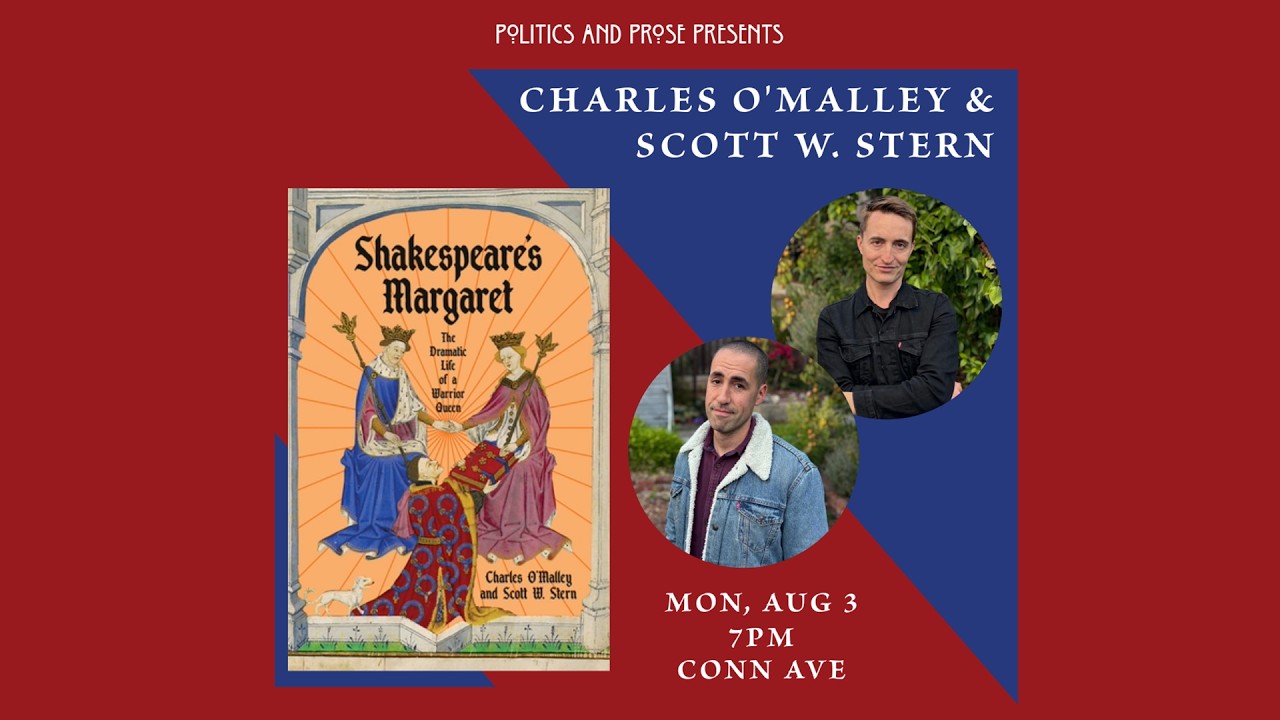
Watch authors Charles O'Malley & Scott W. Stern discuss "Shakespeare's Margaret" at Politics and Prose bookstore in Washington, D.C.
Shakespeare's most powerful female character, her historical inspiration, and her reinventions in performance through the centuries.
She is more violent than Lady Macbeth, more complex than Ophelia, more strategic than King Lear’s daughters. She is the only Shakespearean character, male or female, whose entire life—from youth to old age—appears on stage. She is a wealth of insight into Shakespeare’s understanding of, and influence on, ideas of gender and sexuality, and she speaks by far the most lines of any of his female characters. She has allowed the likes of Peggy Ashcroft, Helen Mirren, and Sophie Okonedo full range for their stunning talents. Yet today, most audiences have still never heard of Margaret of Anjou.
But who was Margaret? In the fifteenth century, she was a fourteen-year-old French princess married to an English king, soon thrust into command amid a bloody civil war. A hundred and fifty years later, she was resurrected on the Elizabethan stage in four of Shakespeare’s earliest plays, Henry VI, Parts 1, 2, and 3 and Richard III.
And in every era since the Bard’s, actors, directors, and producers have recast their own Margaret, slicing, dicing, and rearranging the original Shakespeare to highlight or diminish Margaret’s role depending on the sensibilities of the time. It is this evolution of Margaret’s portrayal that Charles O’Malley and Scott W. Stern track in Shakespeare’s Margaret, from Elizabethan boy-actors in wigs enacting misogynist fears of witchy women to feminist celebrations of Margaret’s uninhibited grasp of power and clever commentaries on global politics and world leaders such as Margaret Thatcher. Her story, as it has changed over the centuries across the page and on the stage, brings to life the evolution of theatre and shows how Shakespeare’s plays have always been living collaborations among actors, directors, writers, critics, and history itself, still unfolding.
Charles O’Malley holds a doctorate in dramaturgy and dramatic criticism from the Yale School of Drama and has worked at theatres across the United States. He is the editor of Toward a Just Pedagogy of Performance.
Scott W. Stern is a scholar and critic. He is the author of The Trials of Nina McCall, a New York Times Editors’ Choice selection, and There Is a Deep Brooding in Arkansas, which the Times called “powerful new history.”
PURCHASE BOOK HERE:
@politicsprose
Visit us online at
Listen on Spotify
Politics and Prose is a beloved and award-winning staple for book lovers around the nation's capital and the world. In addition to our incredible selection of titles, Politics and Prose offers public book talks with today's leading authors and journalists.
Founded by Carla Cohen and Barbara Meade in 1984, Politics and Prose Bookstore is Washington, D.C.'s premier independent bookstore and cultural hub, a gathering place for people interested in reading and discussing books. Politics and Prose offers superior service, unusual book choices, and a haven for book lovers in the store and online.
#books #booktube
Sentinel Indexing in Progress
Metadata and chapters are available. Claim extraction for this episode is pending.
All video content is delivered via YouTube embedded players in accordance with the YouTube Terms of Service. Sentinel provides research tools that promote discovery and accountability across political media.