Prageru
@prageru·3.5M subscribers·6.6K videos
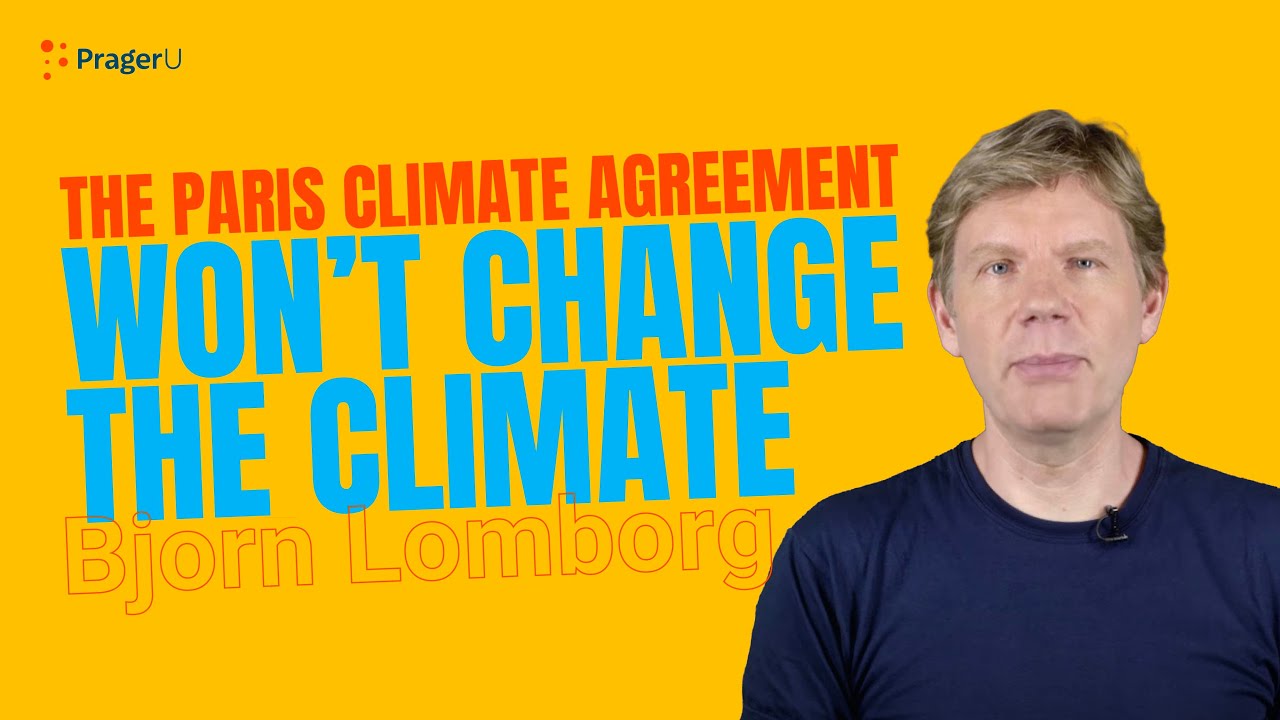
The Paris Climate Agreement Won't Change the Climate | 5 Minute Video
Posted
January 16, 2017
Views
3,513,442
Likes
22,063
Comments
3,900
Engagement
0.74%
January 16, 2017
3,513,442
22,063
3,900
0.74%
Every word spoken in this episode is indexed. Type any phrase to jump straight to the moment it was said.
Type any word or phrase that may have been spoken. Click a result to seek the player to that exact moment.
Try a name, a topic, or a quoted line
 5:38Now Playing
The Paris Climate Agreement will cost at least $1 trillion per year, and climate activists say it will save the planet. The truth? It won't do anything for the planet, but it will make everyone poorer--except politicians and environmentalists. Bjorn Lomborg explains.
Donate today to PragerU!
Joining PragerU is free! Sign up now to get all our videos as soon as they're released.
Download Pragerpedia on your iPhone or Android! Thousands of sources and facts at your fingertips.
Join Prager United to get new swag every quarter, exclusive early access to our videos, and an annual TownHall phone call with Dennis Prager!
Join PragerU's text list to have these videos, free merchandise giveaways and breaking announcements sent directly to your phone!
Do you shop on Amazon? Click and a percentage of every Amazon purchase will be donated to PragerU. Same great products. Same low price. Shopping made meaningful.
VISIT PragerU!
FOLLOW us!
PragerU is on Snapchat!
JOIN PragerFORCE!
For Students
JOIN our Educators Network!
Script:
Much has been made of the Paris Climate Agreement signed by the leaders of 178 countries in 2016. French foreign minister Laurent Fabius, speaking for many, called it a "historic turning point."
The head of the U.S. Environmental Protection Agency, Gina McCarthy, echoed the minister's remark when she testified before the House Committee on Science, Space and Technology. The Paris Agreement was, she said, an "incredible achievement." But when pressed by committee members to explain exactly how much this treaty would reduce global temperatures, she would not – or could not – say.
This combination of grand pronouncements and vague specifics is a good strategy for Paris Agreement fans to take. Because the agreement will cost a fortune, but do little to reduce global warming.
Consider the Obama administration's signature climate policy, the Clean Power Plan. Using the same climate prediction model that the UN uses, I found that the power plan will accomplish almost nothing. Even if its cuts to carbon dioxide emissions are fully implemented – not just for the 14 years that the Paris Agreement lasts, but for the rest of the century – the Clean Power Plan would reduce the temperature increase in 2100 by just 0.023 degrees Fahrenheit.
The President has made further, and grander, promises of future U.S. carbon cuts, but these are only vaguely outlined. In the unlikely event that all of these extra cuts also happen, and are adhered to throughout the rest of the century, the combined reduction in temperatures would be 0.057 degrees.
To put it another way, if the U.S. delivers for the whole century on the President's very ambitious rhetoric, it would postpone global warming by about eight months at the end of the century.
Now let's add in the rest of the world's Paris promises. If we generously assume that the promised carbon cuts for 2030 are not only met (which itself would be a U.N. first), but sustained, throughout the rest of the century, temperatures in 2100 would drop by 0.3 degrees – the equivalent of postponing warming by less than four years. Again, that's using the UN's own climate prediction model.
But here's the biggest problem: These miniscule benefits do not come free; quite the contrary.
The cost of the Paris climate pact is likely to run to 1 to 2 trillion dollars every year, based on estimates produced by the Stanford Energy Modeling Forum and the Asia Modeling Exercise. In other words, we will spend at least one hundred trillion dollars in order to reduce the temperature, by the end of the century, by a grand total of three tenths of one degree.
Some Paris Agreement supporters defend it by claiming that its real impact on temperatures will be much more significant than the U.N. model predicts. But this requires mental gymnastics and heroic assumptions.
For the complete script, visit
Sentinel Indexing in Progress
Metadata and chapters are available. Claim extraction for this episode is pending.
All video content is delivered via YouTube embedded players in accordance with the YouTube Terms of Service. Sentinel provides research tools that promote discovery and accountability across political media.