
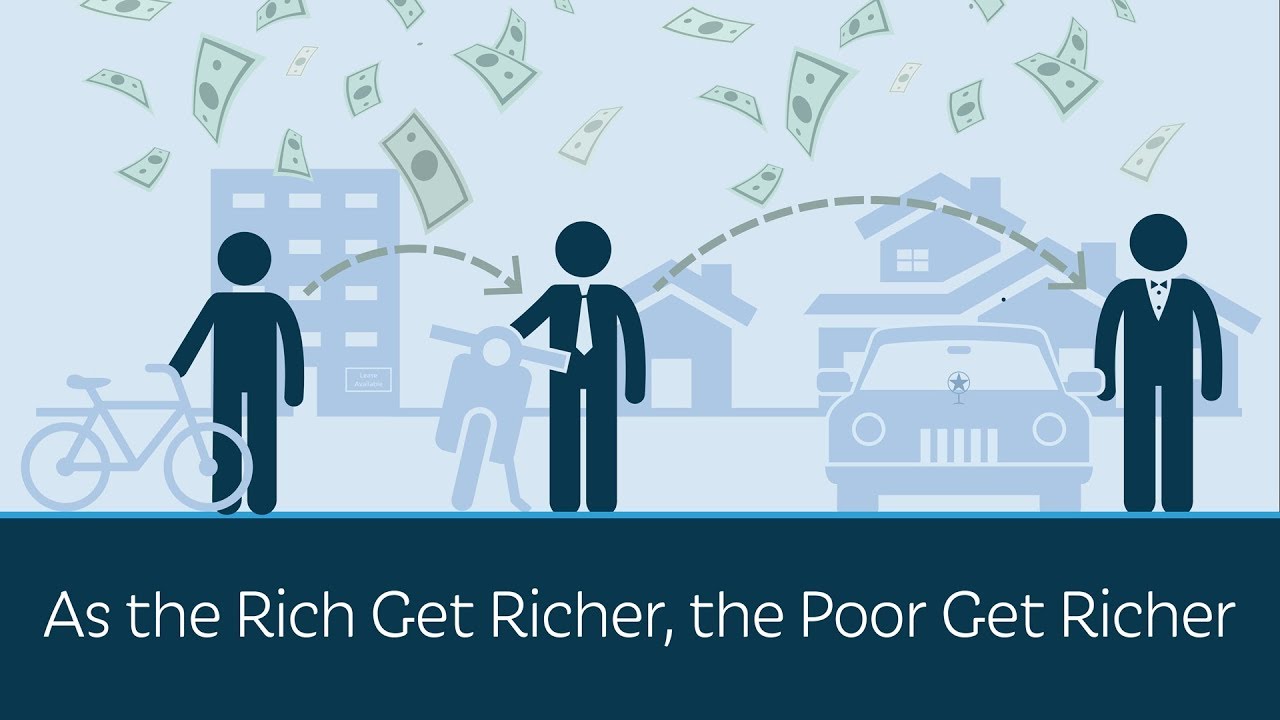
As the Rich Get Richer, the Poor Get Richer | 5 Minute Video
April 9, 2018
7,999,101
40,642
5,251
0.57%
Search the Record
IndexedEvery word spoken in this episode is indexed. Type any phrase to jump straight to the moment it was said.
Type any word or phrase that may have been spoken. Click a result to seek the player to that exact moment.
Try a name, a topic, or a quoted line
Prageru Episodes Around April 9, 2018
See what was published immediately before and after this episode.





YouTube Description
as posted by the channelThe rich are getting richer, and the poor are... also getting richer. What's driving this wealth creation process? In this video, Daniel Hannan explains why it is
capitalism — and capitalism alone — that has led to the unprecedented
enrichment that is the central fact of Western life.
This video is part of the Robert W. Plaster Playlist Watch the entire playlist here
Donate today to PragerU!
Joining PragerU is free! Sign up now to get all our videos as soon as they're released.
Download Pragerpedia on your iPhone or Android! Thousands of sources and facts at your fingertips.
Join Prager United to get new swag every quarter, exclusive early access to our videos, and an annual TownHall phone call with Dennis Prager!
Join PragerU's text list to have these videos, free merchandise giveaways and breaking announcements sent directly to your phone!
Do you shop on Amazon? Click and a percentage of every Amazon purchase will be donated to PragerU. Same great products. Same low price. Shopping made meaningful.
VISIT PragerU!
FOLLOW us!
PragerU is on Snapchat!
JOIN PragerFORCE!
For Students
JOIN our Educators Network!
Script:
“The rich are getting richer and the poor are getting poorer.”
“The top one per cent of people on the planet have half the wealth.”
“Western corporations are plundering developing countries.”
“Capitalism is on its last legs.”
Really?
The truth is that global inequality is tumbling. Yes, the rich are getting richer—but the poor are getting richer faster. And what’s driving that process? The market.
Look at the most basic measures: Literacy. Longevity. Infant mortality. Calorie intake. Height. More and more people are being lifted out of poverty.
I think of the changes just in my lifetime.
When I was born, in 1971, an American worker had to earn a month’s salary to be able to afford a TV set. Now, it’s two days.
In 1971, fewer than half of girls worldwide completed at least primary education. Now, it’s more than 90 percent.
In 1971, a stationary car emitted more pollution than a car moving at full speed today.
Go a little further back. In the seventeenth century, the most powerful man in the world was Louis XIV of France. Every night, he’d have 40 dishes prepared for his dinner, and he’d pick the one he felt like. Think about it: A receptionist today can stop off at a store on her way home and have not only a wider choice than that king, but a fresher one and a healthier one. We all live better than Louis XIV.
What has caused that miracle? Not any UN development program. Not any government aid scheme.
What caused it was the market.
The most rapid falls in poverty are happening in countries that are joining the global trading system. Compare growth rates in free-trading Colombia and protectionist Venezuela; or in free-trading Vietnam and protectionist Laos; or in free-trading Bangladesh and protectionist Pakistan.
It’s the same story every time.
China after 1979, India after 1991. You remove barriers to trade. Prices fall. Your people no longer have to work every hour just to afford food and basic commodities. They have time to invent and make and buy and sell other things. The whole economy is stimulated. Poverty falls.
OK, you might say, so maybe capitalism works; maybe people are better off. But isn’t there a cost? Doesn’t it make us more materialistic? Doesn’t it make us greedier?
If by “greed” you mean a desire for material wealth, that’s part of the human condition. It’s in our DNA or, if you prefer, it’s in our fallen nature. Under any system—socialism, communism, fascism, absolute monarchy, theocracy—people want more stuff.
The unique quality of capitalism is that it structures the incentives so that the way to succeed—the way to be “greedy,” if you insist on using that vocabulary—is to offer a service to the people around you.
Under every other system, you get on by sucking up to those in power: commissars, or kings, or dictators.
But under a free market system, you get on by offering consumers something they want.
For the complete script, visit
Guests & Subjects Covered
Sentinel Indexing in Progress
Metadata and chapters are available. Claim extraction for this episode is pending.
All video content is delivered via YouTube embedded players in accordance with the YouTube Terms of Service. Sentinel provides research tools that promote discovery and accountability across political media.