Prageru
@prageru·3.5M subscribers·6.6K videos
Public Union: Public Enemy | 5 Minute Video
Posted
July 16, 2018
Views
3,904,115
Likes
15,681
Comments
2,062
Engagement
0.45%
July 16, 2018
3,904,115
15,681
2,062
0.45%
Every word spoken in this episode is indexed. Type any phrase to jump straight to the moment it was said.
Type any word or phrase that may have been spoken. Click a result to seek the player to that exact moment.
Try a name, a topic, or a quoted line
 5:23Now Playing
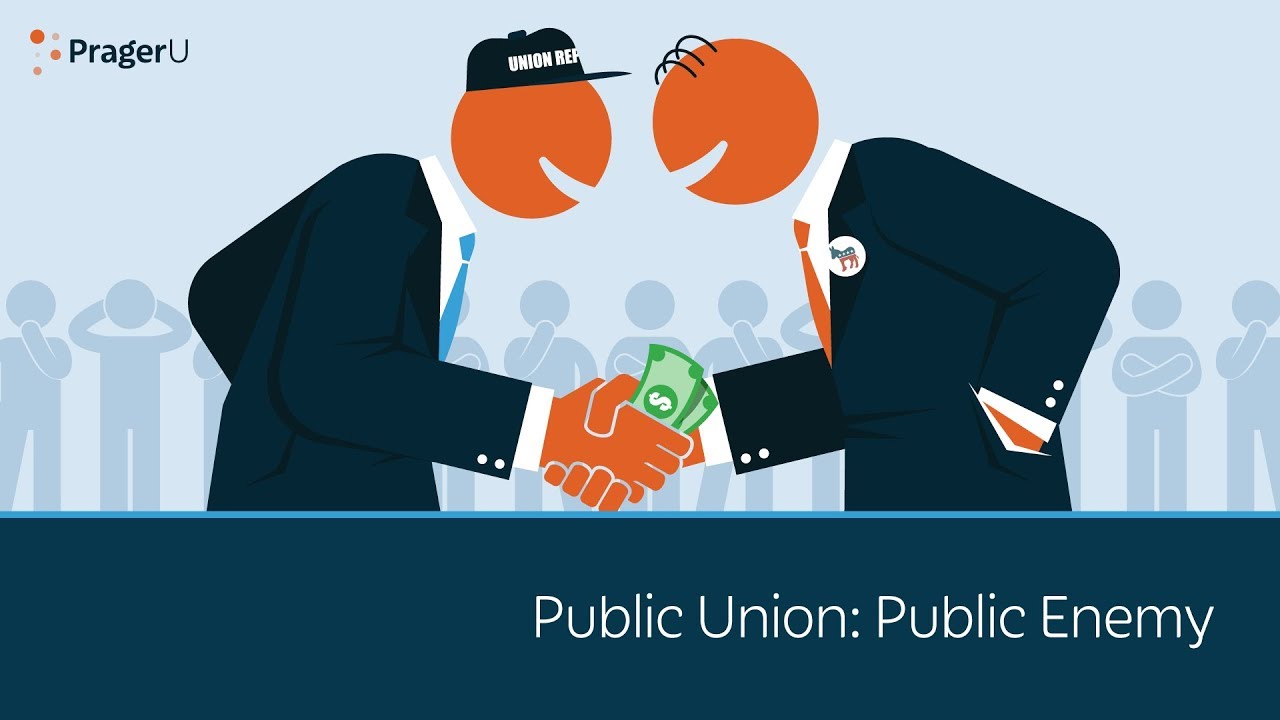
Public-sector unions have been gaming the political system for decades, bankrupting whole cities and plunging states into massive debt. How did this happen and can it be stopped? Akash Chougule, senior policy fellow for Americans for Prosperity, has the answers in this sobering video from Prager University.
Donate today to PragerU!
Get PragerU bonus content for free!
Download Pragerpedia on your iPhone or Android! Thousands of sources and facts at your fingertips.
Join Prager United to get new swag every quarter, exclusive early access to our videos, and an annual TownHall phone call with Dennis Prager!
Join PragerU's text list to have these videos, free merchandise giveaways and breaking announcements sent directly to your phone!
Do you shop on Amazon? Click and a percentage of every Amazon purchase will be donated to PragerU. Same great products. Same low price. Shopping made meaningful.
VISIT PragerU!
FOLLOW us!
PragerU is on Snapchat!
JOIN PragerFORCE!
For Students
JOIN our Educators Network!
Script:
How would you like to fund politicians with whom you strongly disagree?
Not interested?
How about if I… forced you?
How would I do that?
Well, what if I said, “If you don’t pay, you lose your job.”
For decades, millions of state and local government workers—police, firefighters, teachers, and others—have been forced to make that choice.
And who forces them?
Public-sector unions; that is, unions who represent public-sector employees.
How? It’s pretty straightforward.
First, they demand employees pay hundreds of dollars in union dues as a condition of employment—meaning if they don’t pay, they get fired. Next, they use that money to support and elect union-friendly politicians. Then they negotiate contracts with those same politicians—kind of like negotiating with yourself. It’s a sweet deal—unless you’re a worker who doesn’t agree with those union-friendly politicians. Or the taxpayer who has to foot the bill for those union contracts.
This game plan is not a secret. Here’s what the American Federation of State, County, and Municipal Employees say on their website: "We elect our bosses, so we've got to elect politicians who support us and hold those politicians accountable."
These perverse incentives might help explain why, for most of American history, pretty much no one thought that unionizing government workers was a good idea.
This includes liberal icon President Franklin Roosevelt. Roosevelt was a very strong supporter of private-sector unions, but a very strong opponent of public-sector unions. Here’s what he said on the subject in 1937: “All Government employees should realize that the process of collective bargaining…cannot be transplanted into the public service...”
Roosevelt recognized that public-sector unions could hold the government hostage at will. They could simply threaten to walk off the job if they didn’t get what they wanted. Sanitation workers, for example, could put public health at risk by refusing to collect the garbage. Other public employees would have similarly disruptive power. This was, Roosevelt believed, “unthinkable and intolerable.”
In 1943, New York state’s highest court agreed, calling government unions “not only incompatible with the spirit of democracy, but inconsistent with every principle upon which our government is founded.”
In the late 1950s, New York City and Wisconsin defied this view and allowed their public employees to unionize. But it was President John F. Kennedy who opened the floodgates. In order to win the support of union leadership in the 1960 presidential election, he promised to allow federal employees to unionize—and fulfilled that promise with Executive Order 10988 in 1962. It was a shrewd political move, but a bad deal for the country, and its consequences are still being felt today as public-sector unionization spread rapidly in the decades that followed.
Today, unions wield tremendous power in government. Try to fire a poor-performing government worker in New York City or Los Angeles. Or almost any unionized government employee anywhere. It’s extremely difficult—if not impossible—no matter how incompetent they might be. According to one union contract in Michigan, employees could be caught drunk at work five times before being fired.
For the complete script, visit
Sentinel Indexing in Progress
Metadata and chapters are available. Claim extraction for this episode is pending.
All video content is delivered via YouTube embedded players in accordance with the YouTube Terms of Service. Sentinel provides research tools that promote discovery and accountability across political media.