ReasonTV
@ReasonTV·1.4M subscribers·4.8K videos
Three Mile Island nearly killed nuclear. Now it's coming back.
Posted
September 26, 2024
Views
36,426
Likes
1,979
Comments
533
Engagement
6.90%
September 26, 2024
36,426
1,979
533
6.90%
Every word spoken in this episode is indexed. Type any phrase to jump straight to the moment it was said.
Type any word or phrase that may have been spoken. Click a result to seek the player to that exact moment.
Try a name, a topic, or a quoted line
 8:19Now Playing
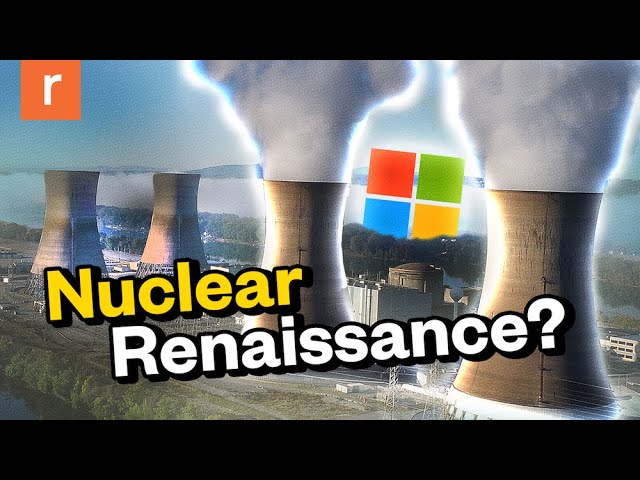
Microsoft has agreed to purchase Three Mile Island's energy to power its AI data centers for the next 20 years. It's the first time a U.S. nuclear reactor will come out of retirement.
---
Is a nuclear renaissance about to begin on the very site of the public relations catastrophe that practically destroyed the industry 45 years ago?
Constellation Energy recently announced a deal with Microsoft to restore a retired reactor on Pennsylvania's Three Mile Island. Microsoft has agreed to purchase energy from the plant for 20 years to power its AI data centers.
A U.S. nuclear reactor has never before been brought out of retirement.
Nuclear power was once considered the clean energy source of the future, with dozens of new plants coming online in the late '60s and early '70s.
But in March of 1979, a meltdown occurred at Three Mile Island's nuclear plant.
There were no casualties, and there was no lingering environmental damage. But the incident spooked the nation. From a publicity standpoint, the timing was disastrous—Three Mile Island occurred while The China Syndrome, a fictional account of safety cover-ups at a nuclear plant, was still in theaters, featuring Jane Fonda, Jack Lemmon, and Michael Douglas.
"After Three Mile Island, what was considered to be the best interest of the public was just reducing risk to as low as possible," says Adam Stein, director of the Nuclear Energy Innovation Program at the Breakthrough Institute. "It resulted in a huge volume of regulations that anybody that wanted to build a new reactor had to know. It made the learning curve much steeper to even attempt to innovate in the industry."
It was a public relations disaster for the nuclear industry, and the industry's expansion tapered off, concluding in a 20-year spell in which no new nuclear reactors were built in the U.S.
"My view is that these supposedly environmentalist groups formed in the 1970s that are not primarily pro-environment. They're really primarily anti-nuclear," says Eric Dawson, co-founder of Nuclear New York, a group fighting to protect the industry on the grounds that nuclear is "the most scalable, reliable, efficient, land-conserving, material-sparing, zero-emission source of energy ever created."
He says that Three Mile Island empowered the antinuclear movement.
As politicians have slowly realized that the dangers of nuclear power may have been exaggerated by activists, and the benefits of a reliable emissions-free energy source underappreciated, the regulatory landscape has slowly changed. The first new U.S. reactor built from scratch since 1974 opened in Georgia in 2022—albeit at a very high cost. The federal government issued its first ever approval for a small modular reactor in January 2023.
Constellation estimates that it will spend about $1.6 billion to bring the Three Mile Island reactor online by 2028 and will seek to renew the operating license through 2054. Pennsylvania's governor Josh Shapiro wrote a letter to federal regulators asking that the application be fast-tracked. Microsoft's VP of energy calls the deal "a major milestone" in the company's effort to "decarbonize the grid" while pursuing an AI-driven future that's going to require a lot of energy.
The Microsoft deal is the latest piece of evidence that nuclear energy—after being hampered by decades of hyper-cautious regulation—is poised for a comeback. Three Mile Island could one day become a symbol for nuclear's rebirth.
Video Producer: Zach Weissmueller
Video Editor: Danielle Thompson
Photo Credits: RICHARD B. LEVINE/Newscom; FRANCES M. ROBERTS/Newscom; Paul Souders / DanitaDelimont.com / Danita Delimont Photography/Newscom; LAURENCE KESTERSON/KRT/Newscom; Robert J. Polett/Newscom; Dick Darrell/Toronto Star/ZUMA Press/Newscom; St Petersburg Times/ZUMAPRESS/Newscom; Library of Congress/Bernard Gotfryd; Jmnbqb, CC BY-SA 4.0 DEED, via Wikimedia Commons; Meghan McCarthy/ZUMA Press/Newscom; Erik Mcgregor/ZUMA Press/Newscom; Joe Sohm/Visions of America/Joseph Sohm/Universal Images Group/Newscom; Reginald Mathalone/ZUMAPRESS/Newscom; Bastiaan Slabbers/ZUMAPRESS/Newscom; Anthony Behar/Sipa USA/Newscom; */Kyodo/Newscom; Pacific Press/Sipa USA/Newscom; Paul Hennessy/ZUMAPRESS/Newscom; Michael Siluk/UCG/Universal Images Group/Newscom; KEVIN DIETSCH/UPI/Newscom; Reginald Mathalone/ZUMAPRESS/Newscom; ROGER L. WOLLENBERG/UPI/Newscom/Midjourney
Music Credits: “Bubbles Drop” by Cosmonkey via Artlist; “Paper or Plastic” by Bubblz via Artlist; “Digital Abyss” by Stephen Keech via Artlist; “Expand” by Theatre of Delays via Artlist; “Monomer” by Leroy Wild via Artlist; “Behind the City” by Ziv Moran via Artlist; “Fantasma” by Omri Smadar via Artlist
Sentinel Indexing in Progress
Metadata and chapters are available. Claim extraction for this episode is pending.
All video content is delivered via YouTube embedded players in accordance with the YouTube Terms of Service. Sentinel provides research tools that promote discovery and accountability across political media.