
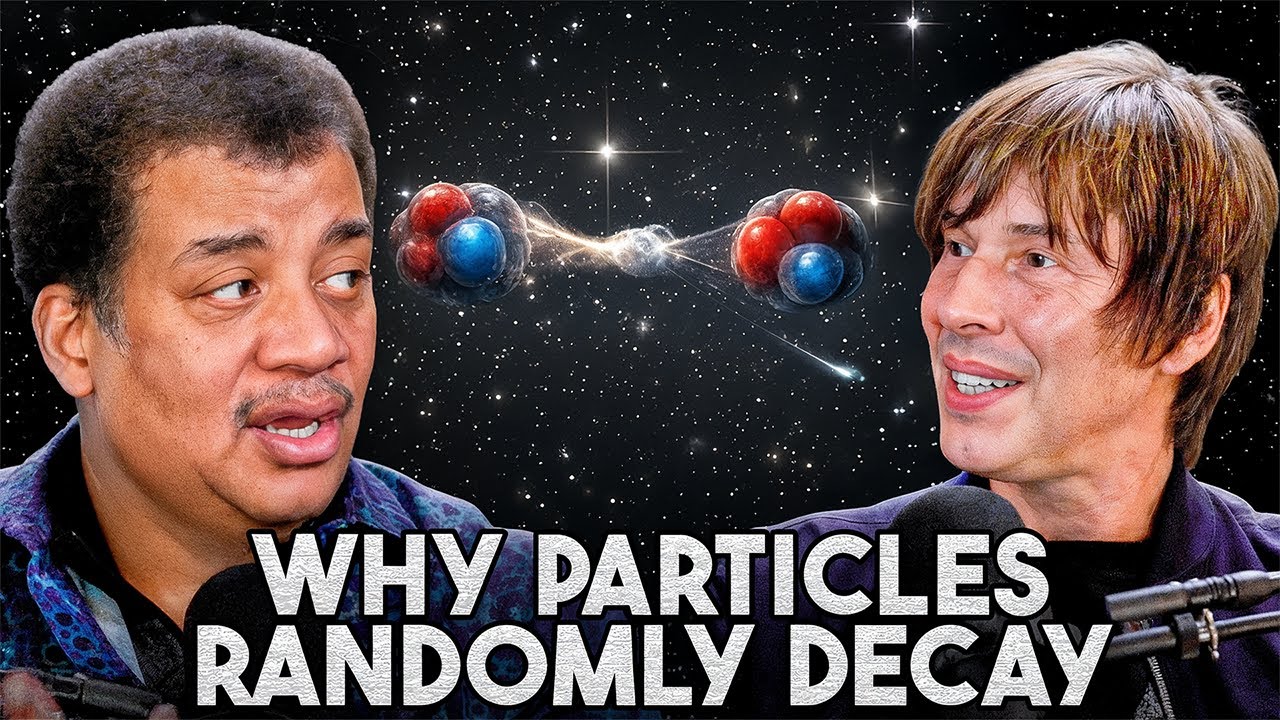
Why Physics Can't Predict When Particles Decay
January 9, 2026
262,765
5,580
560
2.34%
Search the Record
IndexedEvery word spoken in this episode is indexed. Type any phrase to jump straight to the moment it was said.
Type any word or phrase that may have been spoken. Click a result to seek the player to that exact moment.
Try a name, a topic, or a quoted line
Startalk Plus Episodes Around January 9, 2026
See what was published immediately before and after this episode.




 11:19Now Playing
Why Physics Can't Predict When Particles Decay


YouTube Description
as posted by the channelIn this episode, Neil deGrasse Tyson and co-host Chuck Nice speak with physicist Brian Cox about the fundamentally probabilistic nature of reality. The discussion explores why particles decay at random times, how quantum mechanics embeds probability into nature itself, how the weak nuclear force drives particle decay, and how relativity alters decay rates at high speeds. The conversation then expands into deep limits of measurement, explaining the Planck length, why probing smaller scales creates black holes, and how this reveals a fundamental boundary to observing spacetime itself.
From 'Are We The Universe’s Way of Knowing Itself? With Brian Cox'
Get the StarTalk book, 'To Infinity and BeyondA Journey of Cosmic Discovery' on Amazon
Support us on Patreon
FOLLOW or SUBSCRIBE to StarTalk:
Links & Promotions
Guests & Subjects Covered
Sentinel Indexing in Progress
Metadata and chapters are available. Claim extraction for this episode is pending.
All video content is delivered via YouTube embedded players in accordance with the YouTube Terms of Service. Sentinel provides research tools that promote discovery and accountability across political media.