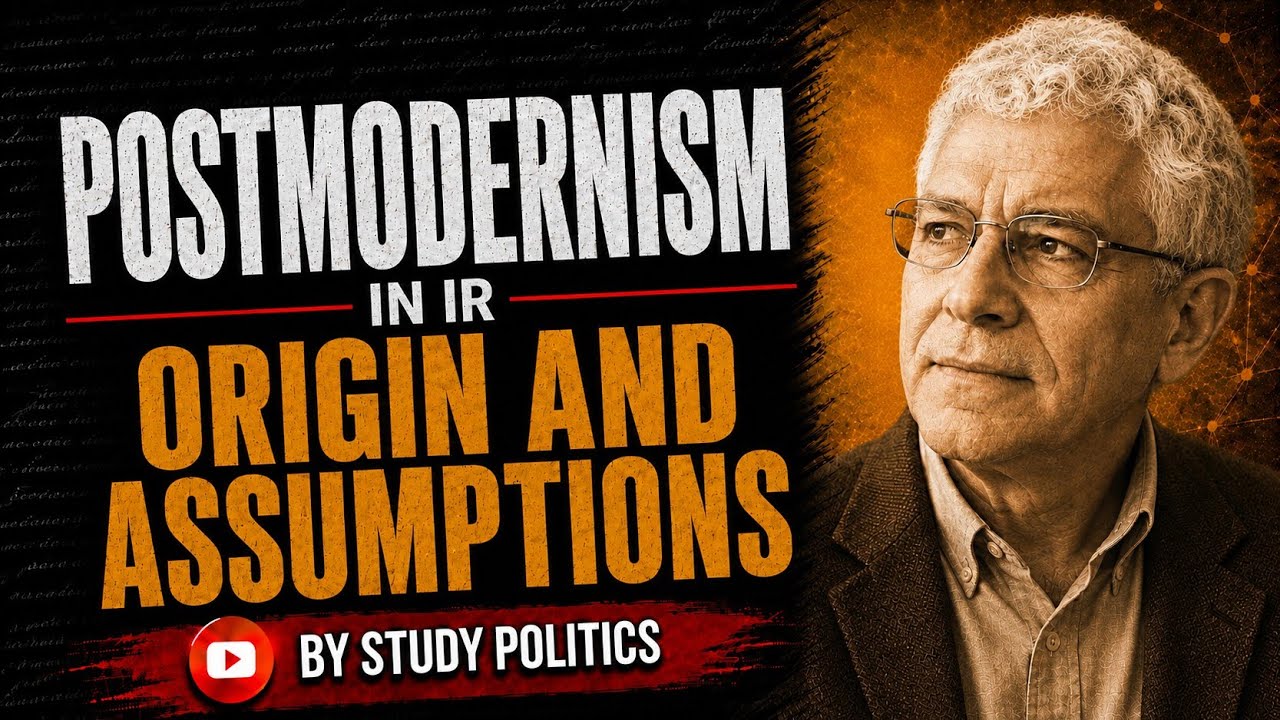
Postmodernism in International Relations | Origin and Assumptions |
June 1, 2020
11,664
283
55
2.90%
Search the Record
IndexedEvery word spoken in this episode is indexed. Type any phrase to jump straight to the moment it was said.
Type any word or phrase that may have been spoken. Click a result to seek the player to that exact moment.
Try a name, a topic, or a quoted line
Study Politics Episodes Around June 1, 2020
See what was published immediately before and after this episode.


 39:36Now Playing
Postmodernism in International Relations | Origin and Assumptions |


Segments
YouTube Description
as posted by the channelPostmodernism is a theory in International Relations that criticizes the ideas of Enlightenment and presents a critique of the consequences of modernity. Postmodernism does not believe in mega theories like Marxism. Postmodernists also do not believe in the emancipation project given by the Critical Theorists. In this regard, they gave us the example of Stalin’s Russia. They believe that these megaprojects are used to suppress and oppress the opposition in the name of universality. They also highlight the rise of “fascism” during the 1930s in the critique of Enlightenment. Postmodernists also do not believe in the ultimate foundation of the truth. They do not support anyone's perspective. The talk about the “death of the author”. They believe that all we know is the interpretation of an interpretation. Reality is not directly accessible to use. The core assumption of postmodernists is:
1. Human nature mutable. Human nature is open and malleable. Human nature is the product of practices of subordinating and resistance.
2. Human actions, values, and beliefs vary according to the wider social and cultural context.
3. We cannot outline any general theory to “make sense” of the world. We cannot give any blueprint or scheme for the universal human emancipation.
4. There is a relation between power and knowledge. Power resides in discourse.
5. There are no real facts about the world. Everything is interpretation and interpretation of others.
Besides this, there are also many themes of postmodernists. The themes include The state and power, security and identity, identity and community, inequality and justice, and conflict and violence. The conflict arises merely due to the construction of hostile “other”.
To watch more videos You can Click on the following Links:
What is State
Liberalism in IR
Structuralism in IR
SovietAfghan War
The era of Ayub Khan
Treaty of Westphalia
To subscribe to my Channel you can click on the following link:
Study Politics is an educational Channel. The purpose of this channel is to provide information about different topics related to History, International Relations, Political Science, Sociology, Current Affairs, and other Social Sciences. The students of competitive exams like CSS, PMS, PPSC, PCS, ISP, UPSC, and others will find this channel extremely beneficial because of its simplified material and nature of its content. Besides some specific students, the other people belong to other fields other than social sciences can also find this channel useful. It will provide them day-to-day news with the explanation.
You can also like my Facebook page, can follow me on Twitter and on Linkedin.
#StudyPolitics #Postmodernism_in_IR #Foucault #Derrida
Links & Promotions
Guests & Subjects Covered
Sentinel Indexing in Progress
Metadata and chapters are available. Claim extraction for this episode is pending.
All video content is delivered via YouTube embedded players in accordance with the YouTube Terms of Service. Sentinel provides research tools that promote discovery and accountability across political media.