Big Think
@bigthink·8.8M subscribers·10.1K videos
Big Think Interview With John Allison | Big Think
Posted
April 24, 2012
Views
1,940
Likes
57
Comments
2
Engagement
3.04%
April 24, 2012
1,940
57
2
3.04%
Every word spoken in this episode is indexed. Type any phrase to jump straight to the moment it was said.
Type any word or phrase that may have been spoken. Click a result to seek the player to that exact moment.
Try a name, a topic, or a quoted line
You’re on April 24, 2012. Earlier episodes are to the left, later ones to the right — the row keeps loading as you go. Click any card to open it.
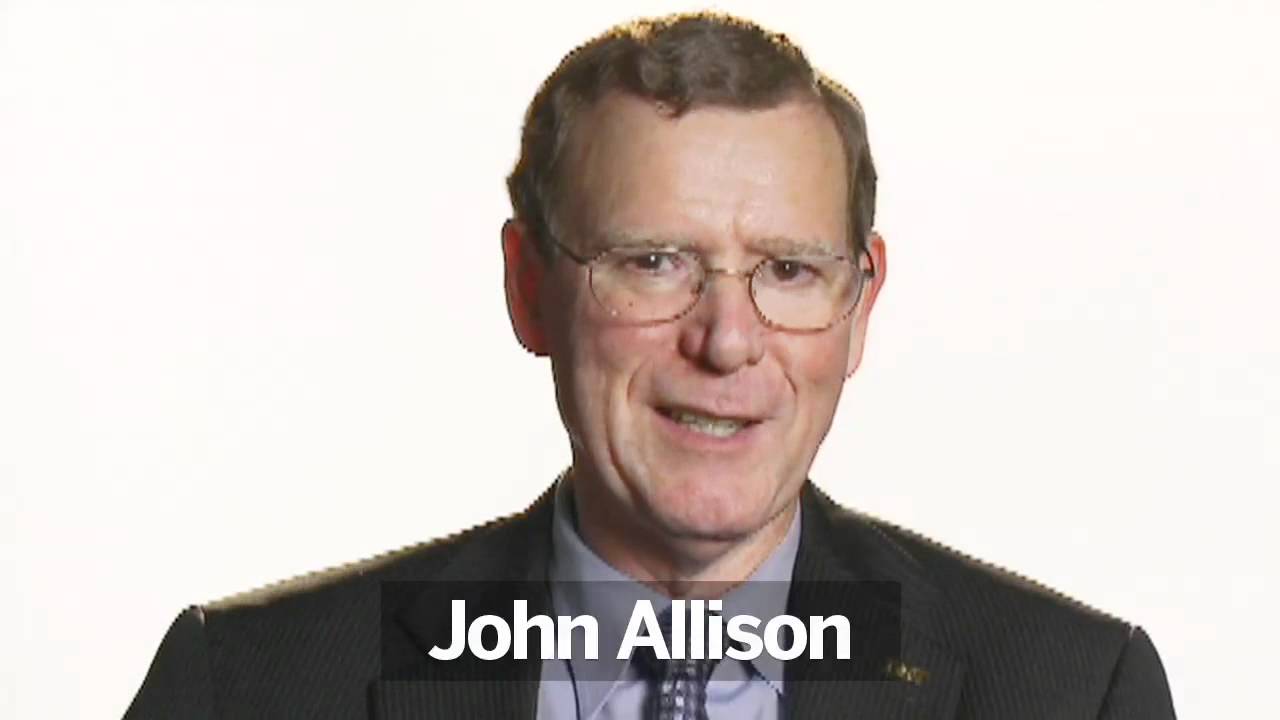 Apr 24, 201224:52Now Playing
Big Think Interview With John Allison
New videos DAILY
Join Big Think Edge for exclusive videos
----------------------------------------------------------------------------------
A Conversation with the former CEO of BB&T.
----------------------------------------------------------------------------------
John A. Allison:
John A. Allison IV is the former CEO of and acting Chairman of BB&T, one of the largest banks in America. Allison was recently named one of the best CEOs of 2008 by MorningStar as his banking principles are largely seen as the reason behind his bank's relative success during the financial crisis. A graduate of the University of North Carolina with an MBA from the Fuqua School of Business at Duke University, he has a wife and three children.
----------------------------------------------------------------------------------
TRANSCRIPT:
Question: What bank regulatory mechanisms, if any, might have prevented the crises? (Dan Indiviglio, The Atlantic Business Channel):
John Allison: In my opinion, the crisis was primarily created by government policies, specifically the Federal Reserve putting in too much money under Greenspan where we had negative real interest rates for two years. And then Bernanke inverted interest rates, which created terrible pressure on bank margins. We couldn’t have had a bubble in the economy if the Fed hadn’t printed too much money. It ended up in the housing market because of Freddie Mac and Fannie Mae, these two giant government sponsored enterprises. So it wasn’t really the regulatory structure that created the problems, it was government policy from the Fed and through Freddie Mac and Fannie Mae.
What is irony is the perception that the banking industry was de-regulated. In fact, the regulatory environment during the bubble, was the worst in my career, it was just mis-regulation, it was a huge amount of focus on—you see a huge amount of focus on the Patriot Act, and no focus really on traditional risk management. So they contributed to the crises more in an indirect way, but the real cause of the misallocations in the economic system came from the Federal Reserve and Freddie Mac and Fannie Mae.
Question: What was your experience in dealing with the Treasury’s bank bailout?: (Dan Indiviglio, The Atlantic Business Channel)
John Allison: I was very opposed to the TARP program. In fact, I wrote congress and tried very hard to keep TARP from happening. Unfortunately, however, once TARP was approved by Congress, there was significant regulatory pressure placed on all the large financial institutions to participate in TARP, particularly on all the $100 billion and over banks. The pressure was based on Bernanke’s study of the Great Depression, where Roosevelt tried to bail out individual companies and the market reacted when he did that. At the time that TARP was instituted, there were three large financial institutions that were under stress, but Bernanke didn’t want to bail those three out, because it’d be obvious he was helping them, so he used regulatory, I mean, intense regulatory pressure, to encourage all the $100 billion and over institutions to participate.
TARP was really a negative for the financial institutions, we didn’t need the capital, we had to pay very high interest rates. They got warrants. And so it was really a subsidy for the unhealthy institutions at the expense of the healthy institutions. BB&T was one of the first banks to pay back TARP, we paid it back as quickly as we possibly could.
Question: Why was TARP so costly to BB&T?
John Allison: All the large financial institutions, the $100 billion-plus institutions were basically strongly encouraged, effectively forced to participate in TARP because the Federal Reserve didn’t want the market to know the specific institutions that were being bailed out and by encouraging everybody, including the strong institutions, to participate, they obscured the fact that certain institutions were being saved. If you didn’t need the capital, the fact that you had to pay a very high interest rate and give warrants to the government was very expensive. In our case, that was several hundred million dollars, probably, and it turned out when they did the stress test, we really didn’t need the capital anyway. So I thought it was a redistribution from the healthy institutions to the unhealthy institutions and not good government policy, although they had created such a panic, they may have needed to do something, but I don’t think TARP was the answer.
Question: What do you feel will be the long-term consequences of TARP?
Read the full transcript at
Sentinel Indexing in Progress
Metadata and chapters are available. Claim extraction for this episode is pending.
All video content is delivered via YouTube embedded players in accordance with the YouTube Terms of Service. Sentinel provides research tools that promote discovery and accountability across political media.