Big Think
@bigthink·8.8M subscribers·10.1K videos
Daniel Dennett Explores the Problems of the Human Brain | Big Think
Posted
April 24, 2012
Views
1,265
Likes
18
Comments
1
Engagement
1.50%
April 24, 2012
1,265
18
1
1.50%
Every word spoken in this episode is indexed. Type any phrase to jump straight to the moment it was said.
Type any word or phrase that may have been spoken. Click a result to seek the player to that exact moment.
Try a name, a topic, or a quoted line
See what was published immediately before and after this episode.
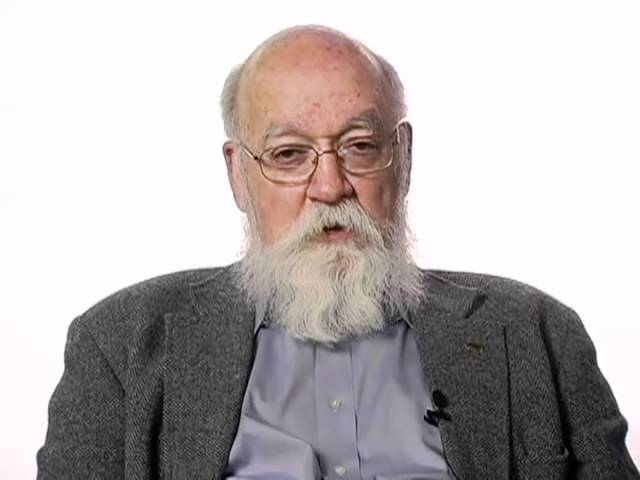 3:08Now Playing
Daniel Dennett Explores the Problems of the Human Brain
New videos DAILY
Join Big Think Edge for exclusive videos
----------------------------------------------------------------------------------
Our brains are cunningly evolved, cunningly designed to make life easier for us.
----------------------------------------------------------------------------------
Daniel C. Dennett:
Daniel C. Dennett is the author of Intuition Pumps and Other Tools for Thinking, Breaking the Spell, Freedom Evolves, and Darwin's Dangerous Idea and is University Professor and Austin B. Fletcher Professor of Philosophy, and Co-Director of the Center for Cognitive Studies at Tufts University. He lives with his wife in North Andover, Massachusetts, and has a daughter, a son, and a grandson. He was born in Boston in 1942, the son of a historian by the same name, and received his B.A. in philosophy from Harvard in 1963. He then went to Oxford to work with Gilbert Ryle, under whose supervision he completed the D.Phil. in philosophy in 1965. He taught at U.C. Irvine from 1965 to 1971, when he moved to Tufts, where he has taught ever since, aside from periods visiting at Harvard, Pittsburgh, Oxford, and the École Normale Supérieure in Paris.
His first book, Content and Consciousness, appeared in 1969, followed by Brainstorms (1978), Elbow Room (1984), The Intentional Stance (1987), Consciousness Explained (1991), Darwin's Dangerous Idea (1995), Kinds of Minds (1996), and Brainchildren: A Collection of Essays 1984-1996. Sweet Dreams: Philosophical Obstacles to a Science of Consciousness, was published in 2005. He co-edited The Mind's I with Douglas Hofstadter in 1981 and he is the author of over three hundred scholarly articles on various aspects on the mind, published in journals ranging from Artificial Intelligence and Behavioral and Brain Sciences to Poetics Today and the Journal of Aesthetics and Art Criticism.
Dennett gave the John Locke Lectures at Oxford in 1983, the Gavin David Young Lectures at Adelaide, Australia, in 1985, and the Tanner Lecture at Michigan in 1986, among many others. He has received two Guggenheim Fellowships, a Fulbright Fellowship, and a Fellowship at the Center for Advanced Studies in Behavioral Science. He was elected to the American Academy of Arts and Sciences in 1987.
He was the Co-founder (in 1985) and Co-director of the Curricular Software Studio at Tufts, and has helped to design museum exhibits on computers for the Smithsonian Institution, the Museum of Science in Boston, and the Computer Museum in Boston.
----------------------------------------------------------------------------------
TRANSCRIPT:
Question: Do our brains play tricks on us?
Dennett: Our brains are cunningly evolved, cunningly designed to make life easier for us. And many ways that it makes life easier for us but one of them is that it gives us over simplified versions of what we’re doing. This is a set of tricks which has been sort of reinvented by software engineers. Your desktop is a very good case of it, we have this you know, little yellow files that can be move around with click and drag and things get put here and there and this is called the user illusion and it is illusory to some degree but of course it’s a very benign illusion, it’s really, really it’s the helpful way of organizing a lot of complexity. We don’t need to know all those details. We just need to know how to achieve certain effects and basically our brain does the same thing and has been doing it for you know, millennia and it’s got, it’s evolve some sort of internal sign posts that are good short hand for things that we can do. Everywhere we look, there’s things we can do we don’t know how we do them. Where completely cut off from the process if I say you know, give me the first line of limerick make up the first line of limerick well you know, give me a few seconds you’ll come up with 2 or 3. How did you do that? You don’t know. The words just come sort of bubbling up and you don’t have any insight into the sort of subterranean unconscious process that generates that particular thing. You may have a little insight but not much. And it’s there is a very sharp limit to the depth that we as conscious agents can probe our own activities and this, this sort of superficial access that we have to what’s going on, that’s what consciousness is. Now, when I say who is this “we” whose got this access that’s itself part of the illusion because there isn’t a sort of vast part of the brain that’s sitting there with this limited access that itself is part of the illusion what it is, there’s a bunch of different subsystems which have varying access to varying things and that conspire in a sort of competitive way to execute whatever project it is that their, in their sort of mindless way executing.
Sentinel Indexing in Progress
Metadata and chapters are available. Claim extraction for this episode is pending.
All video content is delivered via YouTube embedded players in accordance with the YouTube Terms of Service. Sentinel provides research tools that promote discovery and accountability across political media.