Big Think
@bigthink·8.8M subscribers·10.1K videos
Fail Like You Mean It | Big Think
Posted
April 24, 2012
Views
173
Likes
5
Engagement
2.89%
April 24, 2012
173
5
2.89%
Every word spoken in this episode is indexed. Type any phrase to jump straight to the moment it was said.
Type any word or phrase that may have been spoken. Click a result to seek the player to that exact moment.
Try a name, a topic, or a quoted line
See what was published immediately before and after this episode.
 5:03Now Playing
Fail Like You Mean It
New videos DAILY
Join Big Think Edge for exclusive videos
----------------------------------------------------------------------------------
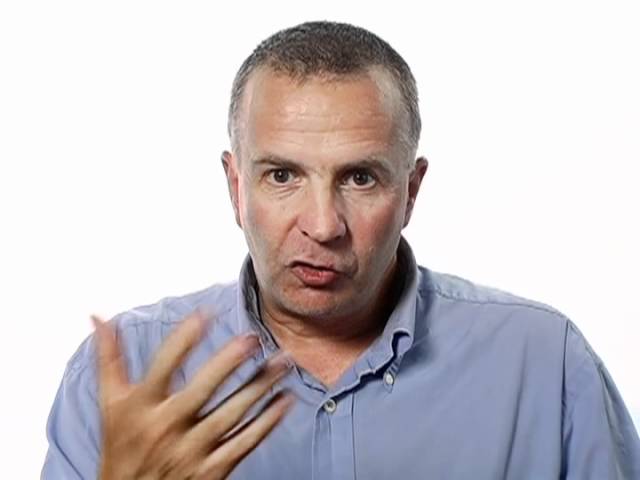
Inventor Dean Kamen discusses how successful creative people fail frequently, rarely work linearly and never give up.
----------------------------------------------------------------------------------
Dean Kamen:
Dean Kamen is an American scientist and inventor whose products include the Segway human transporter (HT) and the iBOT battery-powered wheelchair. His inventions include medical devices and futuristic gizmos that Kamen hopes will revolutionize the way we live and travel.
In 1989, Kamen founded FIRST (For Inspiration and Recognition of Science and Technology), a robotics competition for high school students. In 2007, it held 37 competitions in countries such as Israel, Brazil, Canada, and the United States.
Kamen is the President of DEKA Research and Development.
Kamen was elected to the National Academy of Engineering in 1997 for his biomedical devices and for making engineering more popular among high school students. He was awarded the National Medal of Technology in 2000 by then President Clinton for inventions that have advanced medical care worldwide. In 2002, Kamen was awarded the Lemelson-MIT Prize for inventors, for his invention of the Segway and of an infusion pump for diabetics. In 2005 he was inducted into the National Inventors Hall of Fame for his invention of the AutoSyringe. In 2006 Kamen was awarded the Global Humanitarian Action Award by the United Nations.
----------------------------------------------------------------------------------
TRANSCRIPT:
Question: How is it when the creative process hits a dead end?
Dean Kamen:I wouldn’t know what it’s like to hit a dead end. Every project I’ve ever worked on ends up ahead of schedule and on the budget. We always get it right the first time and we shipped it. And it’s always perfect. But I can imagine that there are a lot of people that don’t have that situation.
Actually, nothing could be farther from the truth. Every project we’ve ever done without exception, we start out with some simple objective. It always seem simple and then you get into the ugly reality of trying to accomplished that simple objective and nature, it’s not cruel but it’s very subtle and inevitably, you’re surprised along the way as you try to make things happen and almost all the surprises are bad surprises. New problems keep cropping up. Things that seem that they should work, don’t. A simple elegant idea turns out to have a bunch of ugly facts are related to that elegant idea, and no matter how elegant the idea is, the facts win. So you rethink that idea, you try different strategies, you employ different technologies.
And as you said, in the end if it finally works. People think you start it with this idea, you went on a straight line and concluded with this product. In fact, they not only think that but the way media present it, it reinforces that because media has a finite amount of time to tell a story. Media has a finite attention span.
Nobody wants to hear literally the five years of frustration that you took taking the wrong paths. For one thing, no matter how fast you’d speak, if they ask you about this project that took you five years, if they really wanted the truth, the whole truth and nothing but the truth, it would take you five years to tell it. You don’t have to tell all the crazy places you got on a piece of spaghetti and you ran through every strand of spaghetti in that bowl until you got to the end. They don’t want to know all about that spaghetti. They want to know where you started and as quickly as they can, they want to know the result and how it can affect them.
So we all, as a matter of course, when I asked about how we do anything in our lives, we start with some big thought, we might tell a few of the funny incidental side-path, but then in a finite amount of time, an interview and a book, we get to the conclusion people want. At best, with a couple of references to a little sidepath here and there.
As a consequence of all of that, people begin to think that some inventor in fact really starts with a big idea, runs along the line, gets to the conclusion, ships it off and starts the next idea, when in fact, at least in my case, you jumped in the spaghetti bowl, you crawled over every strand in that bowl. Some of them will swear you, covered at least five times, and then if you finally ever emerged at the other end, where you want it to be, which does sometimes happen but it is rare. Instantly you forget about all that spaghetti in the bowl. You bask for a moment in the victory of getting where you want it to be.
Read the full transcript at
Sentinel Indexing in Progress
Metadata and chapters are available. Claim extraction for this episode is pending.
All video content is delivered via YouTube embedded players in accordance with the YouTube Terms of Service. Sentinel provides research tools that promote discovery and accountability across political media.