Big Think
@bigthink·8.8M subscribers·10.1K videos
The Changes in the Media Landscape | Big Think
Posted
April 24, 2012
Views
1,370
Likes
10
Engagement
0.73%
April 24, 2012
1,370
10
0.73%
Every word spoken in this episode is indexed. Type any phrase to jump straight to the moment it was said.
Type any word or phrase that may have been spoken. Click a result to seek the player to that exact moment.
Try a name, a topic, or a quoted line
See what was published immediately before and after this episode.
 13:37Now Playing
The Changes in the Media Landscape
New videos DAILY
Join Big Think Edge for exclusive videos
----------------------------------------------------------------------------------
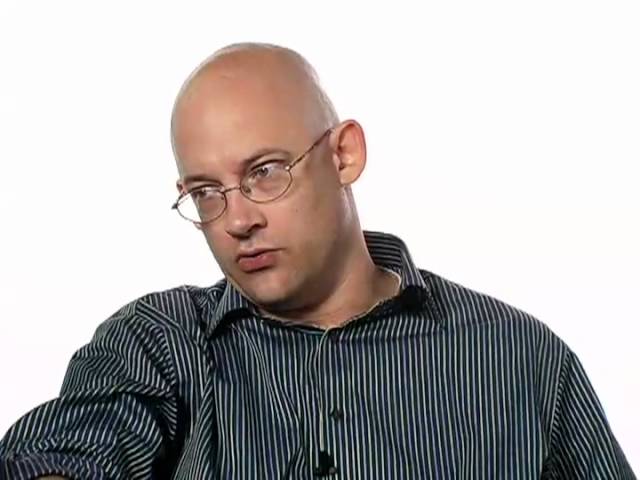
The NYU Professor and author of “Here Comes Everybody” advises business leaders on how to be innovative in the new media landscape.
----------------------------------------------------------------------------------
Clay Shirky:
Clay Shirky is a writer, consultant and teacher on the social and economic effects of Internet technologies. He is an adjunct professor at New York University's graduate Interactive Telecommunications Program (ITP). His courses address, among other things, the interrelated effects of the topology of social networks and technological networks, how our networks shape culture and vice-versa. He has written and been interviewed extensively about the Internet since 1996. His columns and writings have appeared in Business 2.0, the New York Times, the Wall Street Journal, the Harvard Business Review and Wired.
----------------------------------------------------------------------------------
TRANSCRIPT:
Clay Shirky: So, one of the big change in the Media Landscape right now is that media speeds up to Facebook fees and Twitter memes spreading very quickly, URLs shortening to just injects, stuff into the Media Landscape all over. As media speeds up, emotion moves faster than thought.
Humans are not very good at thinking fast, but we’re really good at feeling fast. You know how you feel about something, the instant it happens. You often don’t know how you think about something until weeks or months or in some cases years later.
I’m Clay Shirky. I’m on the faculty at the Interactive Telecommunications Program and the author of Here Comes Everybody, a book about Social Media.
Clay Shirky: And Sociology is interesting because unlike Psychology unlike the sort of Psychology class but what Sociology says is, we behave differently in groups, right? No one was ever a backstabber or a social climber. No one can be unusually generous or a self-effacing sitting at home by themselves, right?
There are lots and lots of effects that can only exist in aggregate and because we’ve just come to this 30-year bottleneck of technology all being designed for personal use, right? The personal computer, the Sony Walkman, right, that has been the normal case of technology. When social effects start to attach themselves to technology it’s kind of the cultural freak out because we don’t have the language to describe that.
So for me Sociology particularly has been the great stream of research and insight into the human condition. Lots and lots of tech firms have psychologist on staff. Very few of them have sociologist on staff.
Clay Shirky: I think the first and probably most important intuition about all of these stuff is that social capitalists counter-say, right? When we rely on the government and the market less we rely in each other more and the number of places where you were seeing people reach out sideways as it were to friends and family to help them through various difficult times. All of these tools are being pressed into service with them.
And so just taking advantage of that taking advantage of the idea that we don’t just care about brands and market real secure about each other essentially the basic advice that I give comes because the question’s so broad it’s not a particular sector business model.
The basic advice I give companies is, essentially, look for any place where in addition to whatever else you do, you can serve a convening function, right. You can make it easier for your users, costumers, readers, listeners, whatever they are to also communicate with each other.
And that’s a relatively unfamiliar function for a lot of businesses. I talk to you, you talk to me or you write me a check and I send you some shoes or whatever.
But we’re relying so much on the social piece of our lives. And now, not just for self amusement and social connection, but also in many cases for kind of advice in how if I get in through as you say this difficult economic time.
So, look for places where you can, where you can perform a convening function.
And the other is essentially do an assessment of what you’ve already got.
The personal computer did not come into businesses because the CEO or the CIO, if there was one of those days, said, “We must have these little computers.” They came in because employees knocked them in the side door. They didn’t want to go down in the hall and talk to the mainframe guys anymore. So, they would bring their own computers from home and run it. E-mail got into businesses the same way.
Read the full transcript at
Sentinel Indexing in Progress
Metadata and chapters are available. Claim extraction for this episode is pending.
All video content is delivered via YouTube embedded players in accordance with the YouTube Terms of Service. Sentinel provides research tools that promote discovery and accountability across political media.