Big Think
@bigthink·8.8M subscribers·10.1K videos
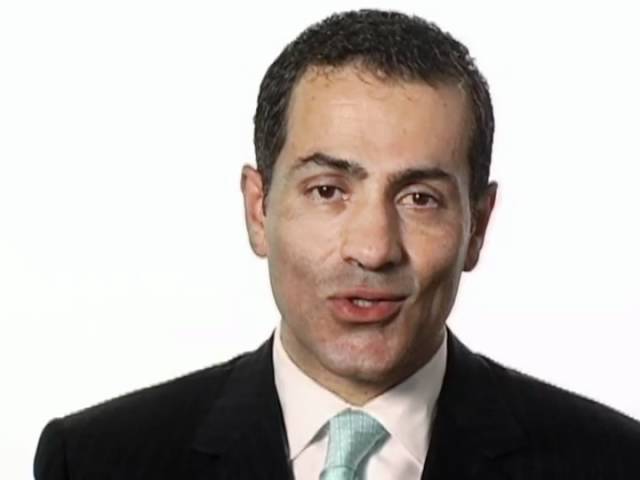
Vali Nasr: What roles does fundamental Islam play in the Middle Eastern politics? | Big Think
Posted
April 24, 2012
Views
703
Likes
14
Comments
3
Engagement
April 24, 2012
703
14
3
2.42%
Every word spoken in this episode is indexed. Type any phrase to jump straight to the moment it was said.
Type any word or phrase that may have been spoken. Click a result to seek the player to that exact moment.
Try a name, a topic, or a quoted line
See what was published immediately before and after this episode.
 4:09Now Playing
Vali Nasr: What roles does fundamental Islam play in the Middle Eastern politics?
New videos DAILY
Join Big Think Edge for exclusive videos
----------------------------------------------------------------------------------
Nasr says it is multi-tiered, and varies from country to country.
----------------------------------------------------------------------------------
Vali Nasr is an Iranian-American political commentator and scholar of contemporary Islam. Born in Iran, Nasr and his family immigrated to the United States following the 1979 Islamic Revolution. Nasr received a BA from Tufts University in 1981 and a masters from the Fletcher School of Law and Diplomacy in 1984. He earned his PhD from MIT in political science in 1991.
Known for his view that wars within Islam will shape the future, Nasr has testified before Congress and has advised the President and Vice-President regarding sectarian violence in Iraq. Nasr is the author The Shia Revival, Democracy in Iran, and The Islamic Leviathan.
He has taught at the University of San Diego and the Naval Postgraduate School, and is currently a Senior Fellow at the Belfer Center at Harvard and Professor of International Politics at Tufts. A Life Member of the Council on Foreign Relations, Nasr has been published in Foreign Affairs, The New Republic, Foreign Policy, Time, the New York Times, and the Washington Post, among others. He is an editor of the Oxford Dictionary of Islam and has appeared on CNN, the BBC, National Public Radio, and not least of all The Daily Show with Jon Stewart and The Colbert Report.
----------------------------------------------------------------------------------
TRANSCRIPT:
Question: What roles does fundamental Islam play in the Middle Eastern politics?
Vali Nasr: Well this is a multi-tiered way of analyzing. There is a militant extremist tendency, even though that it’s a very small minority. But like all extremist movements, because of the force that it’s able to project; because of the way it can interject itself into the political process; because of acts of terror it carries out, it may be much more important.
There is a political, social level of participation. You have political parties. You have syndicates. You have unions. You have civil society organizations that--what is called a “fundamentalist line”--believe in a form of government that is based on religious law or Islamic government, wants much more religiosity in the public life and politics of the Muslim world. Sometimes they’re powerful. Sometimes they’re not. In some countries like Iran they rule. In other places, they don’t. In some countries they are hard line, like in Pakistan, or with Hamaas or the like. In some countries they have softened up considerably --best example being Turkey, but also in Malaysia. In Morocco a lot you have much more “liberalized” interpretations of fundamentalism.
And then there is a level higher in that, which is the fact that the Muslim world is no longer a secular place, if it ever was. At least its public arena is not secular in the same sense that America is no longer a secular place.
Look at the public discussion in America. People are not in the streets chanting with fists clenched. They are not killing. Religious values, in a very prominent way, is in the public arena, which means that issues such as gay marriage, right to life, prayer, euthanasia, etc. – anything that borders on religious values are now hot button political issues.
And there is actually a very strong pressure even in the United States to much more blur boundaries between church and state – prayer in school, having tablets with the Ten Commandments in courthouses, etc.. This would not have happened in the ‘60s and in the ‘70s in America. Something happened. Either America became religious, or religion was there and it just came into the public life.
That’s also what’s happening in the Muslim world. And partly fundamentalist parties are riding on that tide, because yes it’s true that they benefit from being anti-American. Yes it’s true that fundamentalists benefit from corruption, dictatorship of their governments. Yes it’s true that they take the high moral ground of being the rejection force against America, Israel, and their own government. But they also benefit from speaking the language of politics that many Muslims sympathize with in the same way that many average Americans listen to certain politicians and they just like what they hear.
The fact that when President [George W.] Bush in a presidential campaign said, when he was asked who was his favorite philosopher, he said Jesus Christ. It got him enormous amount of votes. He didn’t have to talk policy.
Read the full transcript at
Sentinel Indexing in Progress
Metadata and chapters are available. Claim extraction for this episode is pending.
All video content is delivered via YouTube embedded players in accordance with the YouTube Terms of Service. Sentinel provides research tools that promote discovery and accountability across political media.