Big Think
@bigthink·8.8M subscribers·10.1K videos
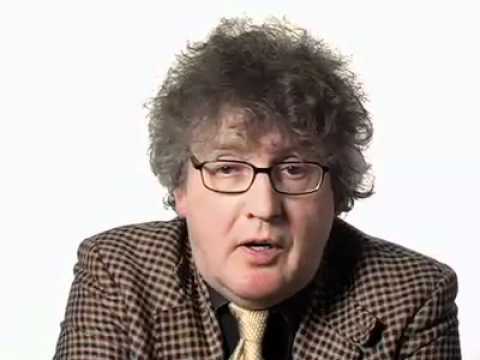
Why repeat a word till it falls apart? Paul Muldoon | Big Think
Posted
April 24, 2012
Views
582
Likes
7
Engagement
1.20%
April 24, 2012
582
7
1.20%
Every word spoken in this episode is indexed. Type any phrase to jump straight to the moment it was said.
Type any word or phrase that may have been spoken. Click a result to seek the player to that exact moment.
Try a name, a topic, or a quoted line
Episode Timeline
Every episode in order around the one you’re watching — click any card and the page flips straight to it.
 3:45Now Playing
Why repeat a word till it falls apart?
New videos DAILY
Join Big Think Edge for exclusive videos
----------------------------------------------------------------------------------
Repetition is just as important in politics as it is in poetry, Muldoon says.
----------------------------------------------------------------------------------
Paul Muldoon:
Paul Muldoon is a writer, academic and educator, as well as Pulitzer Prize-winning poet from County Armagh, Northern Ireland. Since 1987 he has lived in the United States, where he is now Howard G. B. Clark '21 Professor at Princeton University and Chair of the Peter B. Lewis Center for the Arts. In 2007 he was appointed Poetry Editor of The New Yorker. Between 1999 and 2004 he was Professor of Poetry at the University of Oxford, where he is an honorary Fellow of Hertford College. He won the 2003 Pulitzer Prize for this work, Moy Sand and Gravel (2002).
A Fellow of the Royal Society of Literature, the American Academy of Arts and Sciences and the American Academy of Arts and Letters, Paul Muldoon was given an American Academy of Arts and Letters award in literature for 1996. Other recent awards are the 1994 T. S. Eliot Prize, the 1997 Irish Times Poetry Prize, the 2003 Griffin International Prize for Excellence in Poetry, the 2004 American Ireland Fund Literary Award, the 2004 Shakespeare Prize, the 2005 Aspen Prize for Poetry, and the 2006 European Prize for Poetry. He has been described by The Times Literary Supplement as "the most significant English-language poet born since the second World War."
----------------------------------------------------------------------------------
TRANSCRIPT:
Question: Why repeat a word till it falls apart?
Paul Muldoon: Well, repetition of course is key to poetry and indeed to most art forms and indeed to most aspects of our lives. It’s all about repetition, what’s cyclical. Repetitive action, starting with the heart, and we sure as hell hope it’s repeating itself. And then going on into so many other aspects of our lives, including--we need to it eat on a regular-ish basis, sleep on a regular-ish basis.
And one of the things that happens to us in our engagement with language, and one of the things that delights us as children, for example, who are really often the people who are most telling in so much of the world and how we function in the world. Nothing delights a child more than repetition and the recognition of a similar signs, of recognition of puns, and then rhymes, which are part of the same, that are in the same general neck of the same, neck of the woods.
And there is also this tendency for the language to find rhymes and chimes as it goes along. In most cultures, that is a significant component of song writing and, by extension, poetry. And it’s something that we see every day of the week and hear everyday of the week, even on advertisements. The percentage of ads that include rhyme is phenomenal. The ad writers want them to be memorable. Everything from on the side of a truck in Brooklyn, I saw once “from fishes to knishes, one call gets them all.” It’s memorable.
This year of the [US presidential] election in 2008, I’m sure there are a few political pundits sitting around you know trying to come up with a few slogans as that often will be based on rhymes. They get through to people because they are intrinsic to how we are. It’s one of the reasons why I am confident that rhymed poetry is never going to disappear.
This is not to said by the way that it is better than un-rhymed poetry. It's not going to go all way, it’s not going to go away despite the insistence of some.
Sentinel Indexing in Progress
Metadata and chapters are available. Claim extraction for this episode is pending.
All video content is delivered via YouTube embedded players in accordance with the YouTube Terms of Service. Sentinel provides research tools that promote discovery and accountability across political media.